Showing posts with label louis b. mayer. Show all posts

Saturday, March 02, 2024

Girl 27: The Patricia Douglas Story


Although it came out seventeen years ago, the documentary “Girl 27” is still shocking. It begins with a passage from Luke 8:17, which perfectly sets the tone. Writer/director David Stenn made public the tragic story of the 1937 rape of Patricia Douglas at the hands of an MGM exhibitor/salesman, David Ross. As Stenn told Vanity Fair, “I managed to find old newspaper coverage, previously unseen photos, damning studio documentation, long-forgotten legal records, privately shot cinematographic evidence hidden in an MGM film vault, and, most amazing, Patricia Douglas herself. I tracked the reclusive invalid down and eventually persuaded her to break her 65-year silence.”


Hollywood’s most glamorous studio, Metro-Goldwayn-Mayer, invited exhibitors to come to Hollywood to stay at the Ambassador Hotel and attend a wild party at the Hal Roach Studio’s ranch. Over a hundred young girls (many underage) were hired for what they thought was a film. Louis B. Mayer told the exhibitors that anything they wanted would be provided to them during their visit.


One of those exhibitors was David Ross from Chicago. What a charmer.


A natural-born dancer, Douglas drifted into movies “just for something to do.” Since she was supported by her mother, Douglas had no need to work. So when a casting call came on the afternoon of Sunday, May 2, 1937, she demurred at first, but later agreed to show up. “They never mentioned it was for a party,” she recalls. “Ever. I wouldn’t have gone! Oh God, oh God, I wouldn’t have gone.”


The call sheet with the name of Pat Douglas, aka Girl 27. What did the girls receive for their “role”? What they thought was a shot at stardom, hot meal, and $7.50 for the day at the remote Culver City ranch, aka “Rancho Roachero.”


The exhibitors who had been partying all day assumed the professional dancers were theirs to do whatever they wanted to. Isn’t that what Louis B. Mayer told them upon arrival? The girls were trapped at a location with no phones or transportation and had to fend for themselves. Douglas ended up being violently raped, losing her virginity to a man she had no interest in. With guts rarely shown by women at the time (for fear of repercussions), Patricia went public and pressed charges against her rapist. “I did want him punished,” she recalled. “I couldn’t get him out of my mind, because he took my innocence, because I was a virgin, and he left me with horrendous memories of my first time. And believe it or not, it affected the rest of my life physically. I was a frigid woman, and I never changed. I believe that I was about thirty-five when I stopped dating. But you can never miss what you never had.”


Stenn’s compelling documentary shows his journey of how he uncovered the facts of the case, long buried or destroyed many years ago. Here he is with USC archivist, Ned Comstock, as he first looks at the file from Patricia’s case, full of papers not seen since the 1930s.


Stenn also sought out Douglas herself. “I was furious when I heard from David. Imagine, sixty-five years nobody knowing what happened to you when you were young, and here comes some young fellow from out of the blue, and wants to talk to me about the case. I didn’t care about the story being told; I kept it a secret for sixty-five years. Why not die with it? Who would care?” Stenn did, and he patiently chipped away at Douglas’ reluctance. Eighty-six at the time, she finally agreed to tell her story.


David asked her, “Have you ever been in love?” “No,” she replied. “I have never been in love, and I have never known what it is to love somebody.” Pressing on, David asked, “Do you think that was taken away from you by what happened at the MGM party?” “Yes, because I believe no matter how much I feel towards a man, I don’t trust.”


In a touch of irony, while a rape victim was crucified in the press, a movie star was completely protected. The documentary reveals how Loretta Young and Clark Gable (married at the time to Ria Langham) had a child out of wedlock but covered it up by telling the public her biological daughter had been adopted.


As her daughter, Judy Lewis, tells the camera: “Hollywood knew the true story; I was the only one that didn’t.” The contrasting story shows how Hollywood treated people according to their earning potential.

Make sure you see “Girl 27.” You won’t regret it. See more Classic Movie & TV photos at my main website.

Tuesday, February 14, 2023

Temple Tuesday: Shirley & Irvin


Irvin S. Cobb was an author/humorist in the 1930’s who crossed paths with our gal Shirley Temple for a few photo opportunities. With a middle name of “Shrewsbury,” I can understand why he stuck with just the middle initial in public.

Like many celebrities of the day, Cobb visited Shirley on the set of her movies. This particular one was 1934’s “Baby Take A Bow.” On the left is director Harry Lachman. Of course you want to see the book in Shirley’s hand, which was Cobb’s Down Yonder with Judge Priest and Irvin S. Cobb. Looks like this copy belonged to Esmé Ward; wonder who she was? 


Director John Ford made two feature films based on the Judge Priest short stories. Here’s what the cover of the book looks like, up close and personal:


As host of the evening’s ceremonies at the Los Angeles Biltmore hotel, Cobb was the one who presented Shirley with her miniature Oscar on February 27, 1935:

Shirley Temple takes the Academy Award for outstanding work in motion pictures in 1934 from Irvin S. Cobb, humorist, who presented the trophies at the annual banquet held recently.


Here is Shirley’s account of the evening from her autobiography, Child Star:

“One great towering figure in the cinema game,” humorist Irvin S. Cobb read, “one giant among the troupers…for monumental, stupendous, elephantine achievements in 1934…a special award for…Shirley Temple!” I recognized my name but with total surprise. Nobody had even hinted I might win anything. Having watched the earlier succession of winners, I knew what to do. Leaping to my feet, I ran up the ramp to the stage. Right behind me in ladylike haste came Mother, with Father hard on her heels. I reached out for the small Oscar statuette, but Cobb withdrew it from my outstretched hand. He had a white, goatish face.  “I’ll give you this if you’ll give me a kiss,” he said. The audience howled in appreciation. As he spoke  could see little showers of moisture fly out in my direction, each droplet reflecting as a speck in the spotlight before disappearing somewhere on me or my hair. Damp, casual kisses are one of my intense dislikes, but with an eye on the Oscar I turned my cheek upward. Cobb leaned down while the audience cheered. Just as he kissed me I got a firm handhold on the statuette. “Thank you all very much,” I called upwards toward the microphone, not letting go. “Mommy, can we go home now?” Circling just beyond Cobb’s outstretched reach, I ran back down the ramp ahead of my parents. “You-all ain’t old enough to know what this is all about!” he called after me. He was right.

Reading Shirley’s description today, there is more than a certain amount of “ick” associated with Cobb’s behavior. The dress she wore that night:


…and a closeup of her miniature Oscar:


At November 15, 1935 the dedication of the 20th Century-Fox soundstage for the late Will Rogers, Shirley had the honor of unveiling the plaque, with Cobb on the far right. While the other men in the photo were definitely Hollywood’s heavyweights, let’s face it; Shirley was the star that day! 


There we go; just Shirley. Much better!


While digging for info on Cobb, I also stumbled upon this shot of the two outside Shirley’s Fox Bungalow:


There were at least four separate occasions where the two posed for photos; were they friends? One could safely say these were just staged publicity opportunities which benefitted Cobb much more than the world famous Temple. There is no other mention of the humorist in Shirley’s book other than the event at the Biltmore.

See more Shirley Temple photos at my main website.
Tuesday, April 08, 2014

Mickey and Judy: Together Again


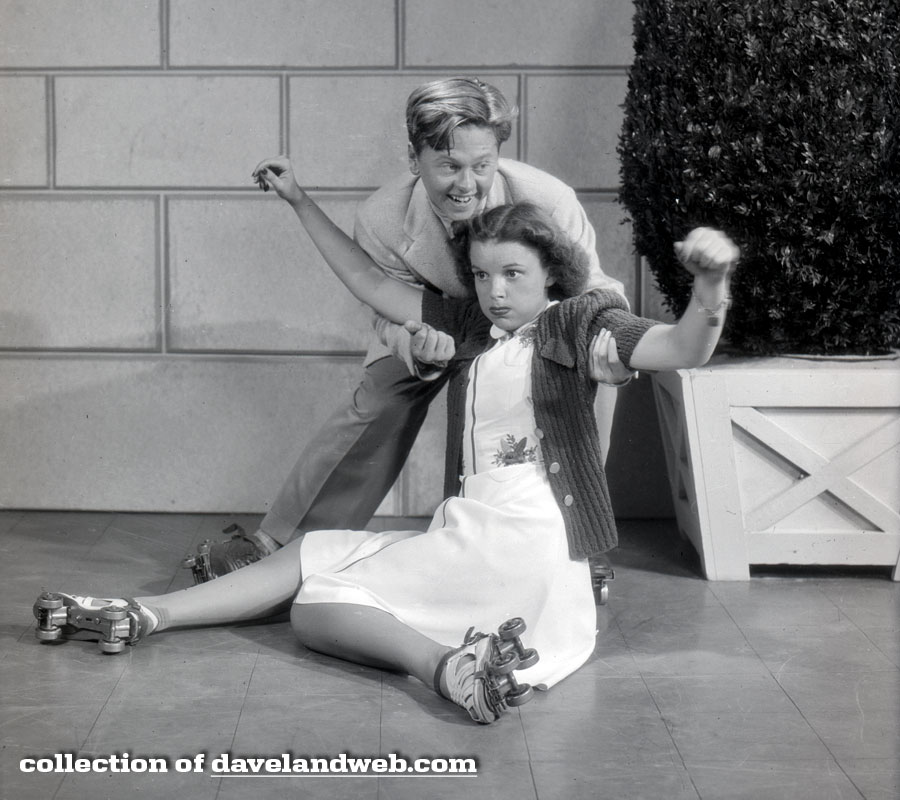
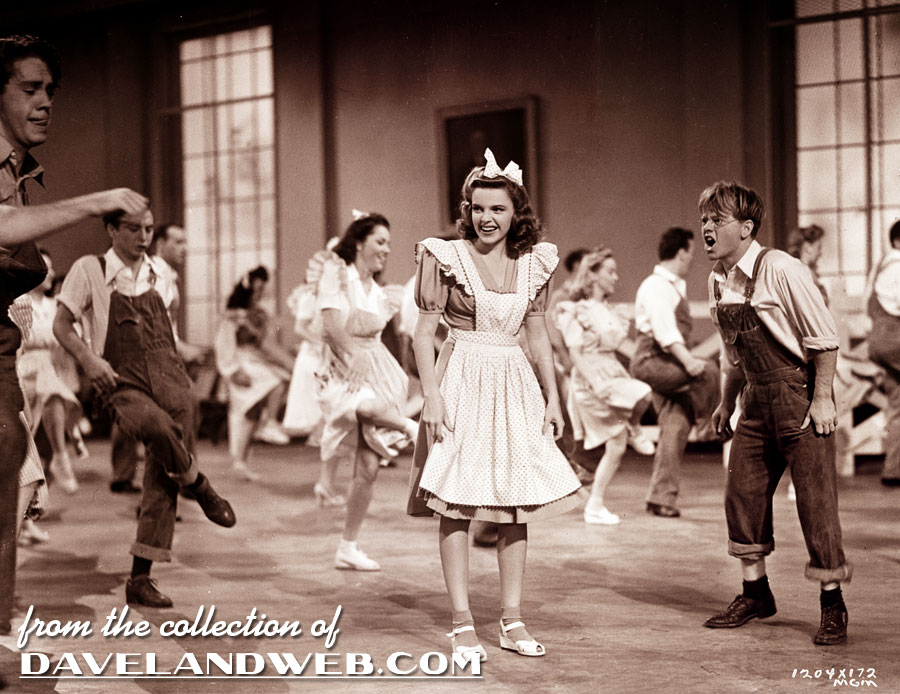
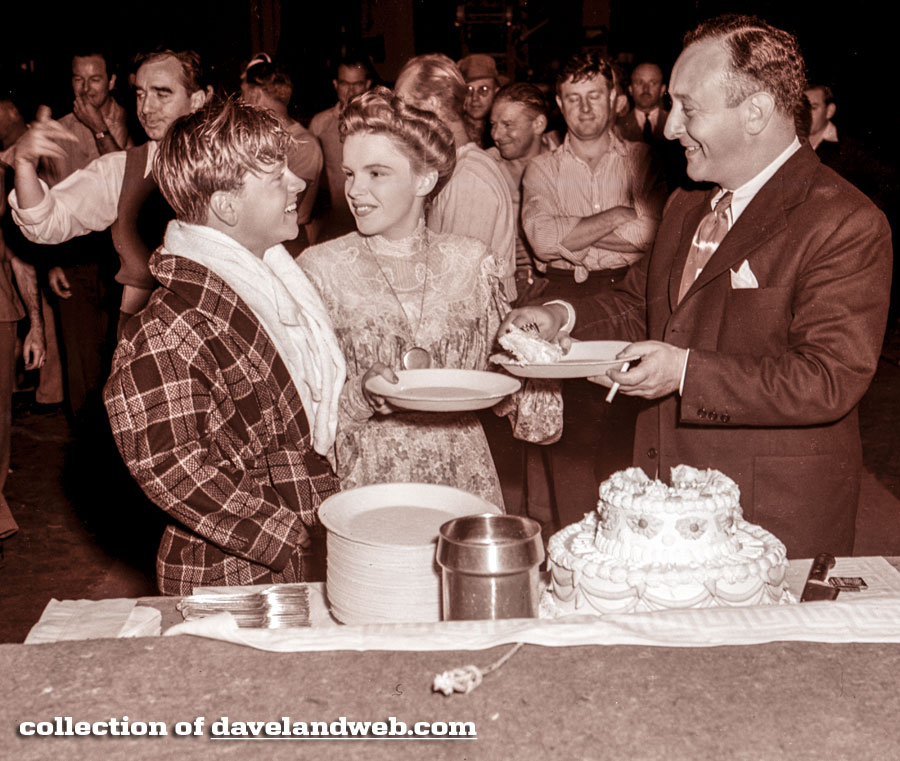
The legendary Mickey Rooney passed away on Saturday at the age of 93. When I told my mom about it, she said, "I didn't know he was still alive!" There are probably many today who have never heard of the versatile star who was awarded a special Juvenile Oscar in 1939 and was the biggest box-office draw in 1939, 1940, and 1941. Famous for portraying the title character in the MGM "Andy Hardy" film series, Rooney is most fondly remembered for a string of musicals he made with Judy Garland. Here the dynamic duo is shown celebrating a birthday on the set of "Strike Up The Band," with producer Arthur Freed dishing up the cake and director/choreographer Busby Berkeley on the left, looking annoyed that he had to stop filming for such frivolity!


In most of their films, Judy's character was gaga for Mickey, but his only had eyes for the voluptuous bad girls. By the end of the film, his senses had cleared and the two were united with a very chaste kiss. Lots of songs and dances filled up the screen time beforehand and audiences of the 30s and 40s ate it up!


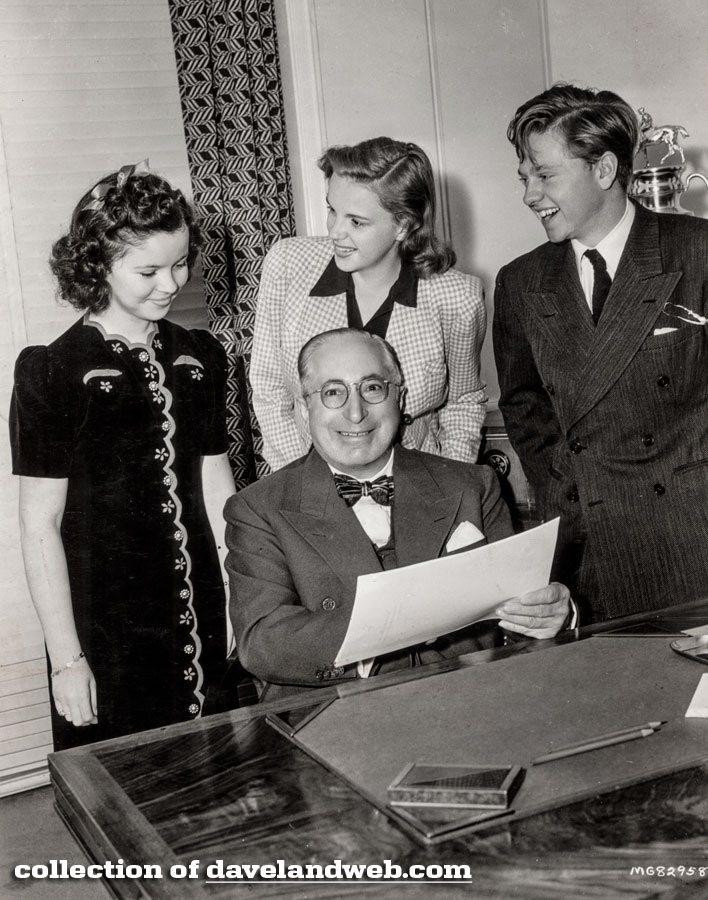
Judy and Mickey are shown welcoming Shirley Temple to Louis B. Mayer's stable of popular teens at MGM.


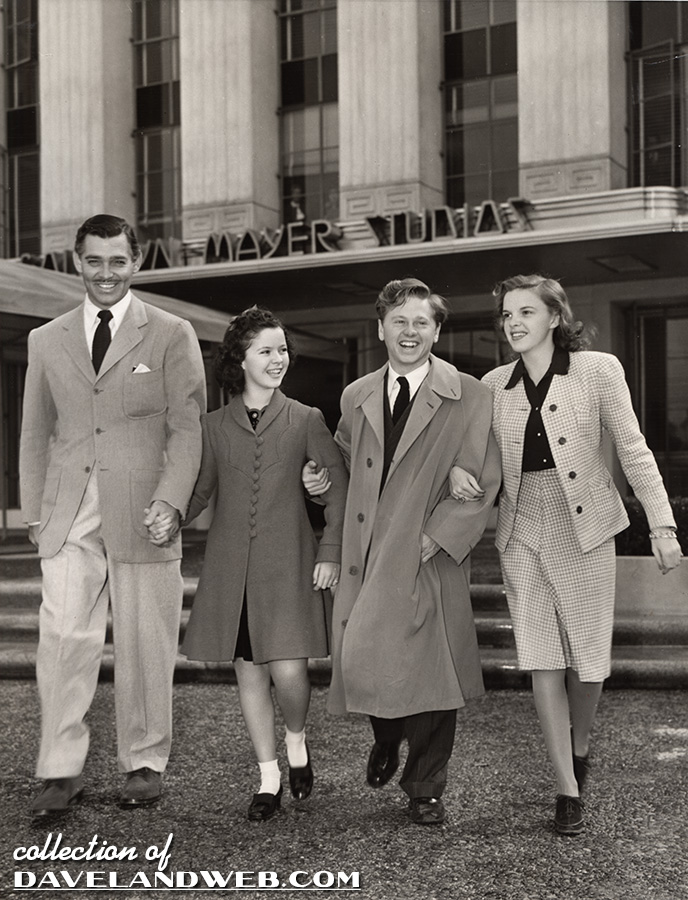
With Clark Gable joining in for the tour of the studio, this quartet looks unstoppable.


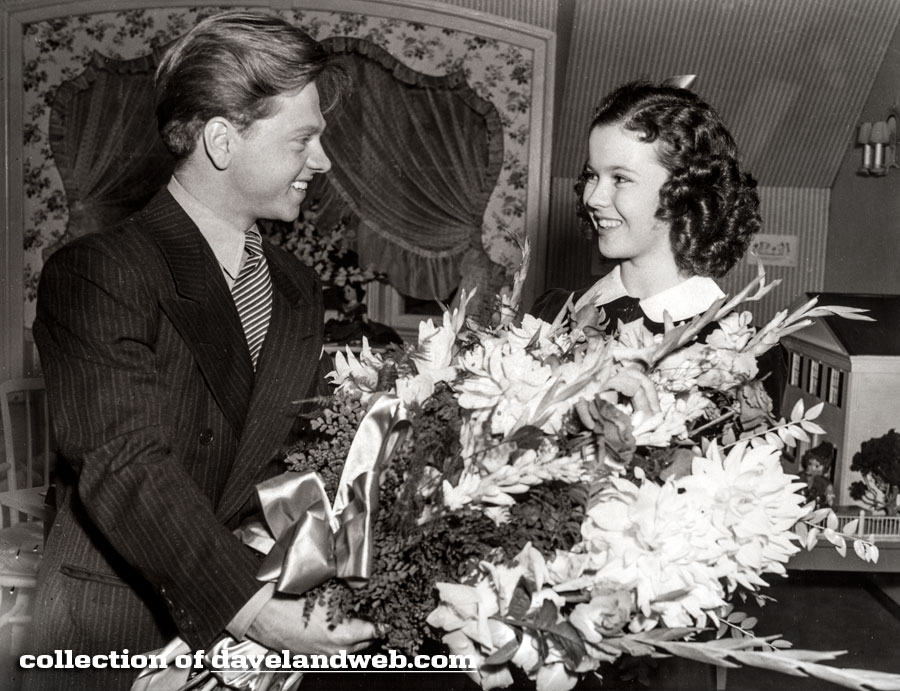
Mickey presents Shirley a bouquet for her first day of filming for her one and only MGM film, "Kathleen." The publicists hoped that Mickey's star would help rub off on Shirley, who had slipped a bit from her days as a curly-haired moppet.


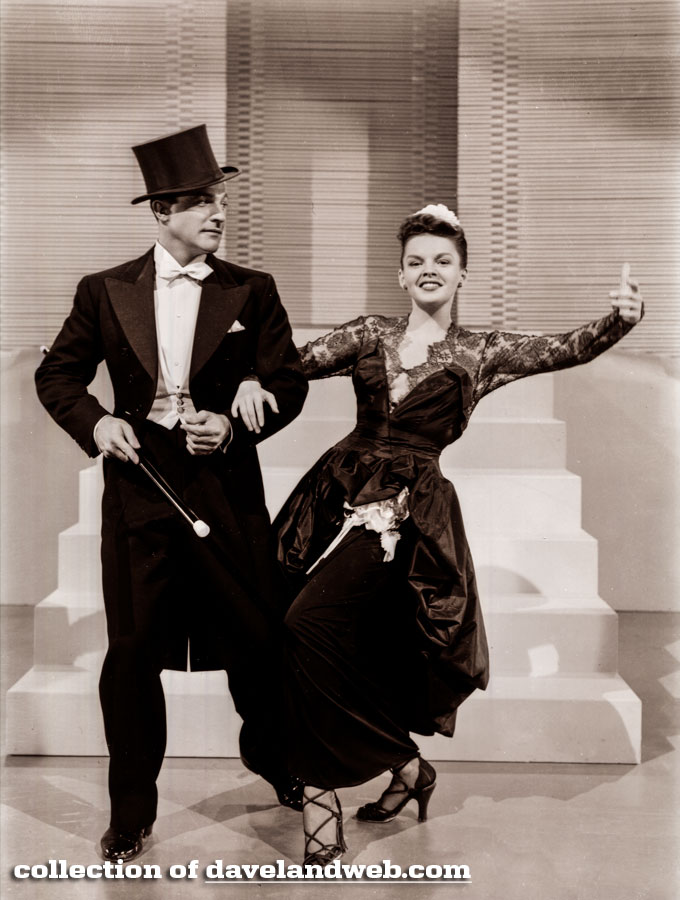
By the late 1940's, Rooney's star had also descended. An intended re-pairing of Garland and Rooney for "Summer Stock" was switched to Garland and Gene Kelly, who the studio felt could bring in higher box office receipts for this lower budget musical.


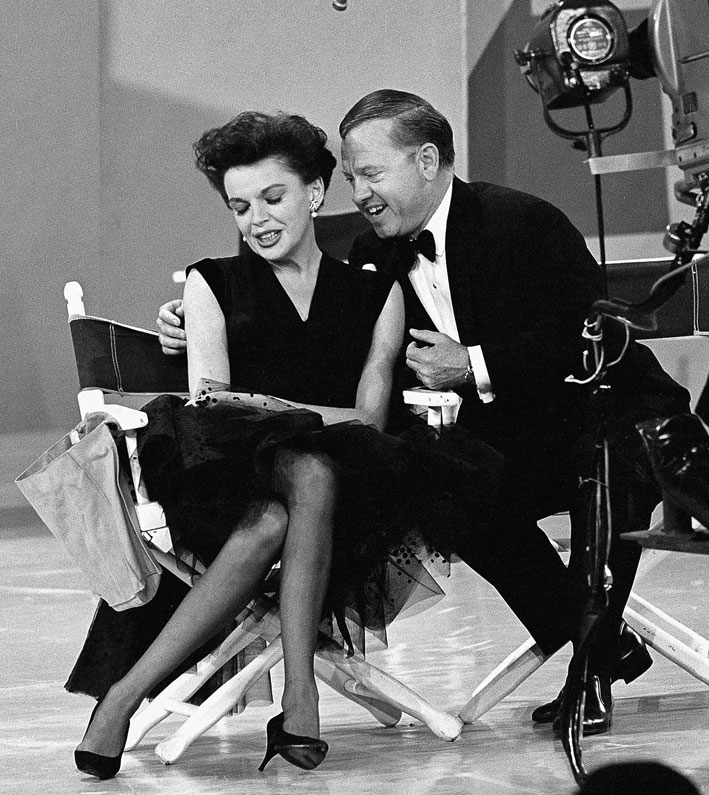
The last time the two performed together was on Garland's short-lived TV series, "The Judy Garland Show" (1963). It was pure nostalgia as the two reminisced and sang the song, "You're So Right for Me." Rooney was her first guest, and the stars came out in droves to watch the magic, including Lucille Ball, Clint Eastwood, Jack Benny, and Natalie Wood.


Here's the last musical sequence that Mickey and Judy filmed for MGM, "Words and Music" (1948).


I am sure the two are putting on one heckuva' show in Heaven!

See more Judy Garland photos on my main website.<

Sunday, December 16, 2012

Shirley's Lost Projects


When Shirley Temple left Twentieth Century Fox and signed on the dotted line at Metro-Goldwyn-Mayer, she joined the ranks of Judy Garland and Mickey Rooney, two of the most talented teens to ever grace the silver screen. Although studio head Louis B. Mayer was very excited to add Shirley to his stable of stars, he wasn't quite sure what to do with her. Although a beautiful young teen, her singing was pleasant at best, unlike the powerful emotionally driven voice of Judy Garland. Could she dance? Of course, but again, not quite up to the level of a Judy, Mickey, or any of the other extremely gifted artists at MGM. Add in a protective mother who wanted to make sure that her daughter had a star property and not a supporting role, and Mayer had himself a difficult equation. The following still originally accompanied this publicity blurb:

SHIRLEY TEMPLE…Young veteran of the screen, poses for her first portrait sitting after signing her contract with Metro-Goldwyn-Mayer. They youngster will start work on two pictures for the studio, "Barnacle Bill," with Wallace Beery, and "Babes on Broadway," with Mickey Rooney and Judy Garland. Here the tiny star wears a many-pleated skirt with a pique-collared jacket.


Mrs. Temple vetoed both projects, feeling that the supporting roles were not appropriate for her daughter (both roles eventually went to Virginia Weidler). She was afraid that the boisterous Wallace Beery would steal all of Shirley's scenes in "Barnacle Bill." A fear that Judy and Mickey would overshadow Shirley was the same reason that Mrs. Temple advised against "Babes on Broadway." One website states that Shirley was removed from "Babes on Broadway" because of a lack of box office success with her first MGM movie, "Kathleen"; the fact that they were released less than a month apart makes that highly doubtful. It has also been said that Mama Temple turned down "Panama Hattie," "National Velvet," and "Life Begins For Andy Hardy" for the same reasons. Mayer saw M.G.M. as the perfect finishing school for an actress, and that they should work their way up the ranks. Mrs. Temple felt Shirley had already done enough in that department and expected a lead role right out of the gate. Running out of options, MGM gave her a lead role like Mama Temple requested. However, it was a Kathryn Grayson grade-B reject called "Kathleen." The revised publicity blurb stated:

SHIRLEY TEMPLE…Young veteran of the screen, poses for her first portrait sitting after signing her contract with Metro-Goldwyn-Mayer. The young star is now working in "Kathleen."

After "Kathleen," Shirley's contract was ended by mutual consent, and she ended up at the David Selznick studio two years later.

See more Shirley Temple photos on my Shirley Temple web page.

Saturday, January 14, 2012

Screen Gem Saturdays: Shirley Temple & Will Rogers


Will Rogers, an extremely down-to-earth and low key humorist, was one of the world's best-known celebrities in the 1920's and 1930's. He is probably best known for saying, "I never met a man I didn't like." A number one box office draw for 1934, Rogers got knocked down a peg a year later by Shirley Temple in 1935.

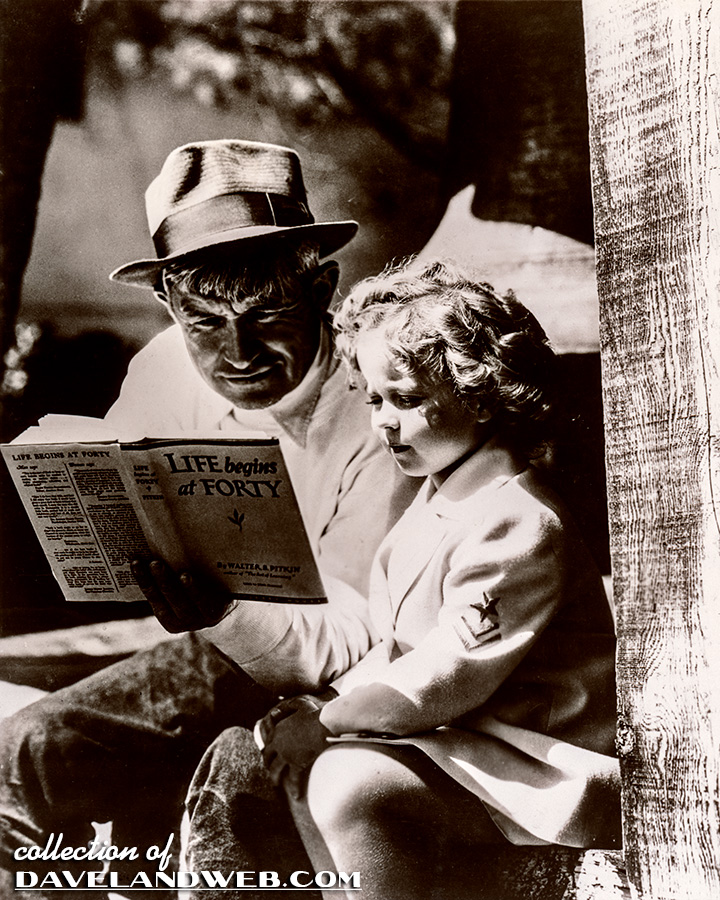
On the set of "Baby Take A Bow," Rogers visited the competition. Shirley herself remembered the visit in her autobiography Child Star:

One day Will Rogers had wandered over to watch us during a break from "David Harum," which was being made on an adjoining soundstage. His black felt hat was crumpled and tipped back, allowing a shock of hair to spill over his forehead. Hooking both thumbs in his suspenders and rocking back and forth on his heels, he was a picture of cheerfulness and vitality.

"They tell me we're going to make a movie together about railroading when I get back from Alaska."

"Where's Alaska?" I asked. he gestured for me to sit down with him on a pile of boards. Taking up some little chips of wood, he arranged them on the cement floor to show where Alaska was. Apart from his revelations, I liked him. He wasn't good-looking like some other actors, but his speech had an appealing cadence, and he laughed a lot.

Rogers was sort of my favorite. As I had been born into a middle-class family without pretense, my natural preference went toward outgoing, accessible people like Rogers and the workingmen around the soundstage.


For her 1934 movie "Bright Eyes," much of the plot is centered around an airport, where Shirley's godfather works. It is on an airplane that she sings her most famous song, "On the Goodship Lollipop," which actually refers to a plane, not a boat. Shirley recalls him visiting the set:

Will Rogers had taken a special interest in what we were doing and often hung around our stage. An unofficial cheerleader for aviation, Rogers had written, "There were eight people killed in planes all over America on Sunday, and it's headlined in every paper today. When will newspapers give aviation an even break? If there's a safer mode of transportation, I have never found it." One year later he was dead in an air crash.


Recalling his tragic death, Shirley said:

Near Point Barrow, Alaska, at 8:15 pm.om on August 15, 1935, a low-winged red monoplane crashed in the slush ice. Dead in the wreckage was Wiley Post, who the previous year had circumnavigated the earth in the record time of seven days and eighteen hours. Accompanying him on this last, fatal flight was Will Rogers. Ripples from the arctic accident reached Hollywood with telling impact. For newly born Twentieth Century-Fox (Rogers' and Temple's studio), Rogers' death was a catastrophe. In all this darkness flickered on pinprick of hope. Although only number with, I suddenly was the only studio performer among the top ten.

Shirley is shown here with some of Hollywood's behind-the-scenes bigwigs, including (left to right) MGM studio head Louis B. Mayer, Darryl Zanuck from Twentieth Century Fox, Joseph Schenck (one of the founders of the Academy of Motion Picture Arts and Sciences), California Governor Frank Merriam, and humorist Irvin S. Cobb.


Shirley remembers the occasion:

At the studio a new soundstage was being dedicated to Rogers' memory on November 15, 1935. Newly elected California Governor Frank Merriam was there. Nevada Senator Pat McCarran came wearing high-heeled cowboy boots and a ten-gallon white hat, and many close friends delivered long eulogies. Joseph Schenck called me from the audience to pull the curtain aside and unveil the memorial plaque.

"Now you say something," he instructed and backed away a pace, his mouth gaping open like a gargoyle's. The others before me had said everything.

"I loved him too," was all I could add.

As our group disbanded, around the corner came a vanguard of carpenters for "Captain January." Within days the new soundstage would be transformed from an echoing, vacant hall into a fog-shrouded Maine coast, complete with lighthouse.


Nearly 30 years later in January 1965, Shirley came back to the studio and was shown posing next to the very same plaque:


I'll leave you with some of Rogers' more memorable quotes:

"Americans will feed anyone that's not close to them."

"Our foreign policy is an open book - a checkbook."

"Lettin' the cat out of the bag is a lot easier than puttin' it back in."

"People who fly into a rage always make a bad landing."

"The movies are the only business where you can go out front and applaud yourself."

"There is only one thing that can kill the movies, and that is education."

"I'm not a real movie star. I still got the same wife I started out with nearly 28 years ago."

See more vintage & current Shirley Temple photos on my Shirley Temple web page.