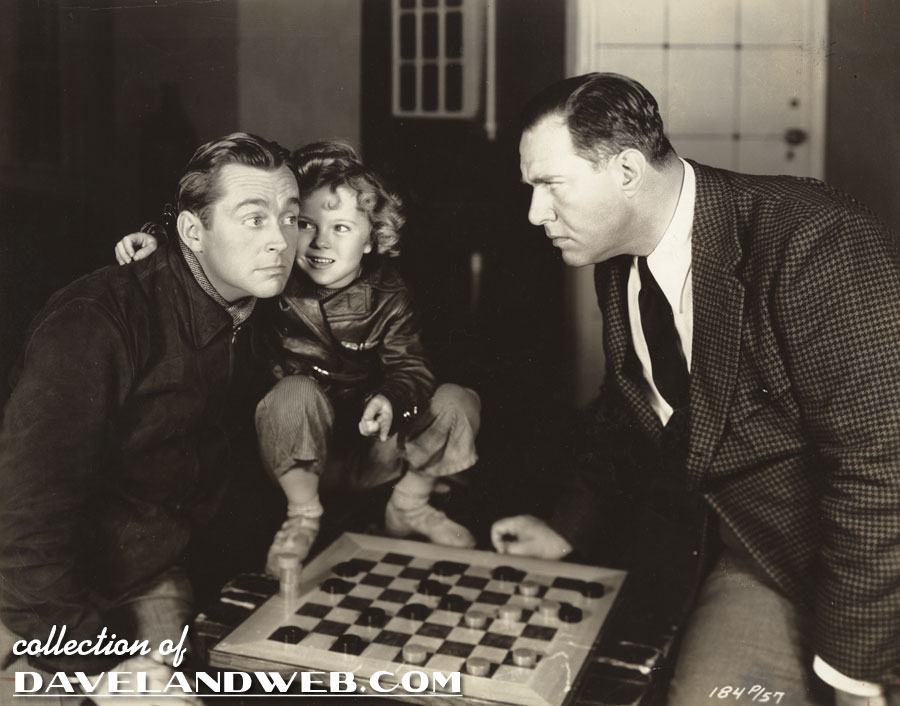
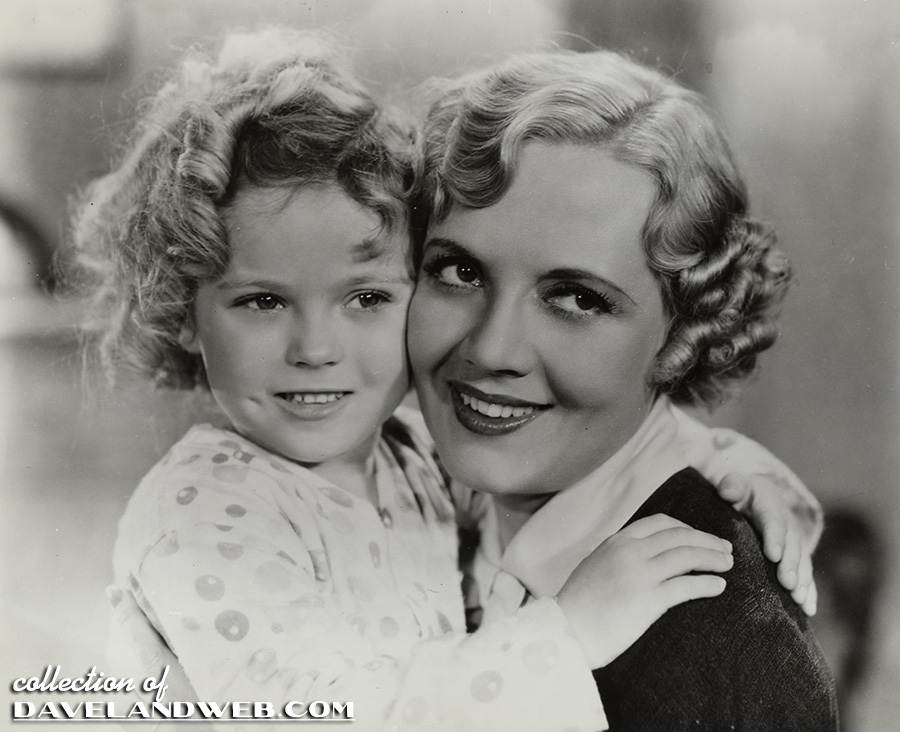
David Butler first directed Shirley in 1934’s “Bright Eyes,” where she launched a taxiing airplane with “On The Good Ship Lollipop.” No…it wasn’t a boat. In the first photo of today’s post, he visited Shirley on the set of “Heidi” (1937) and the two seemed to be having a bit of fun. It was important that the studio gave little Shirley directors who knew how to relate to children, as it made the work day for her more like play. The result yielded a more natural performance out of the talented tot, and Butler was smart enough to realize that. In 1937, Butler directed two films on the Fox lot: “Ali Baba Goes to Town” and “You’re a Sweetheart.” Based on production dates from the AFI website, “Heidi” was from May 17 to mid-July 1937; “Ali Baba” was from late July 1937 to early September 1937. “Sweetheart” was September 7 - late October 1937. If one was to guess, Butler was around for pre-production on “Ali Baba” when he visited Shirley. Below, Butler interrupts a game of checkers between Shirley and “Bright Eyes” costar James Dunn:
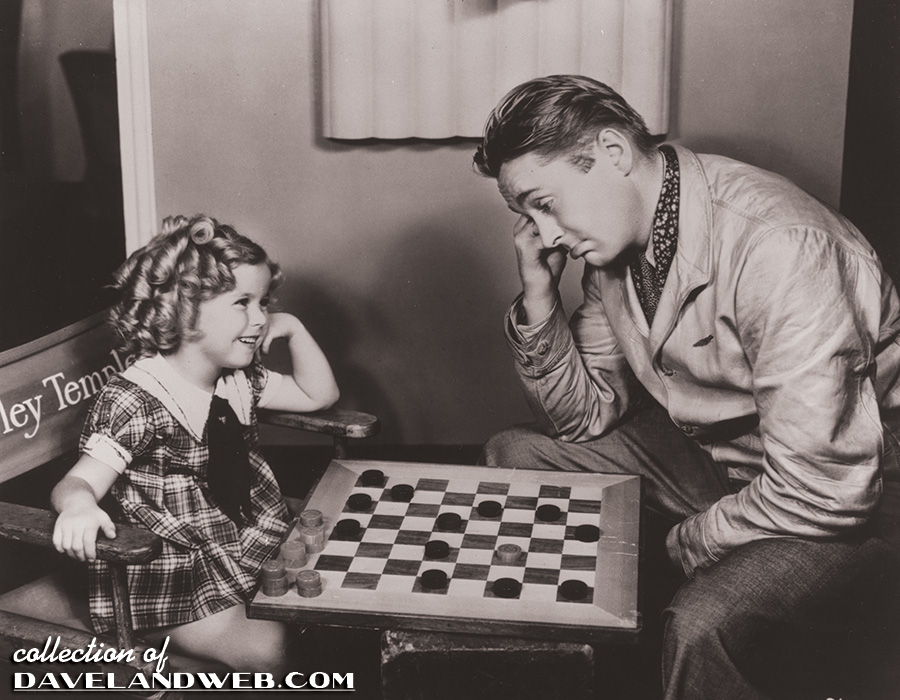
Apparently checkers was a favorite game for Shirley between takes; below it’s a different day during “Bright Eyes” filming, but the same activity!
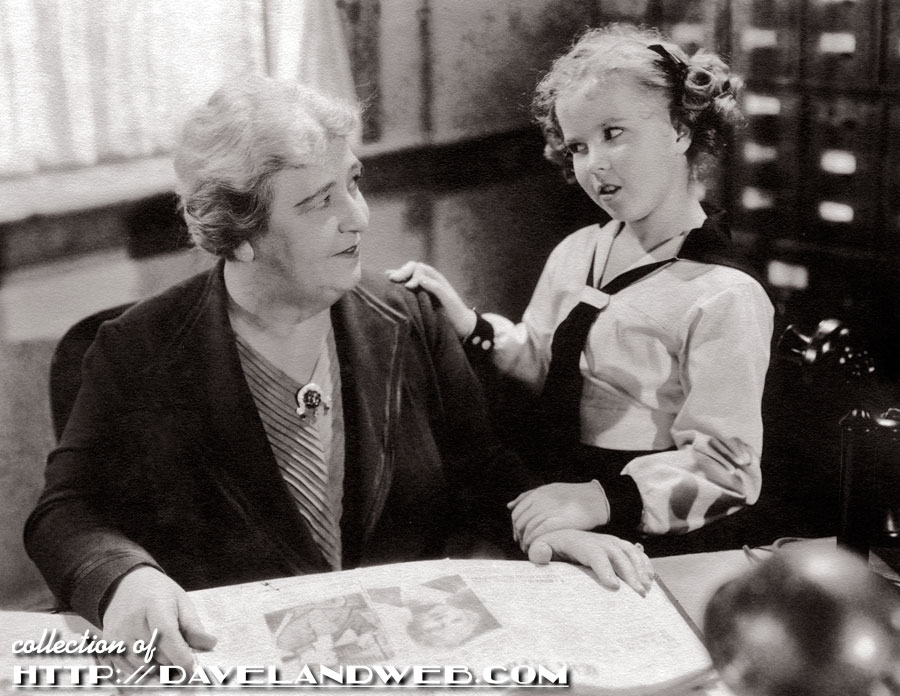
Back to “Heidi”…it just wouldn’t be a Daveland post without a few rabbit holes! Another day, another visitor to “Heidi.” Not sure who the semi-goofy looking guy is, but Shirley was caught mid-blink.
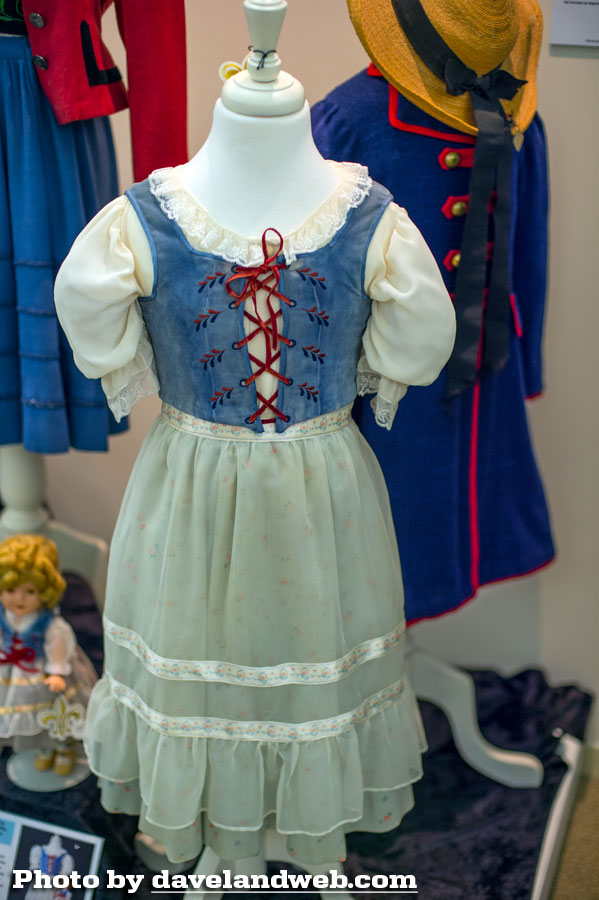
Zooming in to show her costume:
I was able to see it in person at the Santa Monica History Museum before Theriault’s auctioned it off in 2015:
The obligatory detail shot:
As they often did, the studio gifted Shirley a custom-made doll using the same fabrics as her actual costume.
Another “no idea” on this set visitor with the overbite:
…or the significance of the blurry coin in her hand. At least I think it’s a coin.
This particular costume was sold off by Theriault’s, but wasn’t on display at Santa Monica. Sigh. The Theriault’s auction photo will have to do.
If you zoom into the small photo downloaded from the web, as so many shamelessly do and pass off as their own, you get bupkis on the details, and instead a fair amount of blur.
When applying AI, you get a much crisper photo, but the accuracy for the fabric and the techniques used in construction go down the toilet. AI has its uses, but can only do so much when it “guesses” about information for an existing photo. Just a cautionary tale when using this new tool!
See more Shirley Temple photos at my main website.
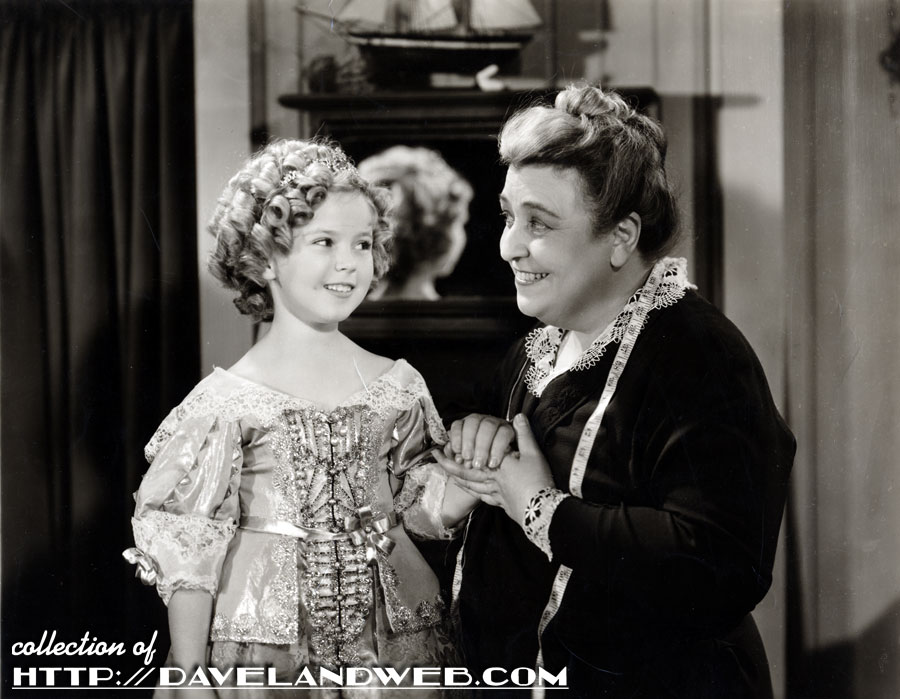
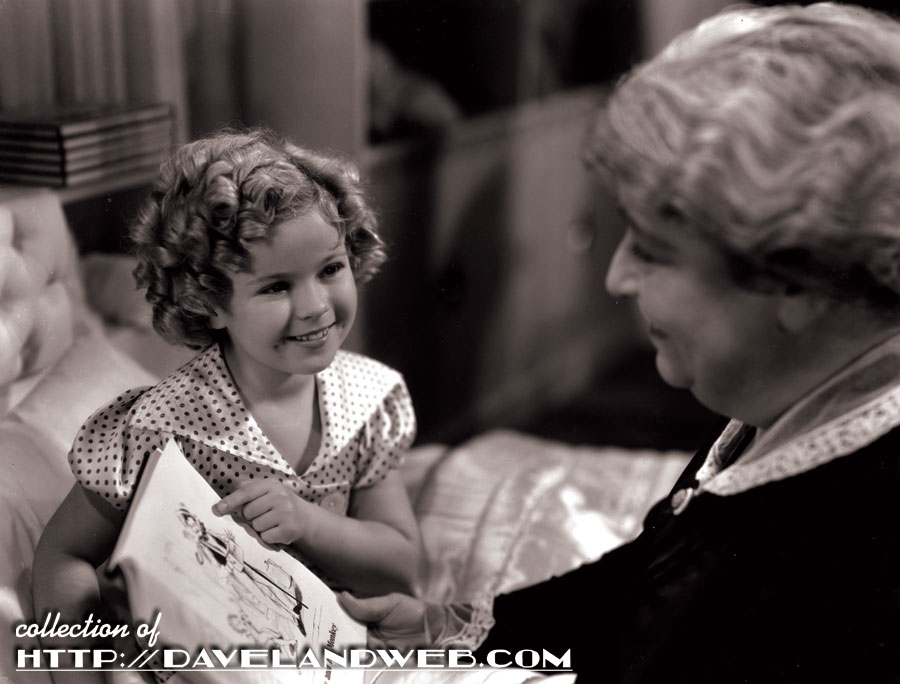
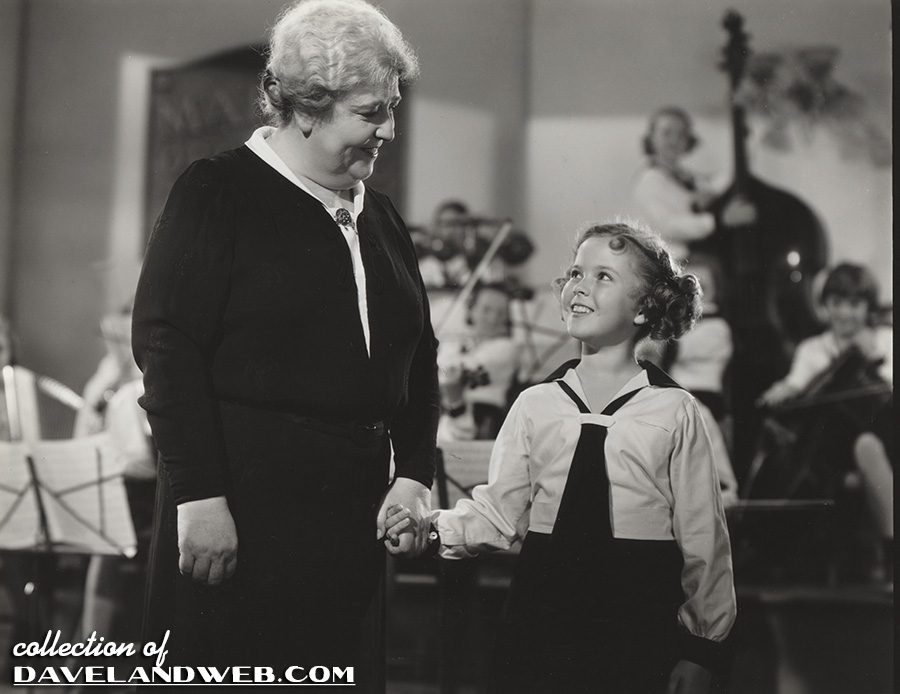
Today’s post pays tribute to character actress Jane Darwell (1879-1967). She was born Patti Woodard in Palmyra, Missouri. Edited from the Find a Grave website:
Her father was a railroad executive who disapproved of her interest in theatre. Despite the disapproval, she continued working in theatre and made her film debut in 1912. It would be the first of over 200 film performances. Her first notable performances in talking pictures came in 1930 and 1931 when she played the part of the Widow Douglas in the films “Tom Sawyer” and “Huckleberry Finn.”
She was a frequent Shirley Temple costar, beginning with the film “Change of Heart” (1934) starring Janet Gaynor, Ginger Rogers, James Dunn, and Charles Farrell. Both Darwell and Temple have bit parts in the film, but no scenes together. Darwell played the mother of Dunn’s character (screenshot below) in a short scene at the beginning of the film:
…and Shirley had a cameo with Charles Farrell (seen above) as he makes her a paper airplane aboard a real airplane. In “Bright Eyes” (1934), Shirley and Jane had a number of scenes together. Darwell played the feisty cook, Mrs. Higgins, who adores Shirley but hates the bratty little child (portrayed by Jane Withers) of her snooty employer.
In the film, Shirley’s character (also named Shirley!) borrows one of the large stockings from the plus-sized Mrs. Higgins so that Santa will have more room to give her all the gifts she’d like to have!
Next up was “Curly Top” (1935) with Darwell as Mrs. Denham, the kindly matron of the orphanage where Shirley’s character lives with her sister. Mrs. Denham is key in getting the wealthy Edward Morgan (John Boles, seen below with Darwell) to adopt the two girls.
The publicity still below shows Mrs. Denham and Mrs. Higgins (Rafaela Ottiano) crying as the two sisters leave the orphanage.
In “Captain January” (1936) Darwell portrayed the widow Eliza Croft, who has the hots for Shirley’s guardian, played by Guy Kibbee.
A few brief scenes between the two in “Poor Little Rich Girl (1936), with Darwell playing yet another housekeeper.
Darwell’s final silver screen pairing with Temple was “Little Miss Broadway” (1938). This time, she actually runs the orphanage that Shirley is adopted from. Finally, a career move up!
Darwell was a busy gal, playing bit parts in several other movies over the years. In “Gone with the Wind” (1939), she memorably portrayed the neighborhood gossip, Mrs. Merriwether.
Her career took a new path when she landed the role of the James Brothers' mother in the 1939 Tyrone Power/Henry Fonda film "Jesse James." It would be the first of several times she would play the mother of Henry Fonda on film. One of those times came in 1940 when she won an Academy Award for Best Actress in a Supporting Role for her portrayal of Ma Joad in the classic film "The Grapes Of Wrath."
Below, you can see a clip showing multiple takes of Darwell accepting the Best Supporting Actress Oscar for “Grapes.” The 13th Academy Awards was held at the Biltmore Bowl of the Biltmore Hotel in Los Angeles on February 27, 1941. She had stiff competition, beating out Judith Anderson (“Rebecca”), Ruth Hussey (“The Philadelphia Story”), Barbara O’Neil (“All This and Heaven Too”), and Marjorie Rambeau (“Primrose Path”).
In late 1948, Shirley returned to her home studio of 20th Century-Fox. Zanuck through a welcome back party and many of her former costars showed up. Below is Darwell and director Henry Hathaway:
Shirley hired Darwell for her television anthology series, “The Shirley Temple Show,” specifically the episode titled “The Fawn,” which first aired on February 5, 1961. Shirley was the narrator and Darwell played Grandma in the story that also featured Robert Crawford, Jr. (seen below).
Walt [Disney] took special care to ensure that the “Feed the Birds” sequence in Mary Poppins would be memorable. As Robert Sherman would explain, “One of the more beautiful moments in the history of movie making occurred as we were casting and filming the ‘Feed the Birds’ sequence. It’s one of those rare instances where life and art became one in the same thing.” During production of the Disney film in the summer of 1963, actor Jane Darwell was 83 years old. With a film career that stretched back to as early as 1913, she was among the most respected actors in the industry, with a star on the Hollywood Walk of Fame and an Academy Award for Best Supporting Actress for her performance of Ma Joad in 1940’s The Grapes of Wrath. She was living at the Motion Picture Country Home, a noted residence for retired film actors and artists.
“Walt offered her the part of the Bird Woman, but in doing so, he also treated her as the star she had once been,” Robert Sherman recalled. “He sent her a script and a letter via special messenger (as opposed to US Mail) and had a limousine and driver pick her up once for a meeting and then again on the day of the shoot. Miss Darwell was tremendously excited to be a part of Mary Poppins and must have felt gratified to have been remembered after so many years away from the limelight. I think it was a particularly poetic thing of Walt to have done this. After all, as Walt said referring to ‘Feed the Birds,’ ‘That’s what it’s all about,’ doing just a little extra and going just a little bit out of your way to make someone feel special. Sometimes it can make all the difference in the world to a person.”
From the DVD commentary track one learns that Robert Sherman provided the speaking voice of Jane because Darwell’s voice was too soft to be heard on the soundtrack. He is heard saying her only line: “Feed the birds, tuppence a bag.”
It’s one of those magical moments where Andrews’ singing and Darwell’s performance together help bring on the waterworks. Watch the scene in the clip below:
Darwell died on August 13, 1967, after suffering a heart attack at the Motion Picture Country House and Hospital in Woodland Hills, California. Her obituary stated that she “had been residing at the hospital for the past two months, according to Maudie Hiser, her companion for 24 years.…The actress leaves a nephew, Winston Ogden, North Hollywood.” Reflecting on her career, Darwell stated, “I played either a grandmother or a housekeeper in every Shirley Temple film ever made.…I’ve played Henry Fonda’s mother so often that he calls me ma, and I call him son.” Darwell was married once in the 1920s, but was divorced within a year, according to her friends.
EXCLUSIVE: Marty Tudor has been working with the family estate of Shirley Temple and will have access to the rights of the child actress-turned Ghana and Czechoslovakia ambassador across streaming, film, stage and more. There are also two unpublished autobiographies by Temple which Tudor is helping the estate get published. The life of Temple, who was discovered dancing in a theater lobby by Fox Film songwriter Jay Gorney, is largely an untapped IP; one prolific adaptation of her life was the 2001 Disney Channel movie, “Child Star: The Shirley Temple Story.” That was based on Temple’s autobiography of the same name and it starred Connie Britton. Tudor is an industry vet, who managed the careers of Paula Abdul and Jon Cryer, and of late has been behind a series of Hologram concert shows starting in 2018 with performances by the late Maria Callas, Roy Orbison, and Whitney Houston.…Temple began her film career in 1931. The 1934 movie Bright Eyes put her on the map as a singing child star with her signature ditty “On the Good Ship Lollipop”. In 1935, she received a miniature Juvenile Oscar. She did segue to roles as a teenager, notably starring opposite Cary Grant in 1947’s The Bachelor and the Bobby-Soxer which won an Oscar for Sidney Sheldon’s adapted screenplay.…Temple’s last movie was the 1949 comedy “A Kiss for Corliss” opposite David Niven. She hosted “Shirley Temple’s Storybook” from 1958-1961 before beginning her diplomatic career in 1969. Her friends included former FBI founder J. Edgar Hoover who gifted her a tear gas pen at the age of 20 to help protect her against any death threats. She also befriended Amelia Earhart; the duo reportedly known for their discussions about feminism, Hamlet and chewing gum. Temple as a child learned geography by tracing Earhart’s flights.“There’s so much more to American icon Shirley Temple’s life that people aren’t aware of. She was the U.S. delegate in the United Nations, a female Ambassador to Ghana and Czechslovakia, she was a breast cancer survivor, she fought sexism as the first female U.S. Chief of Protocol. What appeals to me, as a father of a daughter, is that Shirley continues to be an amazing inspiration and role model for young girls. We see a lot of kid actors who go the wrong way, she did not. There’s an amazing human being here with a big story who gave back as opposed to a pop star in it for the glory,” Tudor tells Deadline. The Temple Black family tells Deadline in a statement: “As the 100th anniversary of our Mom’s birthday approaches, we are so pleased at the idea of sharing with the world the lesser-known second half of her incredible life story. She often observed that ‘the Little Girl opened the door’, but then our Mom stepped through it, confident, courageous, authentic – all grown up.”
It would be amazing to have the rest of Shirley’s autobiography released!
See more Shirley Temple photos at my main website.
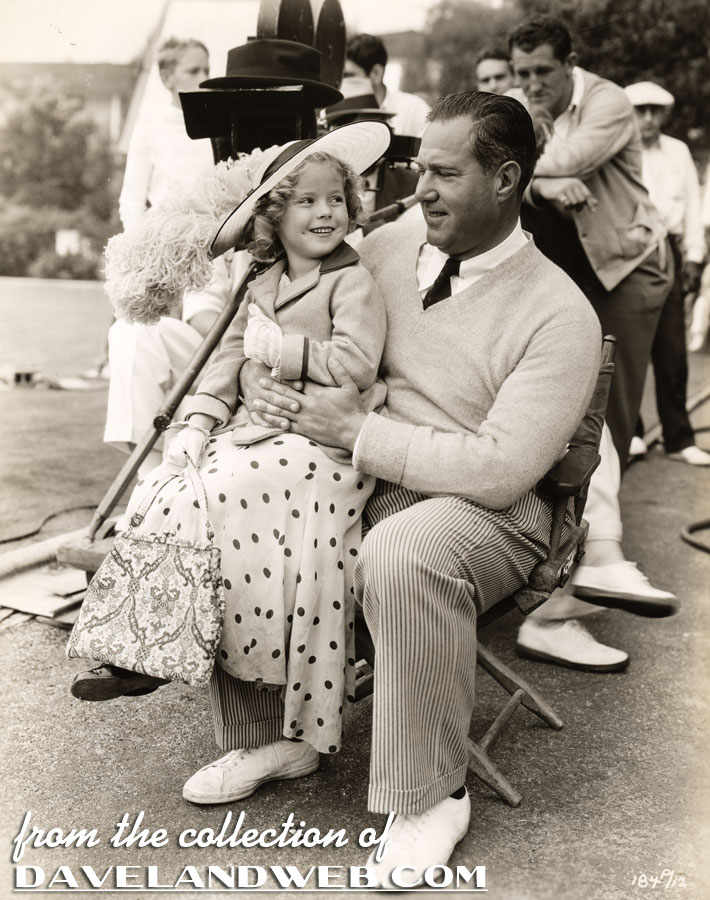
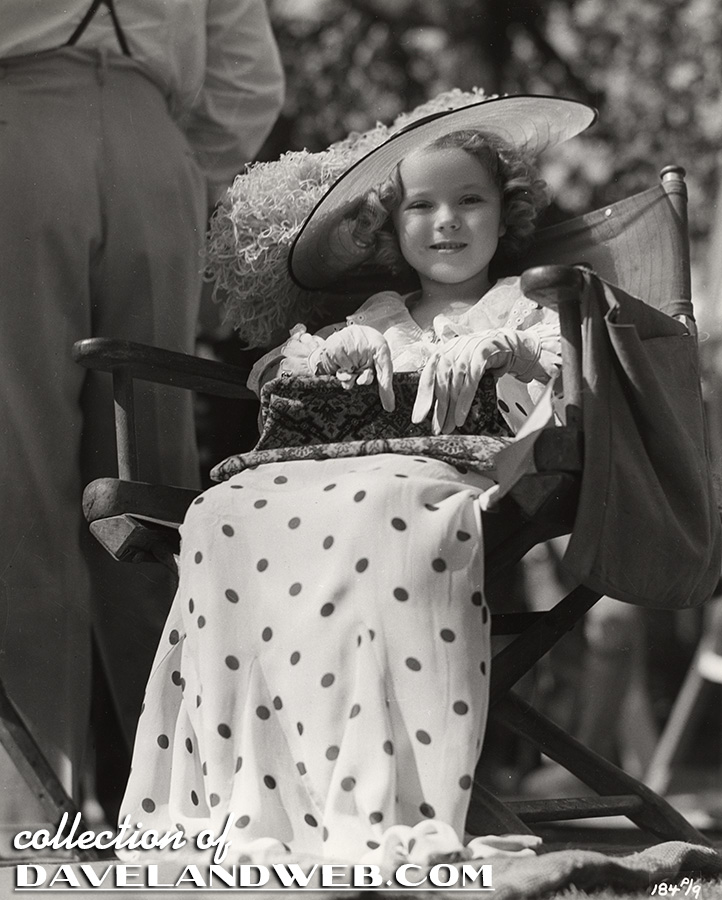
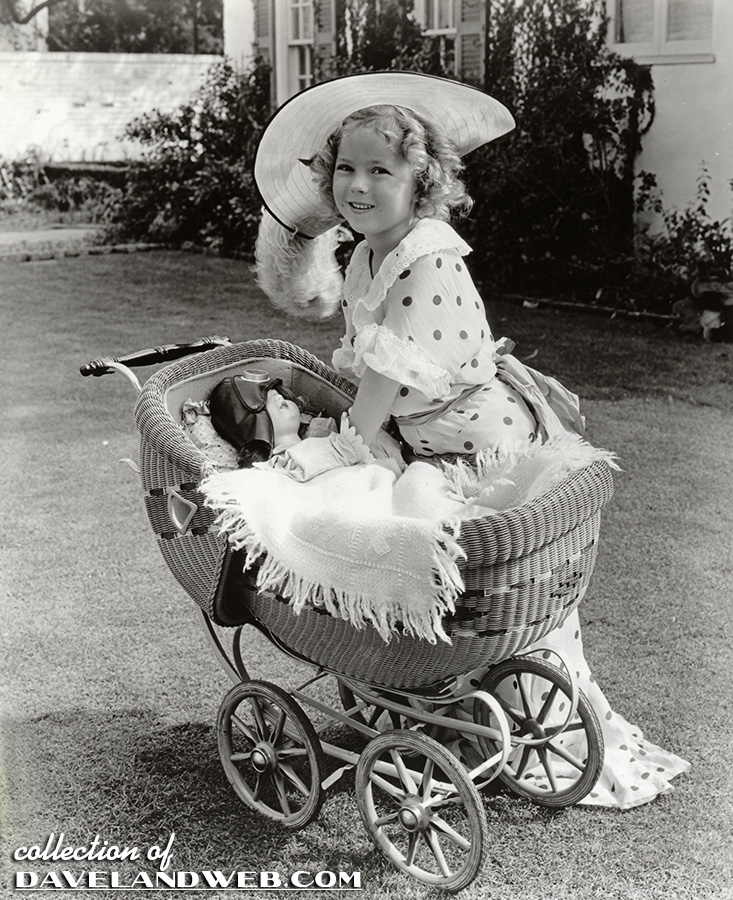
For her 1934 starring vehicle, “Bright Eyes,” Shirley Temple’s character got to dress up in over-sized adult clothes and parade around as if she was an elegant society lady. Here is candid shot of Shirley with director David Butler, in between takes at the Pasadena location for this scene. The accompanying publicity blurb:
WHAT, NO LOLLIPOP? —Shirley Temple is positive Director David Butler will buy her that chocolate lollipop now she’s donned a feathered hat and long dress. The dimpled starlet plays at being grown-up for a scene in Fox film’s “Bright Eyes,” in which she is featured with James Dunn.
Little Shirley patiently awaits her next scene:
SMALL GIRL. IN A BIG CHAIR — Shirley Temple takes a few moments off for rest in Director David Butler’s set chair. Butler is directing Shirley in his own story, “Bright Eyes,” which will be her last picture for 1934.
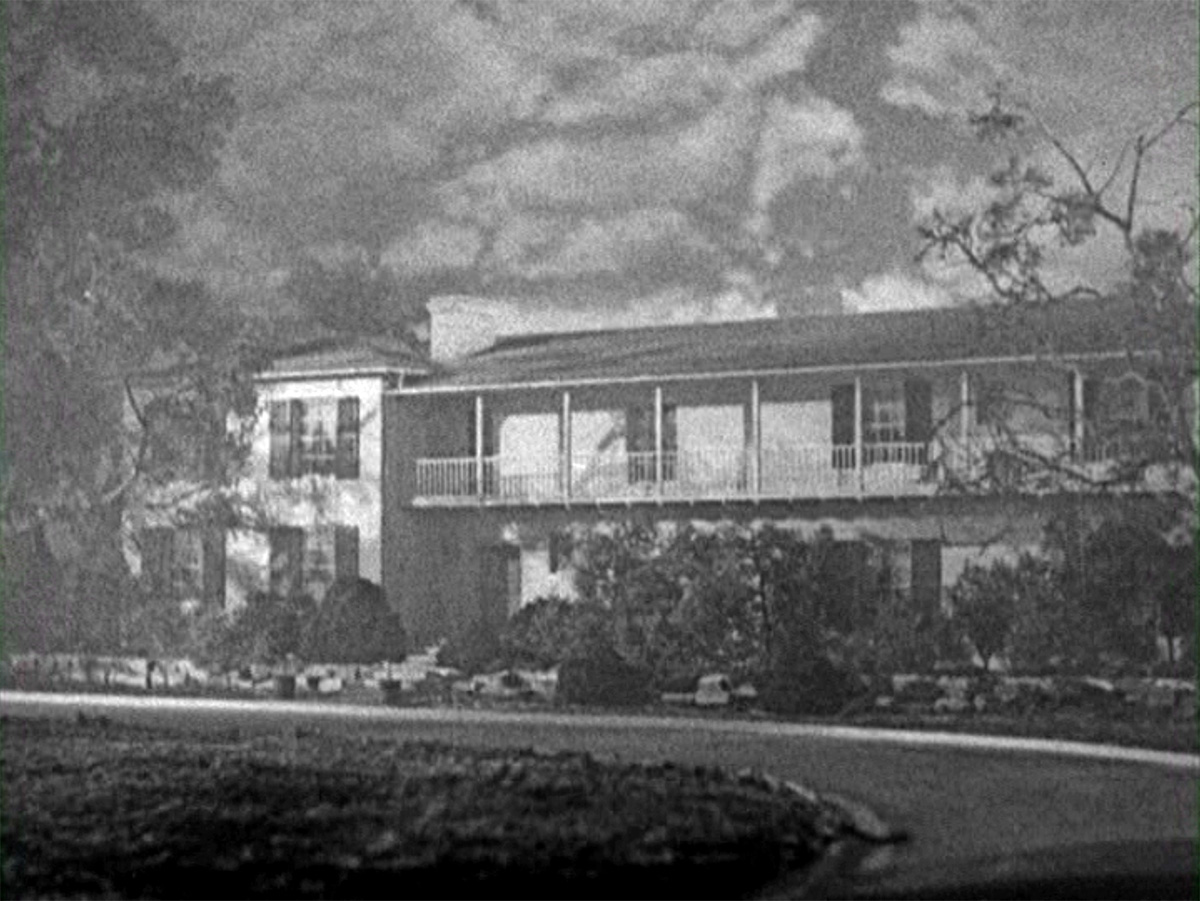
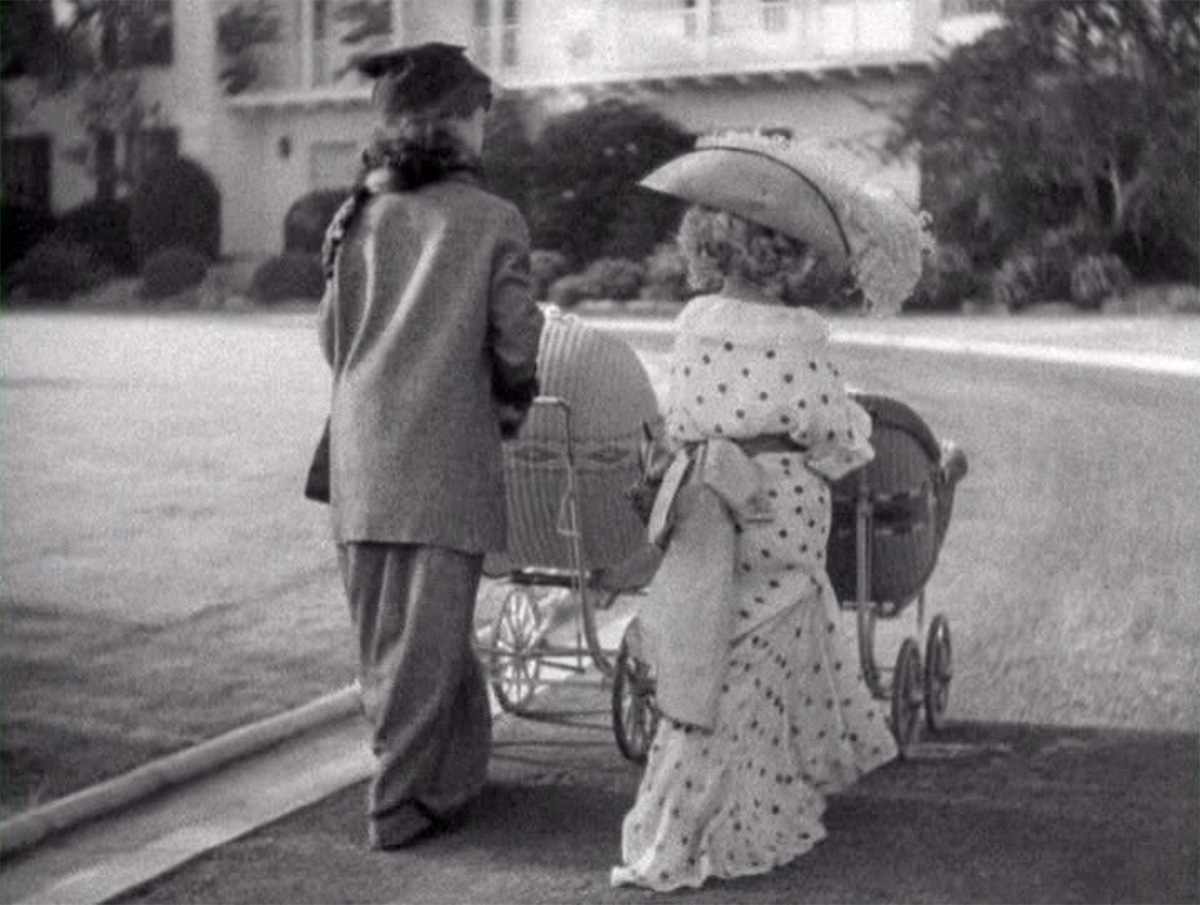
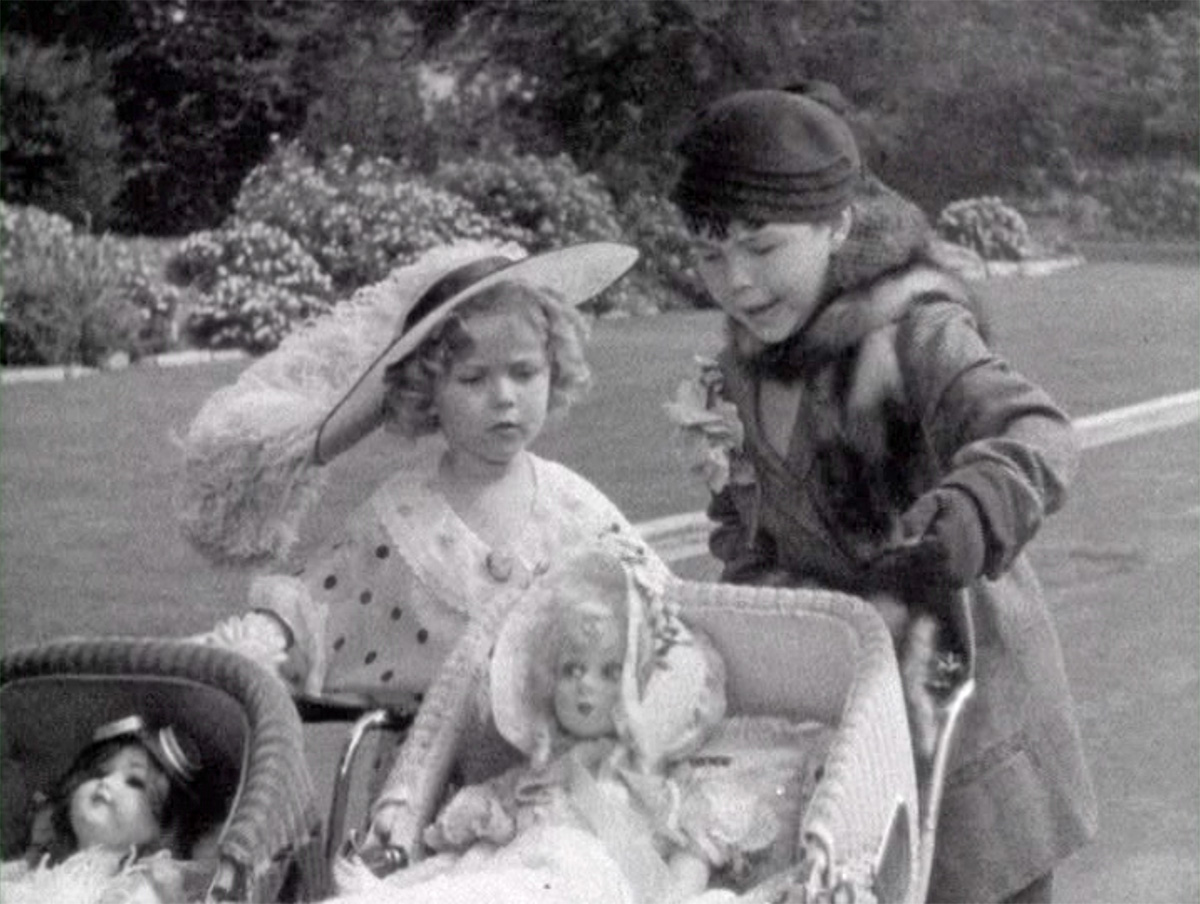
In the scene, Shirley pushes a baby carriage around the property with her doll. Below is a screenshot of the house that was used for exterior locations:
How that house looks today:
Jane Withers and Shirley pushed their baby carriages up that very same driveway ninety years ago!
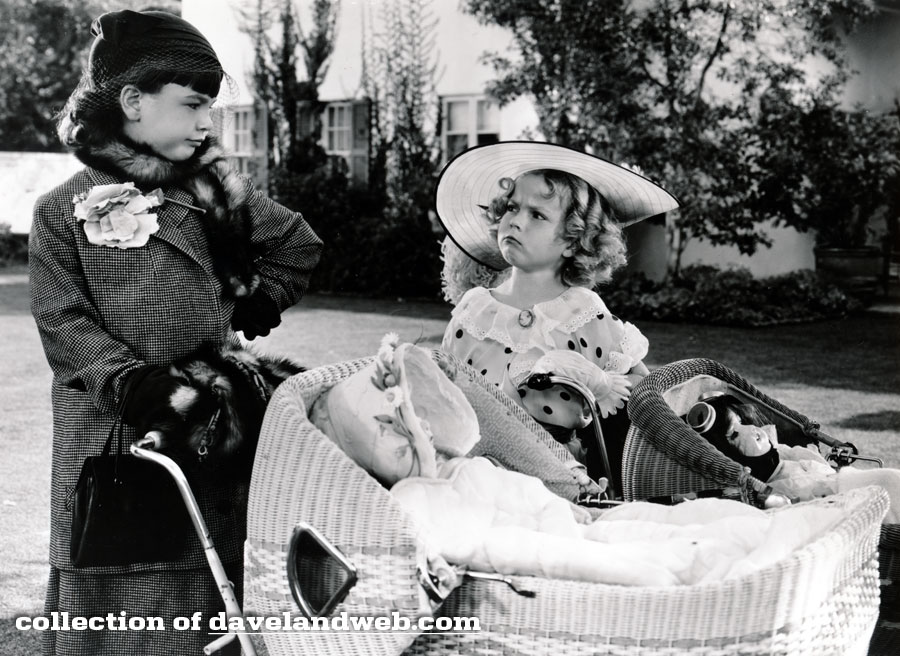
Shirley’s character was kind and loving to her little dolly, whereas Jane Withers’ bratty counterpart constantly swatted hers. Hey Jane, careful — that’s a very valuable Lenci doll!
You can see tensions boiling between the two; who is going to get to keep the dolls once the filming is done?
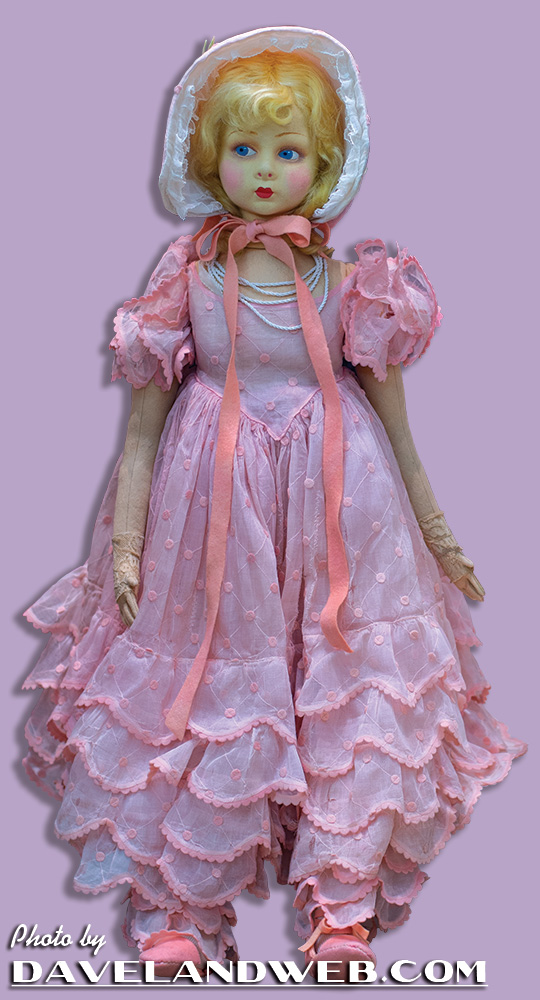
Named “Pinkie,” the 37” tall Lenci doll began the worldwide tidal wave of dolls gifted to Shirley in real life. From her autobiography Child Star:
For props we were each issued a doll, mine modest and frumpy, befitting my role, and hers a giant glorious Lenci from Italy with dangling blond curls and exquisitely costumed in ruffles and a velvet bonnet garlanded with lifelike flowers. Following her stage role, Withers became possessive, denying me even a peek, clutching it and turning away. Ultimately it developed into a quiet offstage competition for something she really did want, but I did not. Toward the end of “Bright Eyes,” Sheehan caught wind of the doll competition and offered Mother the Lenci doll in order to gain her cooperation on some other minor matter. Believing I really coveted it, Mother acepted his bribe, thinking perhaps to employ the doll in some secondary inducement with me. Her hope vanished when Sheehan publicly announced that I was starting a doll collection with the Lenci as my first. This action was tantamount to removing a finger from the dike. From all over the box-office world a thousand dolls of every type and nationality flooded in. In fact, the concept of a collection of anything beyond slingshots had no appeal whatsoever. It was a Pyrrhic victory; winning the Withers war imposed the unwelcome burden of becoming curator for an unwanted collection.
Below is a photo I shot when the doll came up for auction in 2015.
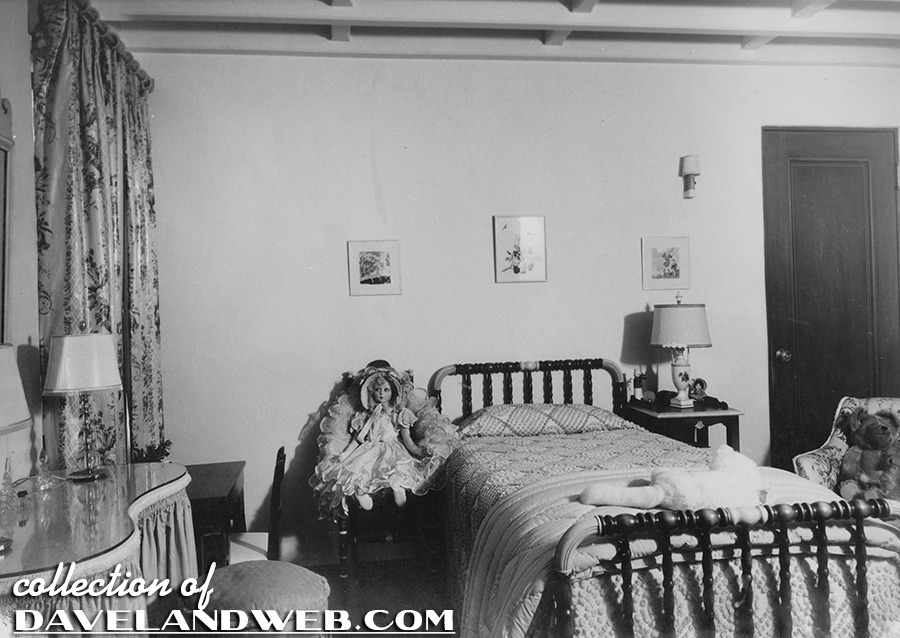
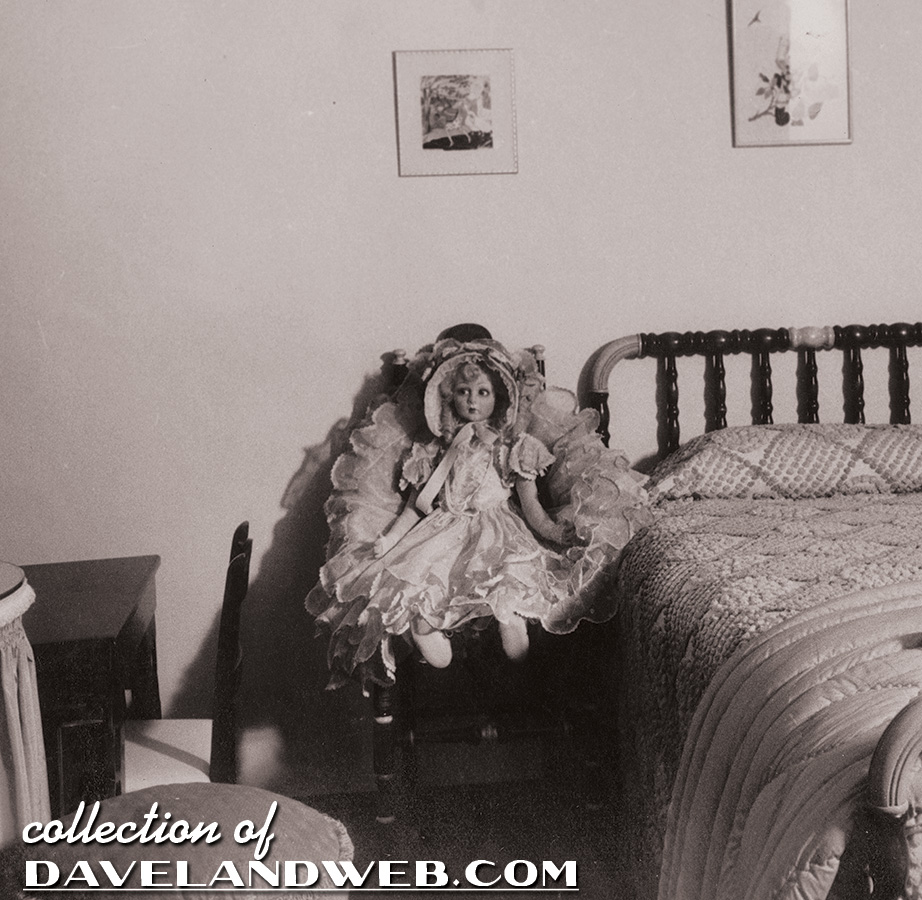
Pinkie had a place of prominence in Shirley’s Santa Monica bedroom (photo below).
Sorry, Jane - you shouldn’t have messed with Shirley.
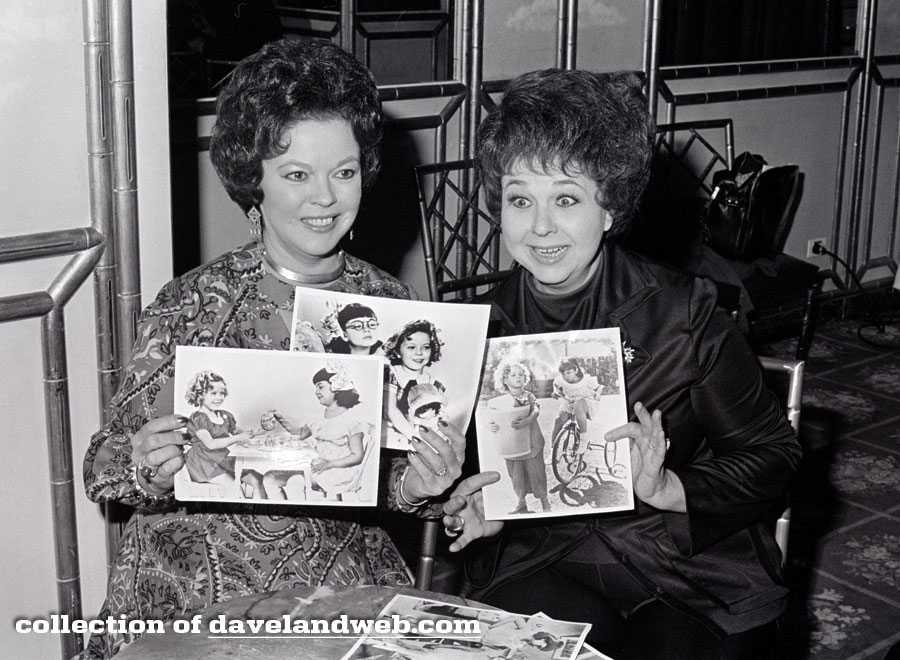
Shirley and Jane Withers’ December 1976 reunion at the Beverly Wilshire Hotel was captured by the photographers. Note that Shirley is covering Pinkie in the photo in her left hand. Why stir up old wounds? Always the diplomat!
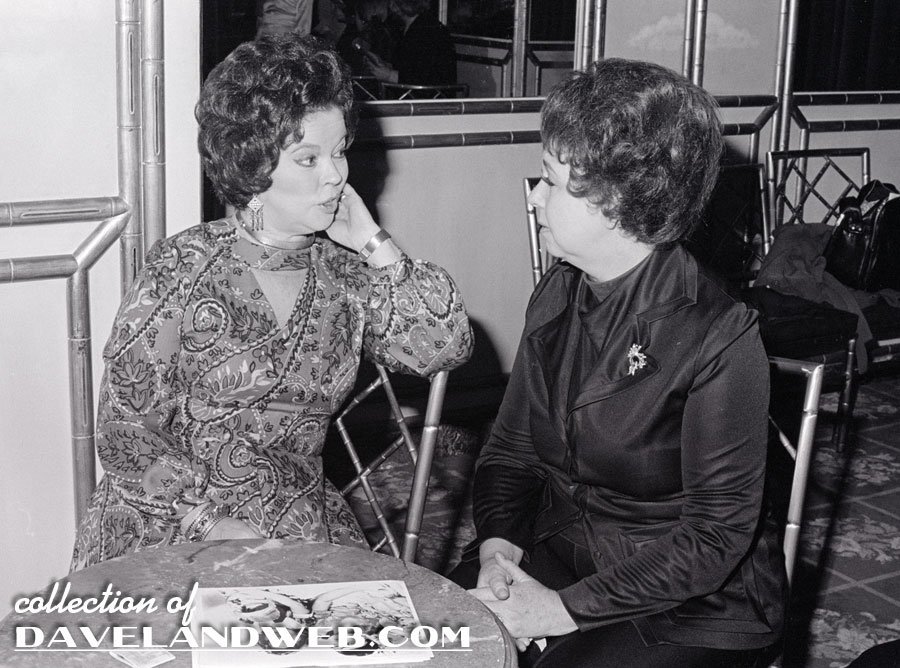
In a quieter moment, you can just hear Shirley: “Really Jane, if you hadn’t been such a pill, you could have had the darn doll for yourself!”
This darling costume also graced the cover of one of Saalfield’s many 1930s Shirley Temple publications:
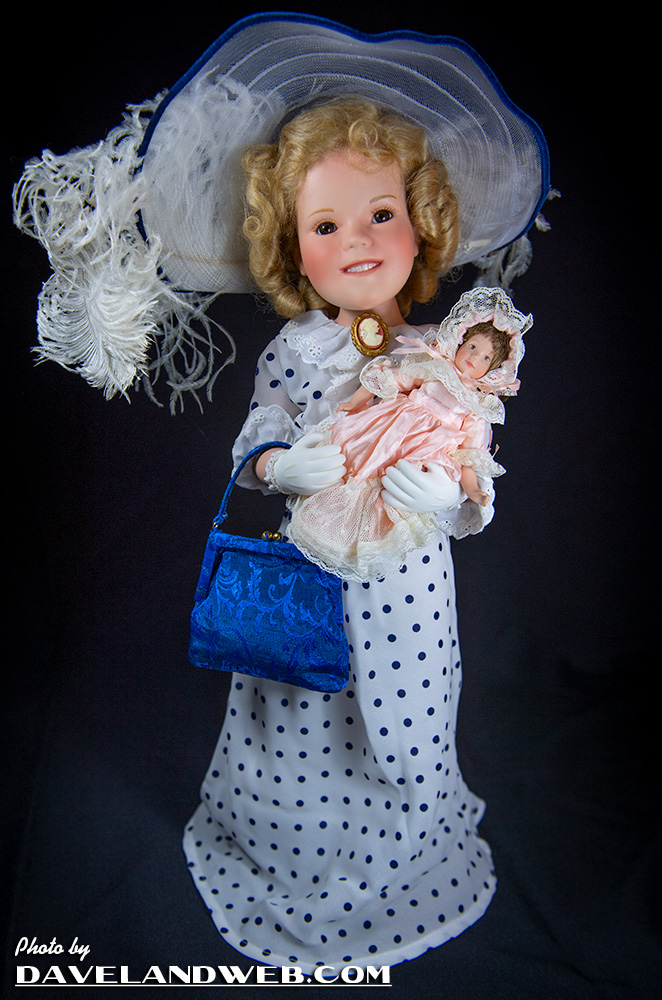
In 2003, the Danbury Mint released a limited edition porcelain doll of Shirley recreating the same scene (minus the carriage) in honor of Shirley’s 75th birthday:
Sorry, Jane - you weren’t part of that tribute, either!
See more Shirley Temple in “Bright Eyes” photos at my main website.
In this publicity still for Shirley Temple’s 1935 film, “Curly Top,” her first stand-in, Marilyn Granas, can be seen standing next to Shirley on the left side of the photo. This was one of the few times that Marilyn got any actual screen time in a Shirley movie.
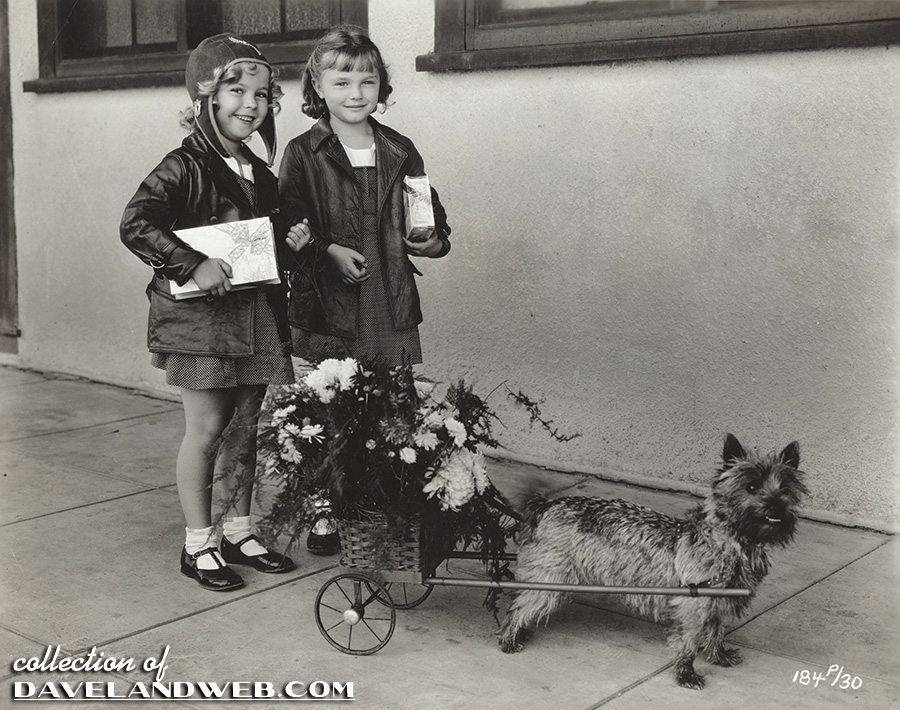
A year before, she posed for this still taken during the making of “Bright Eyes.”
From the accompanying caption:
FRIENDS — Shirley Temple, helmeted, and Marilyn Granas, her stand-in and playmate, about to take “Rags” out for a promenade along dressing room row at the Fox Film studio where Shirley is now engaged on “Bright Eyes.”
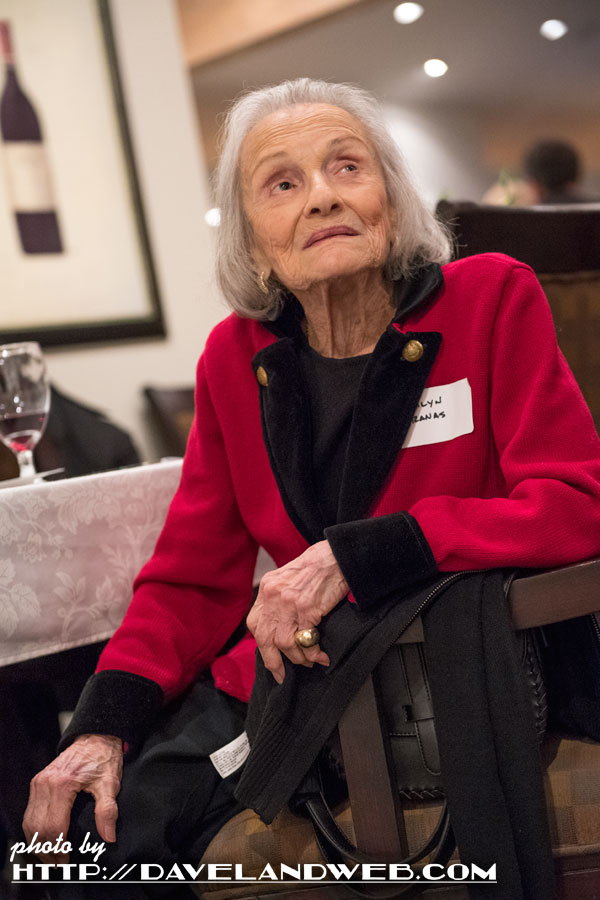
If Rags looks familiar, that’s because you probably recall her (yes, her) playing Toto in “The Wizard of Oz.” Shirley met him before Judy did! Below is a shot of Marilyn when I met her in 2018 at a little get together in Los Angeles commemorating what would have been Shirley Temple’s 90th birthday.
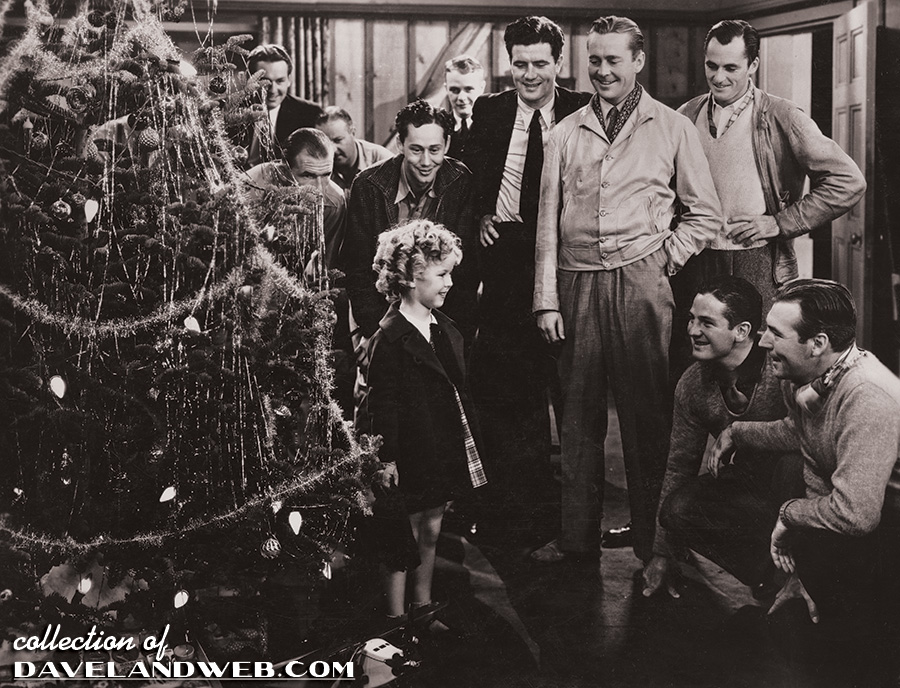
Today for Temple Tuesday we celebrate a quintet of Shirley movies that take place during the Christmas holiday. First up is “Bright Eyes” (1934), one of my favorite Shirley films. There is a very touching Christmas Eve scene where Shirley’s widowed mother (Lois Wilson) confides in her daughter that she misses her husband. The next morning, little Shirley is celebrated by all her aviator friends who used to work with her father before he “cracked up.” She is showered with gifts and love.
Yes, that’s mistletoe in the pilot’s hand. When I attempted to look up the meaning of the branch and berries on Google, this is what it said:
Historically, mistletoe represents romance, fertility, and vitality. Because nothing says love like bird feces and poison. But seriously, the Celtic Druids valued mistletoe for its healing properties and likely were among the first to decorate with it.
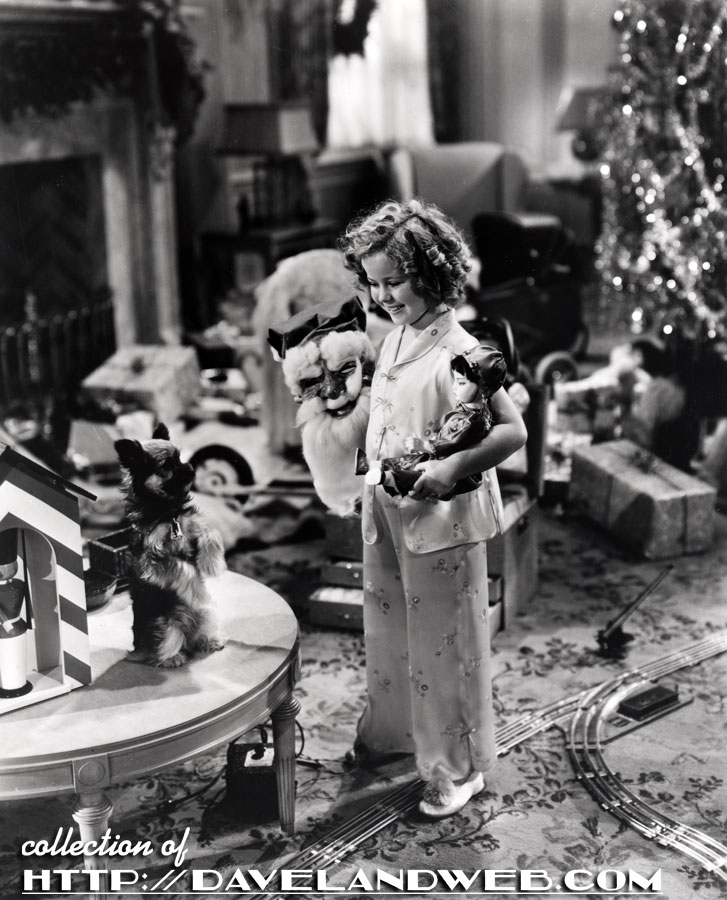
Who knew Google has a sense of humor? In “Stowaway” (1936), Shirley is a little girl who must flee her home to avoid being killed, then gets robbed, stows away on a ship, befriends a rich playboy (Robert Young), runs afoul of Alice Faye’s character’s mother-in-law (Helen Westley), almost gets put in an orphanage, and then has to plea to a judge to keep her “new” parents (Young and Faye) from getting a divorce. Doesn’t sound very Christmas-y, does it? Well, that’s what happy endings are for! The final scene has Shirley singing, “That’s What I Want For Christmas,” and judging by all the toys, dolls, and trains surrounding her, she gets everything on her list.
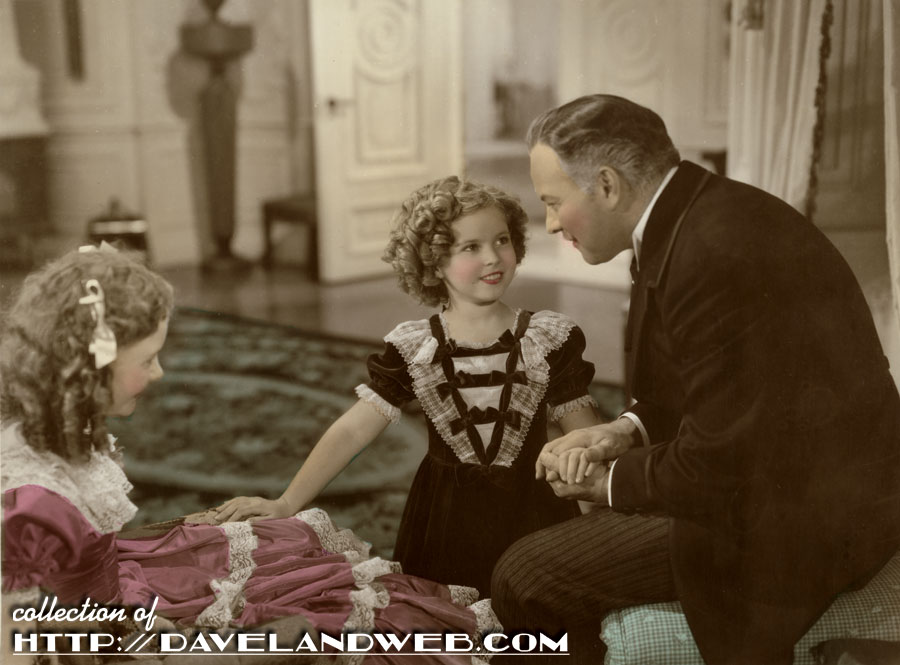
In “Heidi” (1937), Shirley sings “Silent Night” at the Sesemann household with crippled Klara (Marcia Mae Jones), wicked governess Fräulein Rottenmeier (Mary Nash), Herr Sesemann (Sidney Blackmer), and all the household servants.
It is a touching scene as the little girl gazes in wonderment upon the tree, ornaments, and abundance of gifts in the house, followed by a cut to the townspeople, nuns, and law enforcement singing the Christmas carol as well. Pardon the colorization; it was the best clip I could find!
A vintage hand-tinted photo from the same scene in “Heidi”:
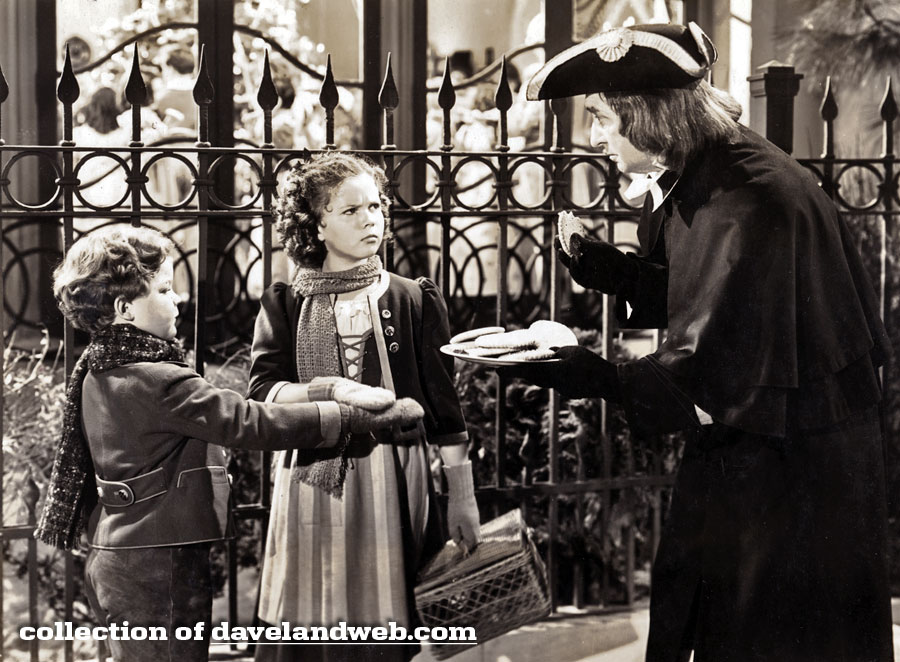
“The Blue Bird” (1940) begins on Christmas Eve, as Mytyl (Shirley) and her little brother (Johnny Russell) rush home for dinner after an afternoon of bird hunting. The merriment inside a mansion causes the poor little girl to stop and gawk, wishing she had all the riches that the people inside did. Regardless, she is too proud to accept cookies from the kind gentlemen who works there.
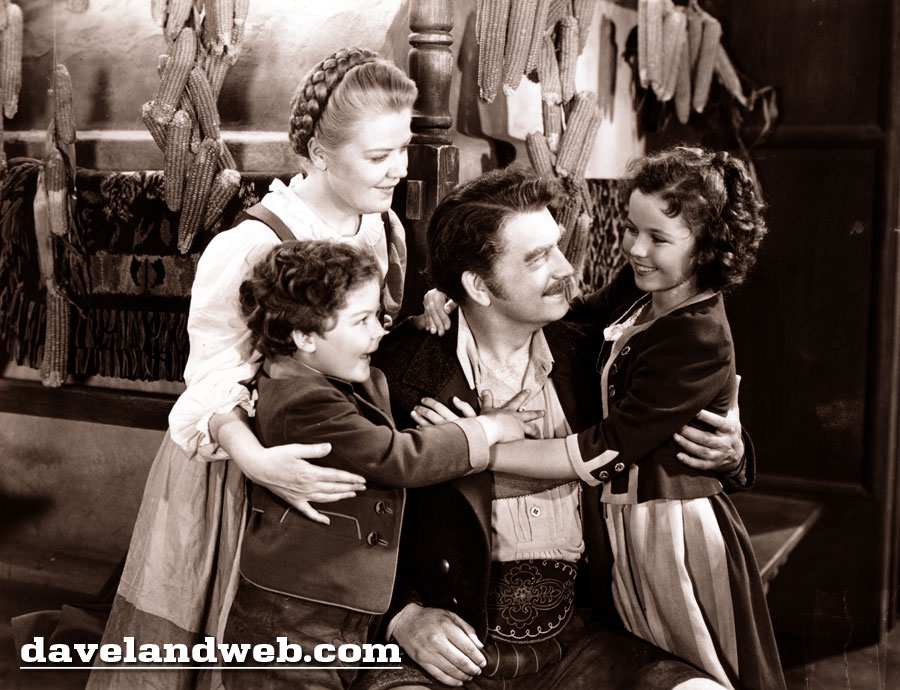
After a long journey in a dream sequence (or was it?), the children awake on Christmas morning to discover that the war has been called off and they can celebrate the holiday with their parents.
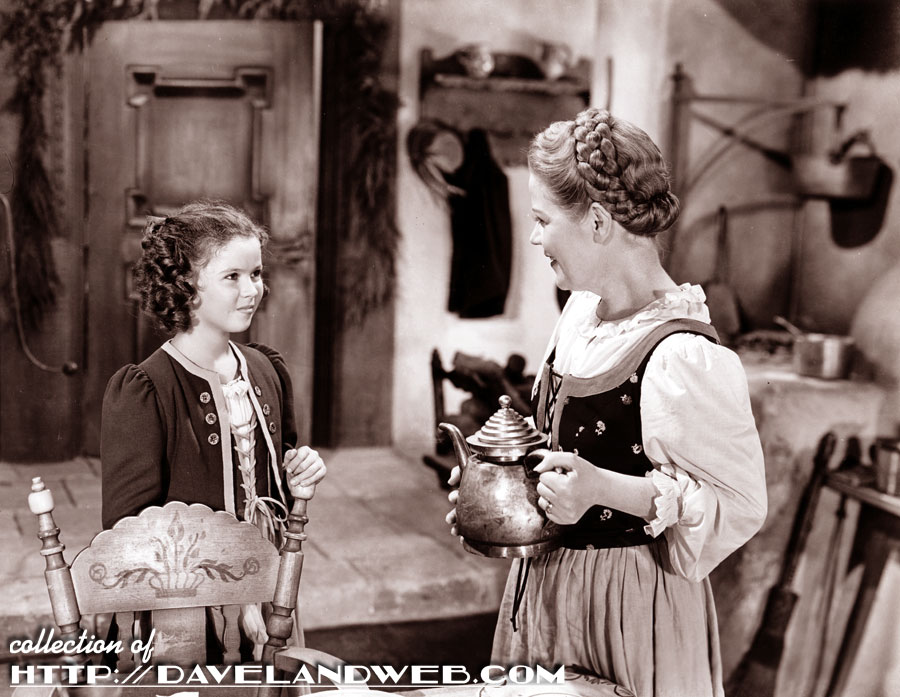
Note the festive garland around the door?
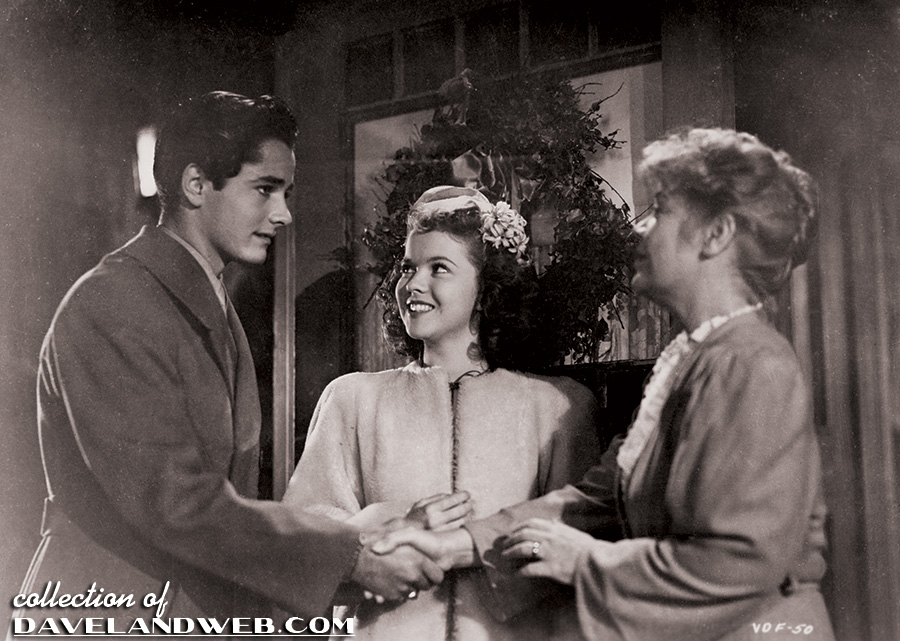
In “I’ll Be Seeing You” (1944), the Morgan family celebrates the Christmas holiday by welcoming their niece Mary (Ginger Rogers) for a visit. Mary meets a handsome Sergeant (Joseph Cotten) on the train there. Sounds like the beginning of a beautiful romance, right? Not so fast, folks. Mary is on parole (for accidentally killing the man who tried to rape her) and Zach is on leave from a military hospital, attempting to adjust to his PTSD. Are they honest with each other? Of course not! However, Barbara Morgan (Shirley) inadvertently spills the beans to Zach about Barbara and…well, you’ll just have to watch it yourself. In this scene from the movie, Barbara is about to go on a date with Lieutenant Bruce, played by John Derek, who put the “Derek” in Bo Derek! You’ll note that in both “The Blue Bird” and “IBSY” Shirley’s mother is played by Spring Byington, who would eventually play Major Nelson’s mother in “I Dream of Jeannie.”
“I’ll Be Seeing You” may not be the happiest of holiday movies, but it is still worth a watch and guaranteed to draw a tear from the driest of ducts!
Which Christmas Shirley movie will you watch this season?
See more Shirley Temple photos at my main website.