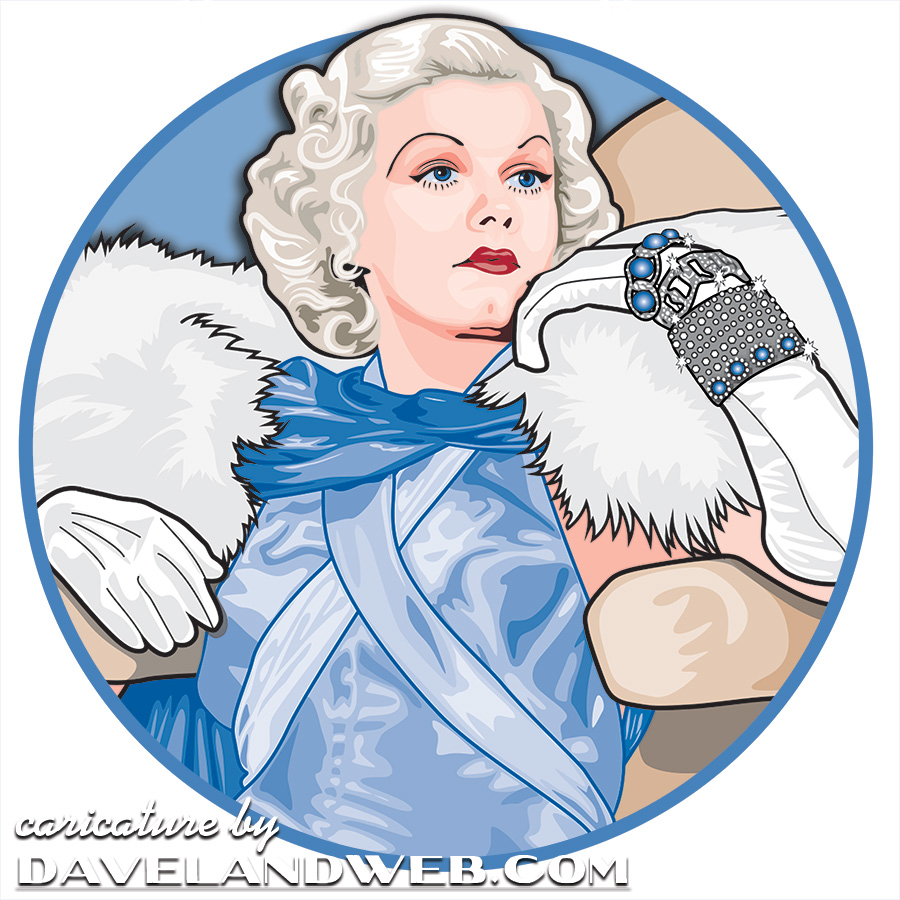
Showing posts with label jean harlow. Show all posts

Friday, October 02, 2026

Fashion Friday: Adrian at FIDM, Pt. 1


One of my destinations for my recent LA trip was the Adrian exhibit at FIDM, which stands for Fashion Institute of Design and Merchandising. Phew…my fingers are tired. I think I'll stick with FIDM. Adrian (Adrian Adolph Greenburg) was a costume and fashion designer, mainly remembered for his incredible work at MGM during the golden age of Hollywood where he was head costume designer from 1928-1941. “The Wizard of Oz,” “The Women,” and “Dinner at Eight” all benefitted from his genius. The outfit below was worn by Jean Harlow at Grauman’s Chinese Theatre. It’s survival is a miracle!


Edited from the accompanying info:

Adrian’s slinky, silk charmeuse evening gown defined the sex appeal of bias-cut clothing of the 1930s. Popular because of its unencumbered stretch around the female body, the rich, creamy color of the reflective material likewise highlighted every bare anatomical curve beneath. Adrian observed this effect on Harlow. “Even her clothes show emotion. They move and breathe with her.”


Harlow wore this gown twice: once in her hugely popular romantic-comedy “Bombshell” (1933, shown above with Franchot Tone) and again, when writing her name in the forecourt of Grauman’s Chinese Theater on Hollywood Boulevard. However, that momentous occasion did not go as planned, due to the original slab of cement breaking in half. Harlow returned four days later to repeat her performance, but this time wearing a different dress.


The 18th-century Style Court Gown was worn by Dorothy Christy as Lady in Waiting to Madame du Barry in “Marie Antoinette” (1938):


Edited from the accompanying exhibit info:

For “Marie Antoinette,” Adrian created more than 1,200 individual women’s costumes, all designed by himself. Research trips to France and Austria uncovered antique velvets and brocades, and braids and lace that were incorporated into the extravagant creations constructed entirely in MGM’s workshops: “I worked with people who did not hold tightly to the purse strings. I never had to make pennies count. This was unusual, even in Hollywood. I had complete creative freedom. I went after perfection, especially in detail, since I had to satisfy the discerning eye of the camera, which magnifies everything eight times.”


The fact that this was producer Irving Thalberg’s last greenlit project for his wife, Norma Shearer, didn’t hurt the budget, either! Below is a metal birdcage headpiece worn by Shearer in the same film. It has paste diamonds and features a stuffed finch resting on the perch inside. It includes an internal mechanical automaton trigger that allowed the bird to turn its head an dopen and close its beak while Shearer wore is in the film.


Another Shearer project was “The Women” (1939), directed by George Cukor. The exhibit has a premiere booklet from the film as well as the two glove ornaments sitting in front that were part of the Technicolor fashion sequence.


A closer look:


Adrian designed these ornaments and Joseff of Hollywood was the maker. These gilt metal and glass ornaments were originally attached to turquoise gloves as seen in the accompanying image below:


Garbo was another famous actress who frequently collaborated with Adrian in her movies. For “Queen Christina” (1933), the below 17th-century Style Court suit designed by Adrian was worn by John Gilbert:


…and this 17th-century Style Court Ensemble was worn by Garbo in the same film:


Edited from the accompanying info:

“Each picture I designed for her [Garbo] involved extraordinary precision. My imagination was never quiet when I approached her pictures. Ideas poured into my head with a liquid easy. I soared, because I knew she would be equal to anything I could conceive and that she would more than do it justice. This she did. No one on the screen has worn regal costumes with more authority or evening gowns with more ease. To put her into the costumes with the madness of my “Mata Hari,” the grandness of “Queen Christina,” or the elegance of “Camille” was a stimulating experience.”


 Still more Adrian to come!

See more Los Angeles photos at my main website.

Thursday, August 08, 2024

Harlow & Faye


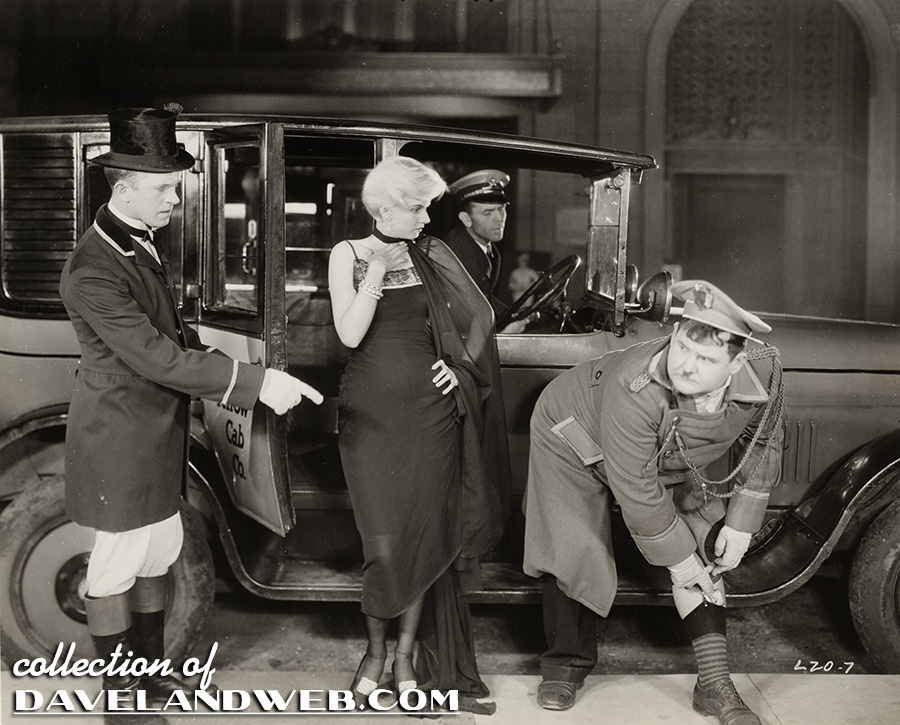
Today’s blog post refers to the two leading platinum blondes of the 1930s: Jean Harlow and Alice Faye. Harlow’s film career first began with supporting roles in silent comedies such as “Double Whoopee” (1929) with Stan Laurel and Oliver Hardy.


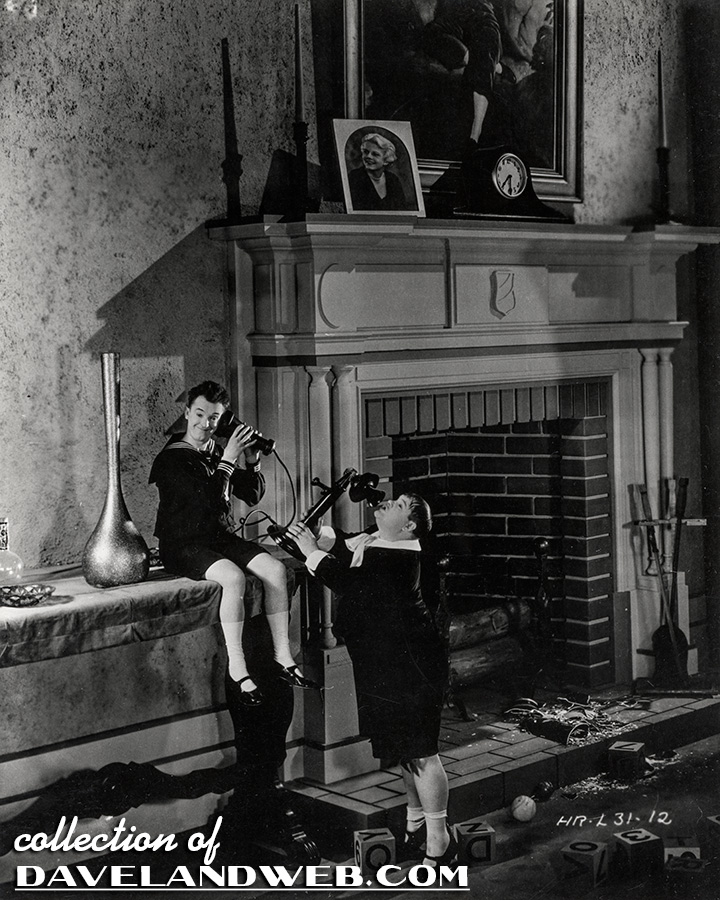
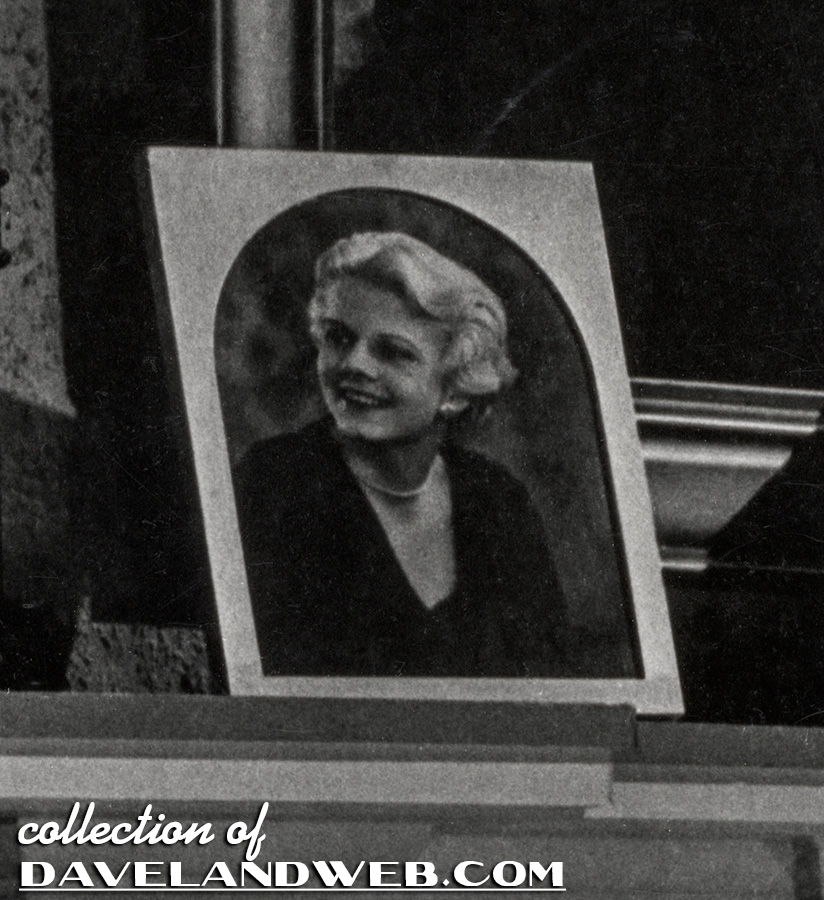
In “Brats” (1930), Harlow can be spotted briefly if you look closely at the photo on the mantle. Producer Hal Roach apparently quipped that he got Harlow to appear “for nothing” in this comedy short as well as in 1931’s “Beau Hunks.”


Zooming in:


Harlow’s breakthrough role came in the 1930 war film, “Hell’s Angels.” By 1932, MGM put her under contract and she became a box office favorite with hits like “Red-Headed Woman” (1932), “Red Dust” (1932), and “Dinner at Eight” (1933).


The pencil thin eyebrows, the platinum hair, and the sarcastic wit were all part of her manufactured persona.


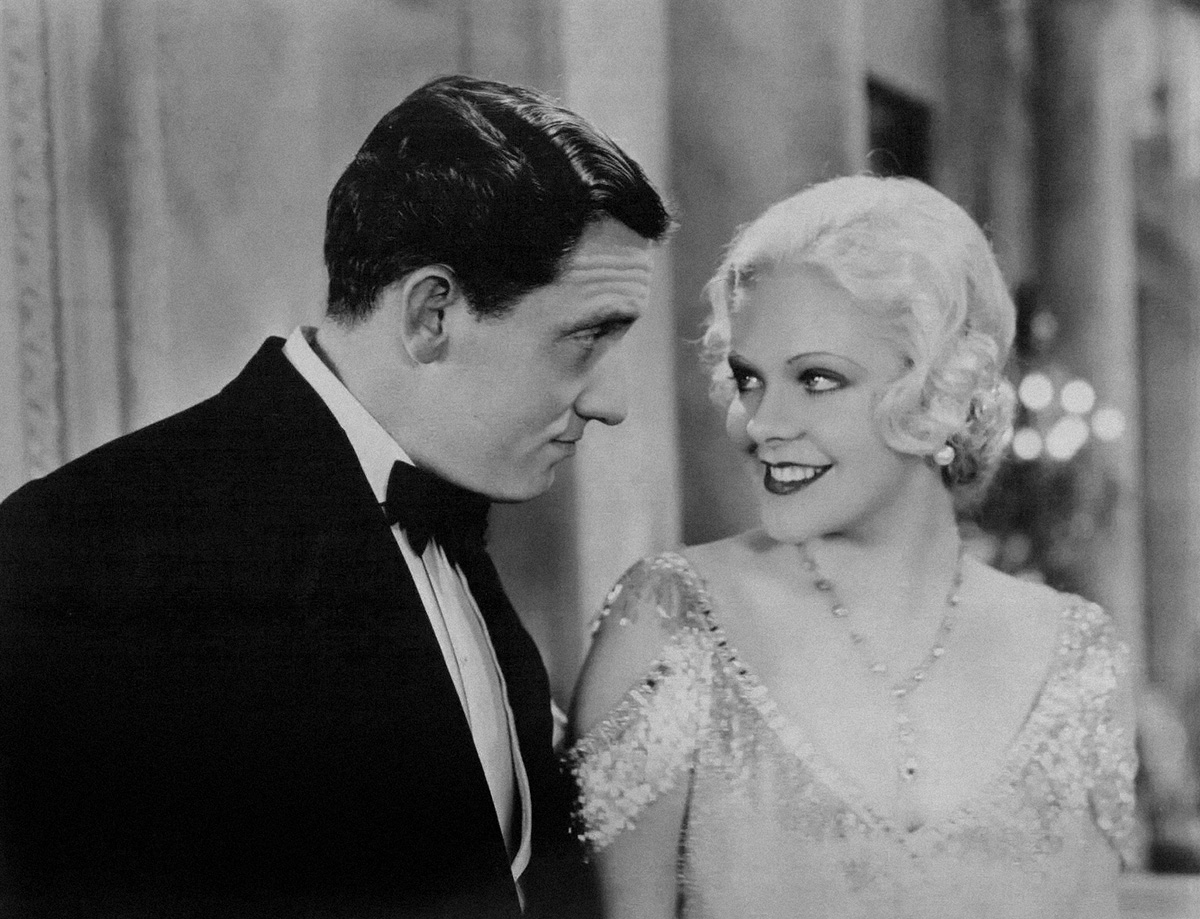
Enter Alice Faye (approximately four years younger than Harlow), Fox Studio’s “answer” to Harlow over at MGM. Today, portraits of the two are often confused. Faye was given the same platinum hairdo as well as the hardened makeup that Harlow had been sporting in her early career, as seen in “Now I’ll Tell” (1934), where Faye played the “other woman” opposite Spencer Tracy.


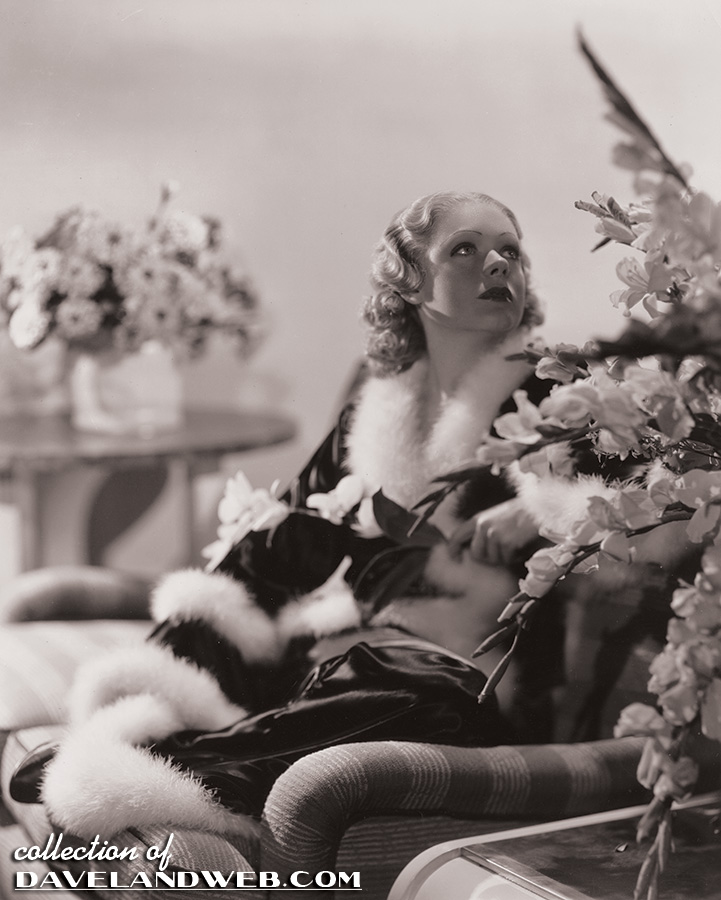
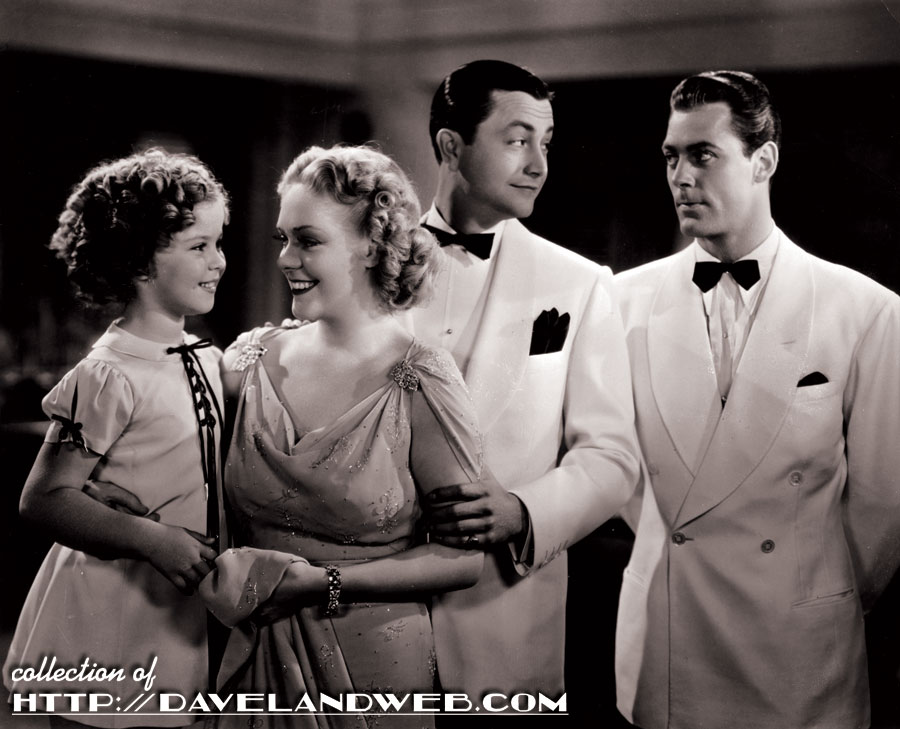
Below, a Gene Kornman publicity shot of Faye for “Poor Little Rich Girl” with Shirley Temple (1936) with this caption:

After she’s through with the day’s dancing sequences in “The Poor Little Rich Girl,” Alice Faye curls up in her favorite chair, clad in her favorite pajamas of black silk velvet lavishly trimmed in white marabou. In this 20th Century-Fox production, starring Shirley Temple, Alice finds herself teamed with Jack Haley, who does pretty well as a dancer himself!


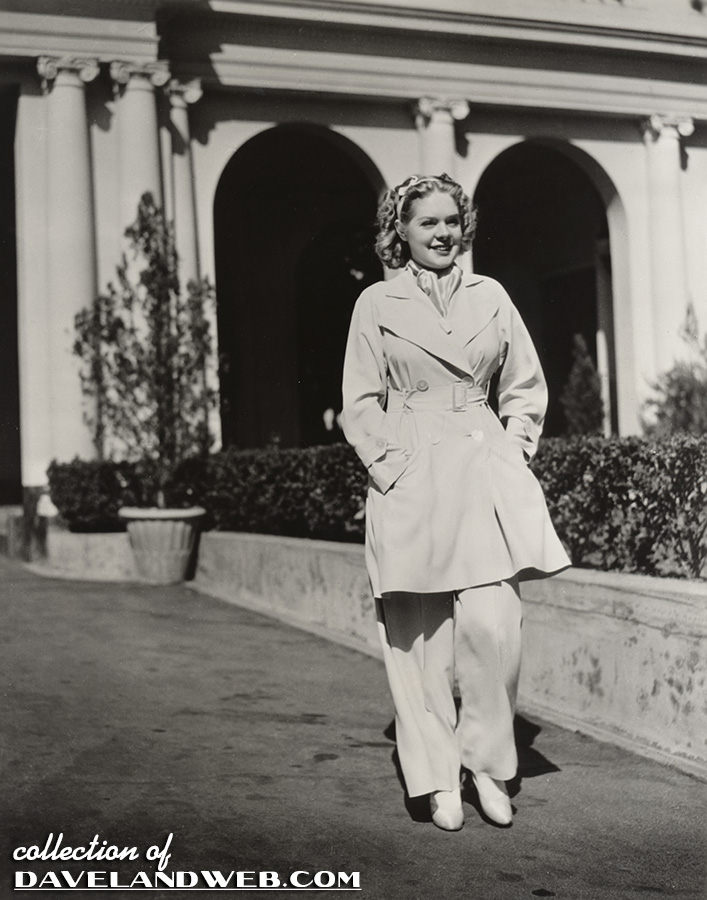
In this, her first Temple film, Faye played the wisecracking wife who nags husband Jack Haley all day long. Faye’s characters up to this point lacked the innocence and vulnerability that made Harlow so appealing underneath the sarcasm. Still, Faye had one thing Harlow didn’t: a gorgeous contralto voice! 20th Century-Fox Studio head Darryl Zanuck saw the potential in Faye and by the time she made her second Shirley Temple film, “Stowaway” (also in 1936), she was almost unrecognizable. In the following publicity still, Alice had graduated from silk velvet and marabou to an outfit that any typical woman of the day might have worn. The accompanying caption:

Attired as comfortably as possible, Alice Faye takes a stroll for the sake of fresh air before reporting for preparation at 20th Century-Fox for her role with Shirley Temple in “Stowaway.”


Zanuck saw the value in making Alice Faye more approachable to both sexes by softening the edges and putting the vocal talents front and center, much to the chagrin of little Shirley who would later recall:

I retired to bed singing “Good Night My Love,” a delectable ballad by Mack Gordon with Harry Revel with lyrics about Dutch dolls, teddy bears, and my dead daddy. Faye then reprised my song outside, under a romantic full moon, using mature lyrics sung in her own silky style. Instantly I knew her rendition had finessed mine. Hers was deeper-throated, more resonant, and her facial expressions insinuated much that I sensed was important without knowing why. Yet my proprietary feeling could not so easily be quenched. It was my song. I had sung it first. Why did I lose when she won?…Perhaps the problem was not my deficiency but her skill. She was older, I brooded, and had beautiful cow eyes to boot.


At the same time, MGM was working hard to soften Harlow’s image, realizing (just like Zanuck) that her appeal would be greater if they moved away from the one-dimensional platinum bombshell approach.

One of the oft-told legends of Hollywood was that MGM wanted so badly to borrow Shirley Temple for “The Wizard of Oz,” that they offered Clark Gable and Jean Harlow for Fox’s production of “In Old Chicago.” Shirley herself even repeated this myth in her autobiography, Child Star. It doesn’t take much digging to figure out that this was a fabrication, although portions of the story are true. When Alice Faye was interviewed by Joe Franklin in her later years, he asked, “Did you get that part [In Old Chicago] when Jean Harlow was about to die?” “That's what I read,” replied Alice. “I read that, but I’m not sure.” “I never believed it,” responded Joe. “I never did either. I wouldn’t mind following Harlow,” Faye said with a smile. “She was pretty dishy!” This speaks to the fact that back in the 1930s and 1940s, the studio bigwigs made trades and deals but the stars themselves were the last to know. They were under contract with the understanding that they would follow along with executive orders without complaint. Shirley Temple herself would not have had any firsthand knowledge about any of this, either. Here’s what we know:

“In Old Chicago” went into production mid-June of 1937, shortly after Jean Harlow’s untimely June 7th death. Thanks to some sleuthing by Melissa (aka “The Colonel”), we know that on May 27, 1937, the L.A. Times was still reporting that Harlow…

…is pretty certain as one feminine lead in that picture, incidentally.

One day later, the Times changed its tune:

With no chance of getting either Jean Harlow or Helen Hayes for “In Old Chicago,” Twentieth Century-Fox is to set about popularizing two of its own feminie players in this banner picture. And that’s not a bad idea either, particularly as one of the young ladies is Virginia Field.

On June 1st, the Evening Courier reported:

I don’t know what would have happened if Darryl Zanuck couldn’t have borrowed Jean Harlow for “In Old Chicago.” He had his heart set on her, but for a few weeks it looked as if M-G-M would have to refuse. In order to swing the deal, Darryl had to promise Tyrone Power in exchange. So it’s set that he will play the boy in “Madame X.” First of course, he co-stars with Jean in the Chicago epic, with Don Ameche in an important part and Virginia Field and Phyllis Brooks in supporting roles. Henry King directs.

Other than Harlow and Virginia Field, the rest of the report panned out. MGM made “Madame X” without Tyrone Power, using Warren William instead. “Madame X” began production mid-July 1937 and was released on October 1. And what about Shirley? Where does she fit into all of this? Based on contemporary accounts, Shirley Temple had zilcho to do with the “In Old Chicago” / “Madame X” swap. MGM didn’t even own “The Wizard of Oz” at the time all of these shenanigans were going on. While the bean counters at MGM wanted the box office stability of Shirley for “Oz” when they did purchase it, the production and creative team all wanted Judy Garland and the story was purchased specifically for her. MGM vocal coach/composer/arranger Roger Edens was sent to Fox for an informal audition of Temple and reported back that her “vocal limitations were insurmountable” for “Oz.” And that was that. 

What would “In Old Chicago” have been like with Harlow? What would “The Wizard of Oz” have been like with Temple? To quote Alice Faye, “You’ll Never Know”!


See more Alice Faye photos at my main website.
Monday, July 08, 2024

Marmont Monday: The Harlow Suite


In my previous post about Jean Harlow’s stay at the Chateau Marmont in Hollywood, I covered room 33. Now I can say that I’ve also stayed in the other portion of the two-room suite where the recently wedded couple resided. The above September 1933 photo shows Jean and husband Harold Rosson; standing behind them are Jean’s mother and stepfather, Marino Bello. This photo is often miscaptioned as having been shot at the Chateau Marmont, when in actuality it’s from Harlow’s Beverly Glen residence. In the book Life at the Marmont (1987) by former owner Raymond Sarlot and Fred Basten, the caption reads, “The Harold Rossons and Marino Bellos in a rare snapshot taken the day Hal and his bride, Jean Harlow, checked into Chateau Marmont.” While it may have been taken the day they checked in, it was not shot at 8221 Sunset Boulevard. Thanks to some digging from Melissa (aka “The Colonel), I was able to have access to an article written by John C. Moffitt, a reporter who had the pleasure of being served breakfast by Harlow herself. From the Kansas City, Star, Sunday, November 19, 1933:

Jean Harlow, Tired of Being a Vamp, Settles Down in a Cozy Apartment With a New Husband


The caption for the above photo reads: Jean Harlow has one of the prettiest new houses in Hollywood, but she lives in a 4-room kitchenette with her new husband, Hal Rosson.

The 4-room kitchenette refers to rooms 32-33, aka “The Harlow Suite.” The article continues on:

Hal, who has a house of his own, doesn’t like the idea of living in his wife’s house, and he just won’t do it. At present the new place is occupied by Jean’s mother and stepfather, Mr. and Mrs. Marino Bello.…His solution was that they should go to the servantless apartment where he had lived as a bachelor. It was there that we repaired after making “the spots” that night.…Jean’s a perfect hostess. She insisted that I take one of the beds in the lone bedroom, while she and Hal slept in the acrobatic bed that spends most of its time standing on its hind legs behind French doors in the living room.

From my April 2018 stay, you can see the room (part of 33) that Harlow and Rosson moved to so that the reporter could have the main bedroom (32).


The “acrobatic bed” referred to is what is commonly known as a Murphy Bed, which folds up into the wall and provides more space during the day.

Back to the article:

In the morning there was the usual two hours of silent stalling as hosts and guests tried to keep from awakening each other, but eventually there was a clatter in the kitchen and the voice of Jean yelling: “How do you like your tomato juice?” Everyone wanted it straight, so it was not long before she was busy with coffee and scrambled eggs while Hal and I took turns shaving with his razor. As the later spattered and the eggs sizzled they kept up a running fire of chatter telling all about their romance and how it came about.…“I’m not a handsome guy,” he explained as he stuck out his chin to demolish a stubborn bit of whisker. “You are a handsome guy,” shouted his spouse as she unmercifully smacked a sputtering skillet with a brisk fork, “and besides I hate handsome guys—the kind that are in the movies.”

What about the bedroom where Jean and Harold normally slept? You can find a photo of it in Life at the Marmont.


From the Sarlot book:

As manager [Ann] Little remembered: “Mrs. Rosson acted more than pleased with her accommodations. She went from room to room, commenting, ‘This is perfect—just perfect.’ The remark seemed quite natural at the time.” The Bellos, she said, exchanged disapproving glances, but for the most part, kept silent. “They appeared to be biting their tongues.” The only negative comment came from Jean’s mother. Stepping into the master bedroom, she gasped, “Twin beds! Wait until some nosey reporter gets ahold of that!” A call to the switchboard brought a strapping young man on the run, who removed the small dividing bedstand and secured the two bed frames snugly together. The result was one bed of mammoth proportions, a playground worthy of a sex siren. Suite 3BC [as it was referred to at the time] was actually two adjoining suites, connected by a long central hall. It contained a foyer, a large high-ceilinged living room (with a hidden Murphy bed and a flickering antique faux fireplace, through French doors), kitchen, master bedroom, and two full “his and her baths, each with its own dressing room.

Most likely this recessed area is where the faux fireplace was once located:


French windows throughout opened to sweeping views: the city to the south, the ocean to the west. The suite was elegantly furnished with period pieces of the Chippendale style, upholstered in muted tones of blue and beige. Contrary to legend, nothings was “Harlow white, not even the walls, which were painted a soft sand to match the draperies and carpeting. The layout was especially appealing to honeymooners, as the master bedroom, located at the far end of the central hallway, was completely isolated form the rest of the suite. It even had its own private entrance leading to the outside corridor.

Below you can see the entrance door to the master bedroom (room 32); at the end of the hallway on the same wall is the entrance to 33.


33’s entry door on the right:


How 32 looks now (Willis is substituting for Jean):


The furnishings are obviously different, but the bones of the room have stayed the same. Room 33 is the larger of the two, containing a living room:


bedroom:


kitchen (where Jean made those eggs):


…and bathroom.


32 is a bedroom


…and bathroom.


While 32 is smaller overall, the bathroom has both a tub AND shower, which makes sense since it was closest to what would be considered the master bedroom.


See more Chateau Marmont room photos at my main website.

Thursday, June 13, 2024

Thursday at the Museum: Jean Harlow


I recently saw a number of rare Jean Harlow items on display at the Hollywood Heritage Museum. She was the 1930s platinum blonde bombshell and comedienne supreme who died way too soon.


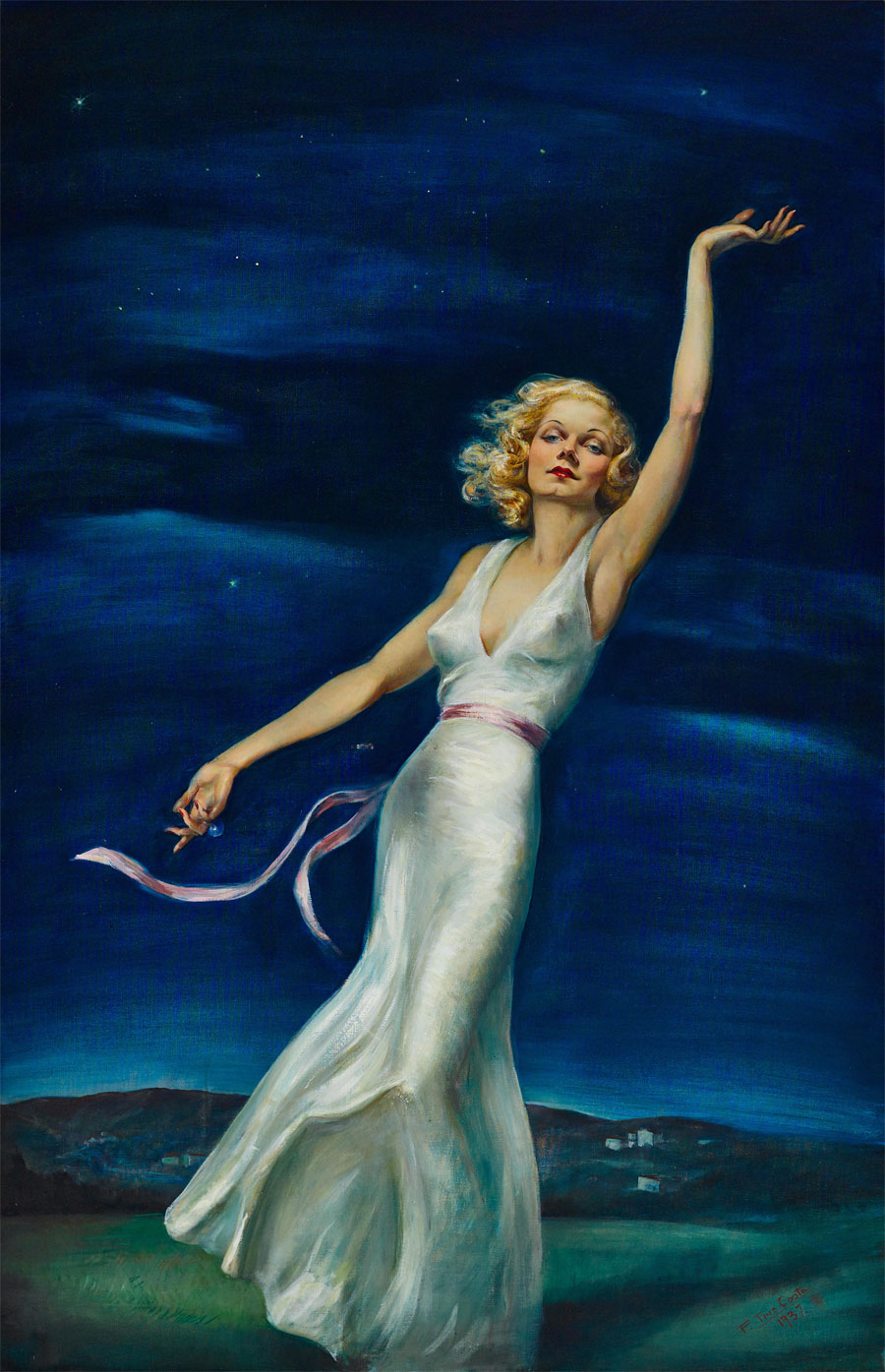
There were so many “wows” to see, especially this 1937 painting by Tino Costa, “Farewell to Earth.” A blog post from 2019 covered a bit of the backstory for this 52" x 80" piece of art.


A detailed view of the painting, which was completed after Harlow’s untimely passing at the tender age of 26.


A better shot of the stunning painting from the 2016 Bonhams auction, unencumbered by display glass and other exhibit items overlapping it:


MGM Prop Department Silver Trophy used in two Jean Harlow films (“Red Headed Woman,” 1932, and “Suzy,” 1936) and the 1952 musical classic, “Singin' in the Rain,” from the Brian Bundy collection.


Jean Harlow Frankart Cigarette Holder, 1930s. This art deco treasure from the Brian Bundy collection almost makes me want to smoke.


Jean Harlow in her Club View Drive sunroom with the Frankart Cigarette Holder in the background, 1932:


If the cigarette holder doesn’t get you puffing, maybe this gigantic Jean Harlow Lucky Strike ad will (Marne Rafter collection)!


A Jean Harlow brocade purse, from the Brian Bundy collection:


Jean Harlow’s Rex rabbit fur sleeves on a replica gown, from the Darrell Rooney collection:


Vine Street Brown Derby Jean Harlow caricature by Vitch, from the Darrell Rooney collection:


The Vine Street Brown Derby in Hollywood where the above caricature was on display:


In 1936, Jean purchased three chiffon silk handkerchiefs in different colors: pale blue, navy blue (below, from the Brian Bundy collection):


…and cream-colored (also from the Brian Bundy collection):


1935 photo of Rose Davies (sister of actress Marion), William Powell, and Jean Harlow at Hearst Castle from the Darrell Rooney collection:


The same area at Hearst Castle when I visited in 2010:


1936 Joseff's of Hollywood simulated diamond and aquamarine brooch worn by Jean Harlow in “Libeled Lady.” Also worn by Lucille Ball in “Two Smart People” (1946).


The numbers for room 826 at the Good Samaritan Hospital, where Harlow checked into on June 6, 1937. These pot metal numbers came from the 8th floor just before the wing was demolished.


From the Darrell Rooney collection comes this April 29, 1932 “Grand Hotel” autographed register from the film’s premiere at Grauman’s Chinese Theatre.


1932 Grand Hotel premiere register autographs, including Harlow and husband, Paul Bern.


A photo from the Robin Smith collection showing Bern and Harlow’s arrival at the premiere, signing the register:


A star-studded 1937 MGM Café signed menu from the Darrell Rooney collection:


An MGM Leo the Lion family paperweight from the May 3, 1937 sales delegate luncheon, from the Marne Rafter collection. This was where “Girl 27: The Patricia Douglas Story” took place.


MGM Executive Sam Katz and Jean Harlow at the May 3, 1937 luncheon:


There are very few color photos of Jean. Here’s a beauty from the Darrell Rooney collection, circa 1937 Jean Harlow, shot by James Doolittle:


Hearth tiles by Davis and MacDonald of Los Angeles, were recovered from the fireplace of Jean’s last home at 512 N. Palm Drive in Beverly Hills, and are part of the Darrell Rooney collection.


Also from the Darrell Rooney collection is this photo of famed illustrator James Montgomery Flagg sketching Jean for a 1936 Photoplay magazine cover:


The sketch itself! For whatever reason, this illustration was never used by the magazine. Glad it still exists!


If you’re excited to go to the Heritage Museum to see these items, unfortunately, the exhibit ended last weekend.


See more Hollywood Heritage Museum photos at my main website.