Showing posts with label ideal toy company. Show all posts

Tuesday, September 15, 2026

Temple Tuesday: Shirley the Tomboy


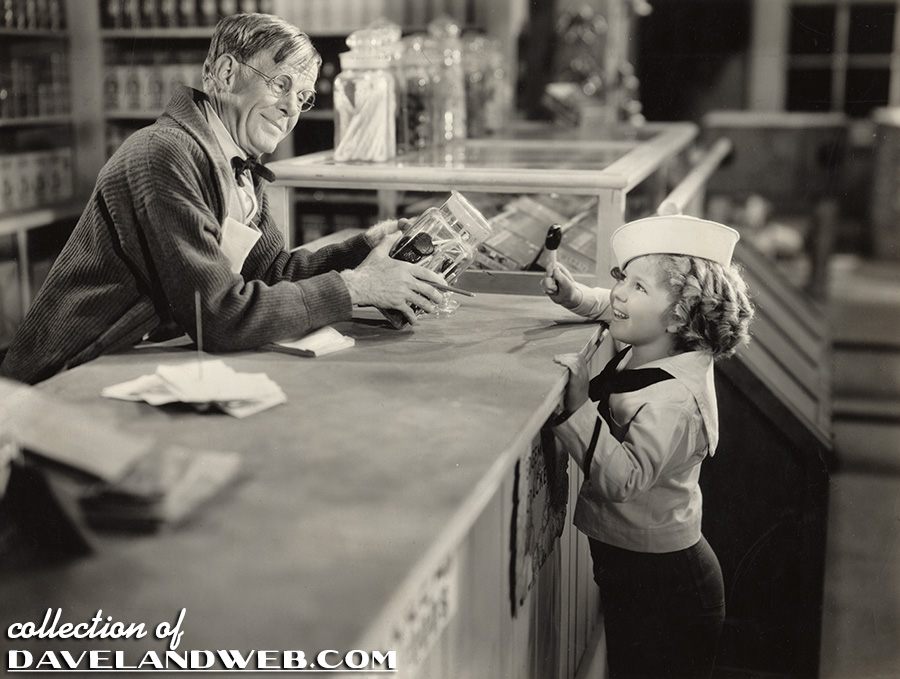
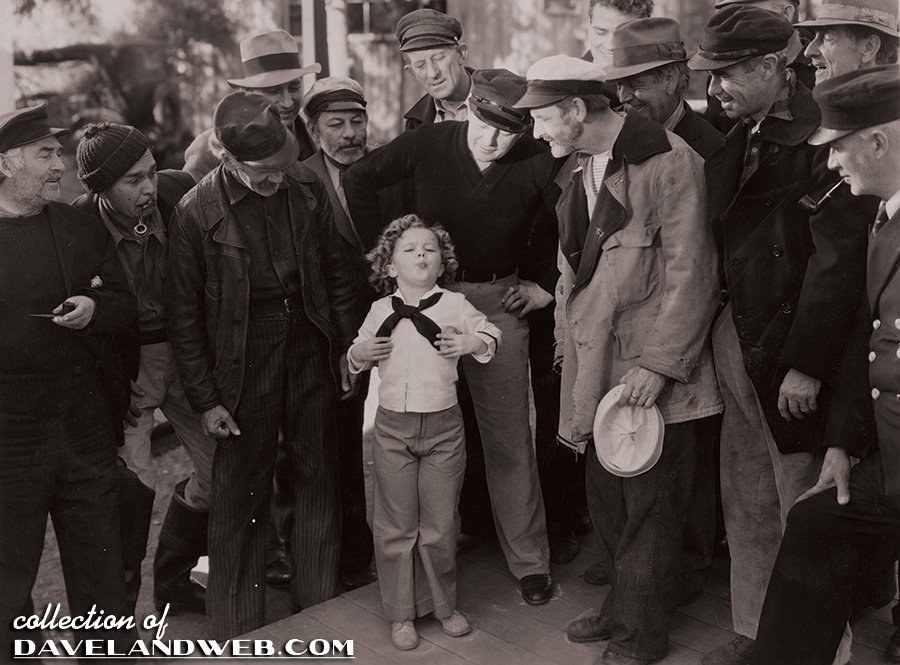
Shirley Temple was the most popular movie star of the 1930s, but that didn’t keep 20th Century-Fox mogul Darryl Zanuck from worrying about retaining those audiences. In order to appeal to little boys,  her innate tomboy characteristics were brought out in “Captain January” (1936). Set at a seaside lighthouse, Shirley gets to wear boyish naval attire through most of the movie, and is even taught how to properly spit!


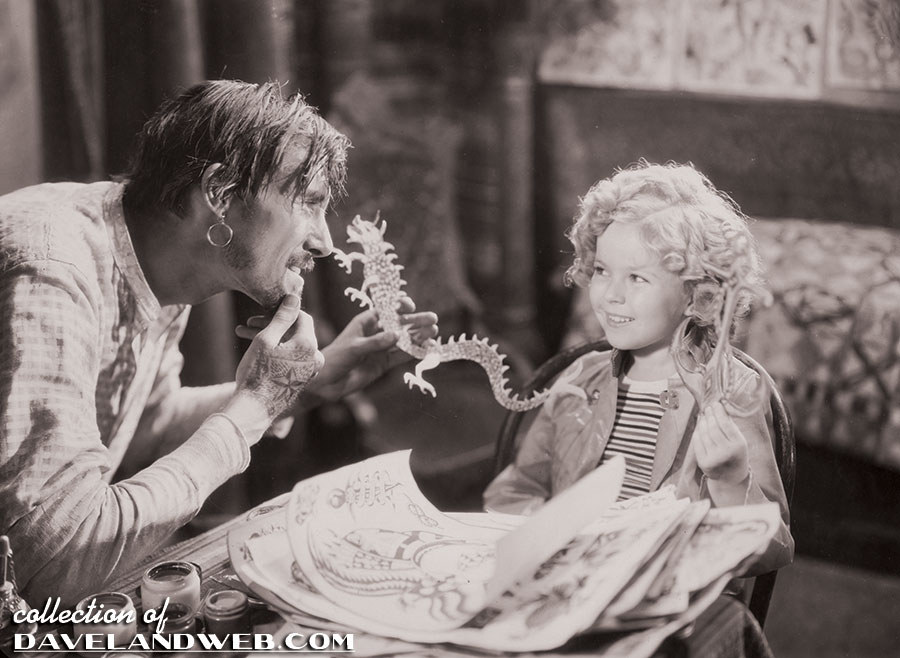
In this still from a deleted scene, Shirley almost gets a tattoo from John Carradine. Spitting is fine, but no tattoos for Shirley!


The dance sequences focused on athletic and daring routines, including a memorable one staged on this spiral staircase. This closeup of Shirley and costar Guy Kibbee is also from a deleted scene:


Shirley later recalled the scene where she learned her multiplication tables while doing a tap dance routine down the lighthouse spiral staircase. From her autobiography Child Star:

Learning my solo tap dance descending a forty-five-foot-high spiral staircase in a lonely lighthouse taught me not only the routine, but also how to multiply. It was all tight steps, like a ballet, a devilishly complicated task. There were three things to do at once: the taps, move down the spiral staircase a step at a time, and synchronize multiplication tables with both taps and movements.

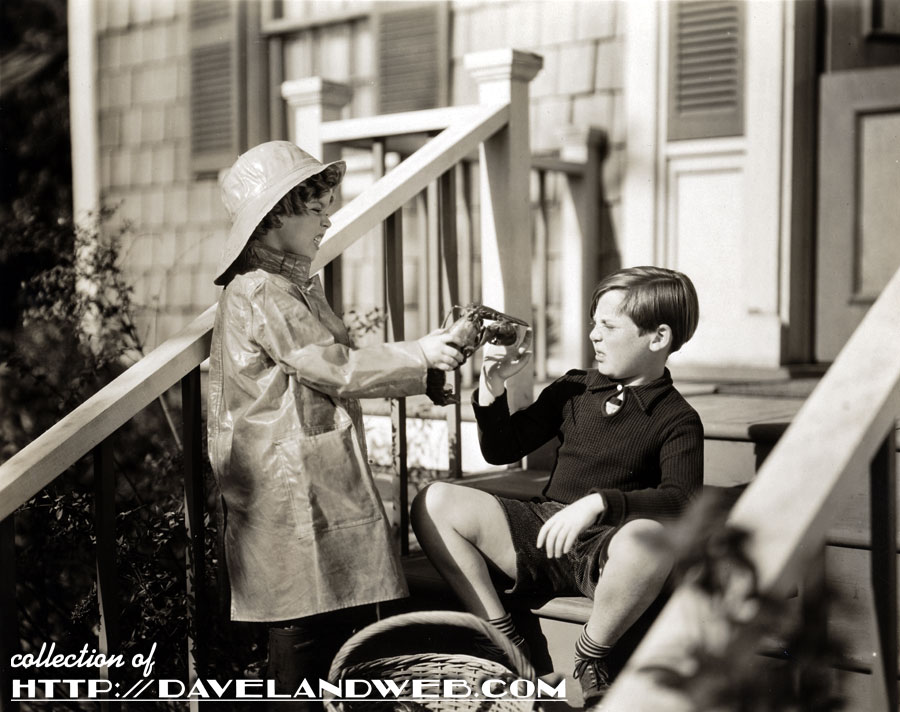
Shirley’s character was still a bit of a helpful Hannah, but thanks to pairing her with a thoroughly unlikeable counterpart, ably played by Jerry Tucker, the audience naturally roots for Shirley! In a deleted sequence, Shirley is shown below with Tucker, selling lobsters. The prissy little brat is obviously appalled!


In one of my favorite scenes, Tucker and Temple’s characters are tested together for their scholastic aptitude. You can see the tension building between the two before the test begins:


Motion Picture magazine reported professional jealousy on Shirley’s part:

Jerry Tucker, ten-year old ‘Captain January’ juvenile, had her attention for almost a day. That was because his line-remembering agility was a slight thorn in Shirley’s side. She learned her two pages of dialogue and leapt into it like a gazelle, not permitting Director David Butler to break it into smaller scenes and thus lessen the tax upon her memory. She’d show that Jerry Tucker (who had done his scene in only two takes) that women had good memories, too!
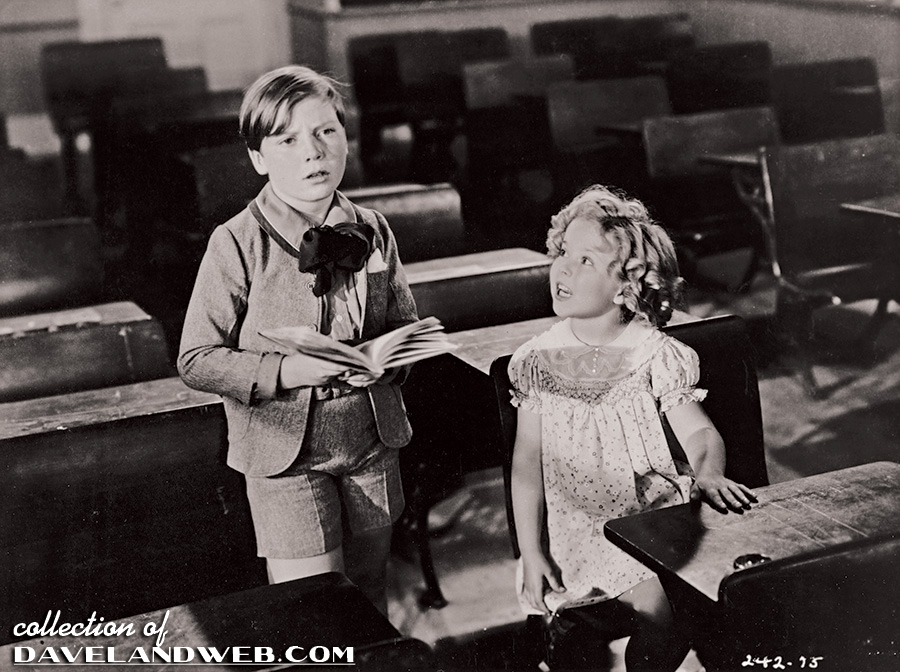


Below, June Lang is at right, playing the part of the pretty schoolteacher:


A detailed view of Tucker and Temple. Tucker was born Jerome Harold Schatz, and garnered his first taste of fame with the “Our Gang” comedies. His movie career ended in 1941, and he went on to serve in the U.S. Navy during World War II and the Korean War. Tucker followed his years of service with a successful career as an RCA electrical engineer, living on to the ripe old age of 91.


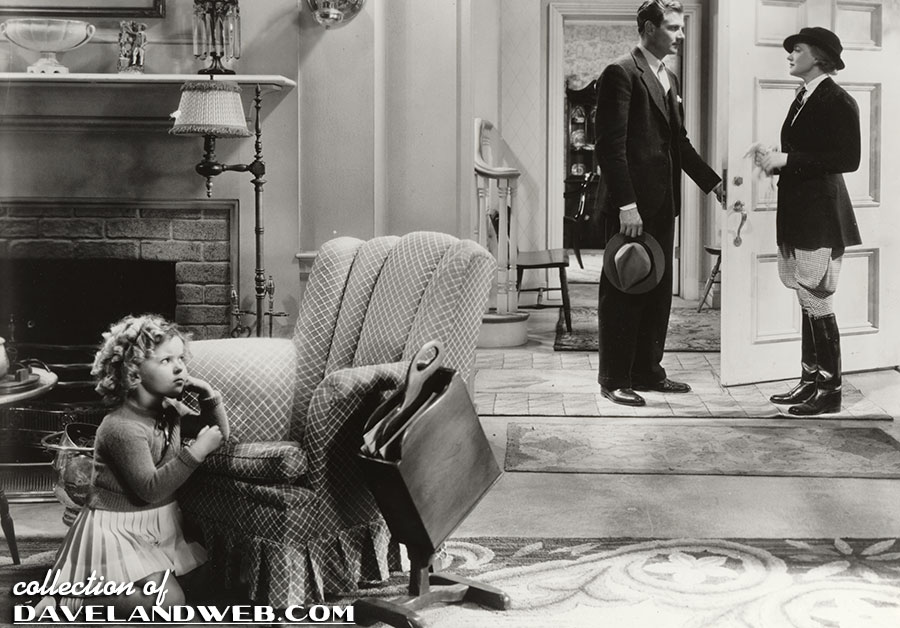
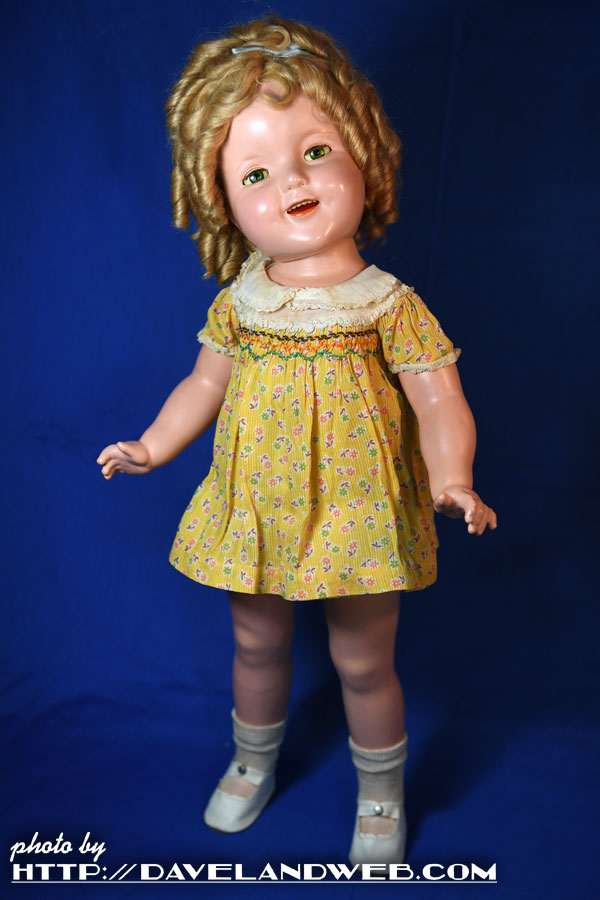
So as to continue the appeal for little girls, Shirley gets a cute little frock for her aptitude test, which was also sold as an outfit for the popular Ideal Toy Company Shirley Temple doll of the 1930s:


The movie also used the “Captain January” sets and costars Slim Summerville and Buddy Ebsen to promote the RCA Victor Magic Brain. Maybe this is what inspired Tucker’s later career?


From the publicity blurb on back:

Slim Summerville and Buddy Ebsen, featured players in 20th Century-Fox “Captain January” starring Shirley Temple, are seen discussing the qualities of the RCA Magic Brain Radio. Summerville and Ebsen are seafaring men in this great picture and they depend upon R.C.A. Victor Radio for their news and entertainment.

Magic Brain…sounds a bit like a pre-cursor to AI!


What a 1936 RCA Victor Magic Brain radio looks like, as seen in this photo from Facebook:


Here’s a view of what the Cunningham Radio Tubes, shown in the window, look like in color, from the Tube World Express website:


In other Shirley news, Shirley Temple expert supreme, Rita Dubas, has just released another thoroughly detailed video with EVERYTHING you could possibly want to know about the famous Shirley Temple soft drink, of which Shirley herself could not stand!


See more Shirley Temple photos at my main website.

Tuesday, July 29, 2025

Temple Tuesday: When I Grow Up


In what can only be called a musical tour de force, Shirley Temple performs “When I Grow Up” in 1935’s “Curly Top.” Ray Henderson, Ted Koehler, Edward Heyman, and Irving Caesar created the song specifically for the little star. Yes…four people collaborated on this number for Shirley! In the film, Elizabeth (Shirley) has been adopted by a wealthy gentleman; as a result of her good fortune, she decides to hold a benefit for her former orphanage.


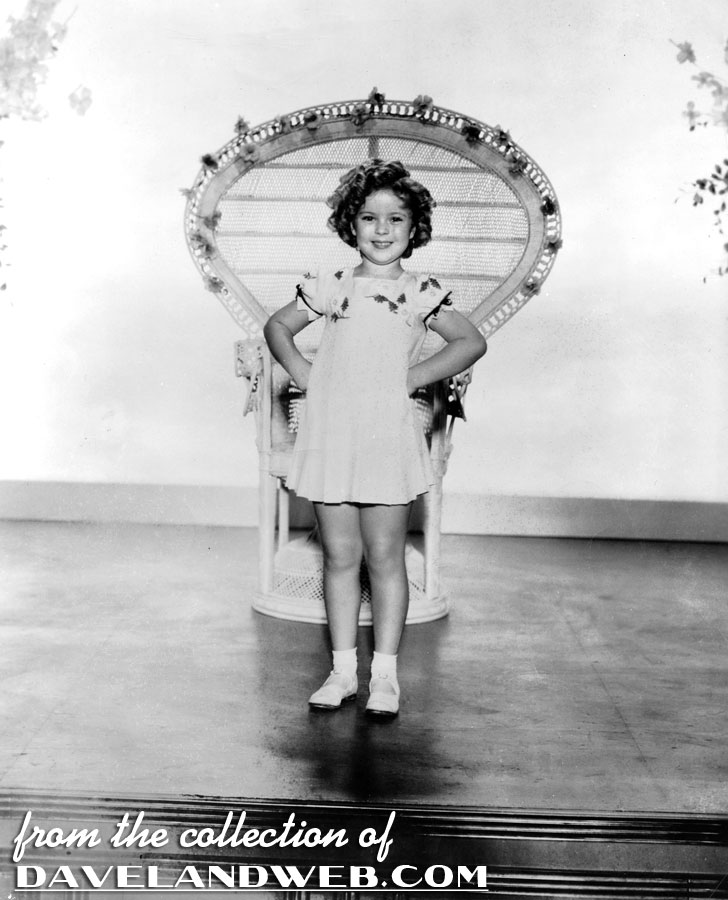
Shirley arrives on stage wearing a yellow dress with daisies, designed by René Hubert. How do I know it was yellow when the film was shot in black and white?


Because it still survives today and is in the hands of a private collector. From the Theriault's auction catalog:

Of delicately textured fine silk in pale daffodil-yellow color, the dress features wide pleats falling from the fitted yoke with V-shaped edging that is repeated on the short puffed sleeves. The dress is trimmed with applique white velvet daisies and leaves. The studio label "4982" is inside the dress.


The dress was also part of a paper doll set from the 1930s printed by the Saalfield Publishing Company.


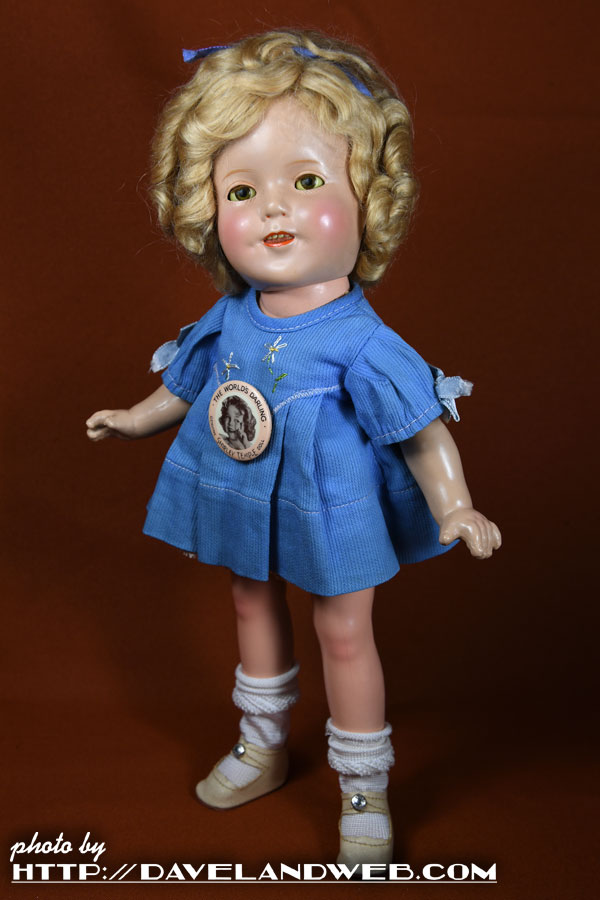
The Ideal Toy Company produced dolls wearing a modified version of the dress in multiple colors. Shirley was a merchandising bonanza during the Great Depression!


The next stage represented by Shirley in this number is Sweet Sixteen. Cute close-ups abound!


I was able to view this dress in person when it was on display at the Santa Monica History museum in 2015, just before it was auctioned off:


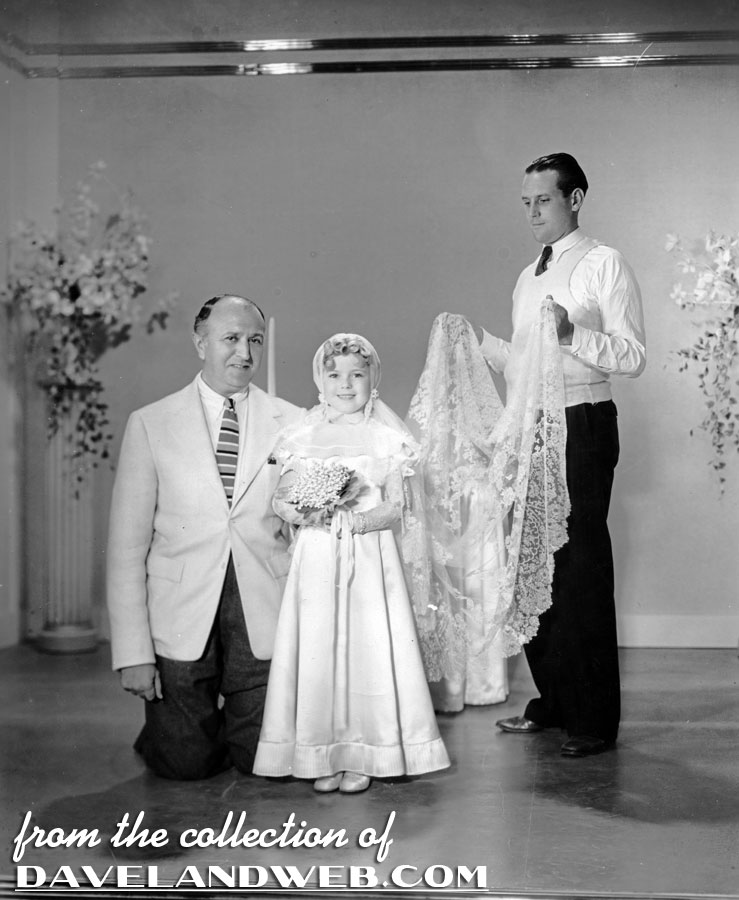
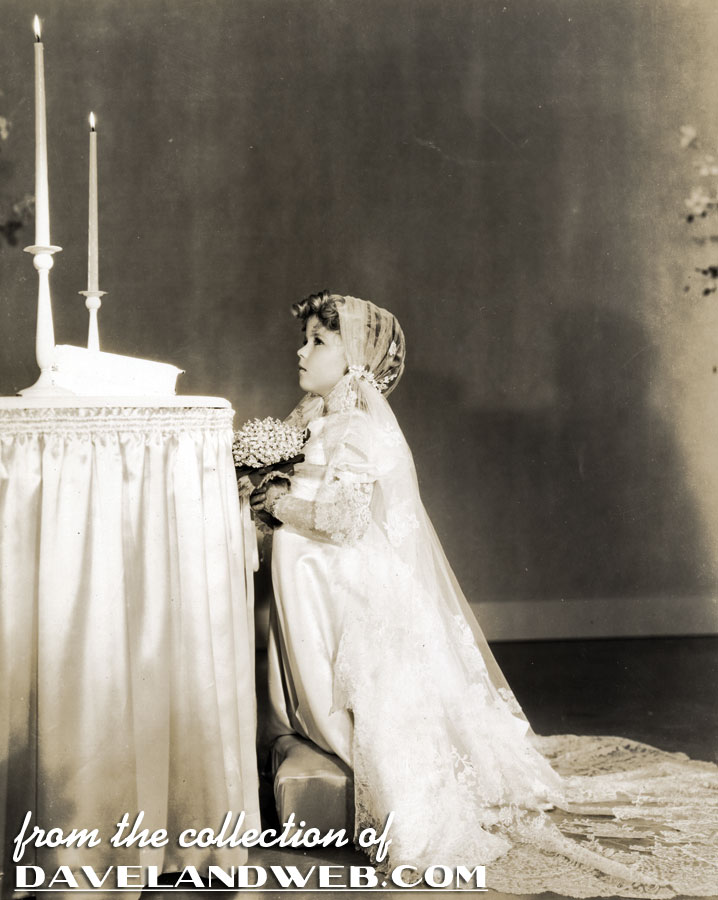
At the tender age of seven, Shirley made a very charming bride! Here she is with director Irving Cummings and some poor sap who had nothing else to do but hold up Shirley’s train!


This outfit also survived and was auctioned off. From Theriault’s:

The ivory satin gown has padded bodice, very wide collar with pleated ruffle at the edge, full short sleeves with pleated edging, flared bias cut full-length skirt with pleated ruffle at the hem. Included is the original wedding veil with elaborate embroidery, designed to fit the head in cap-like manner, and a pair of fingerless lace gloves. The gown and gloves are in excellent condition, the veil is extremely frail. The gown has studio label of "4993".


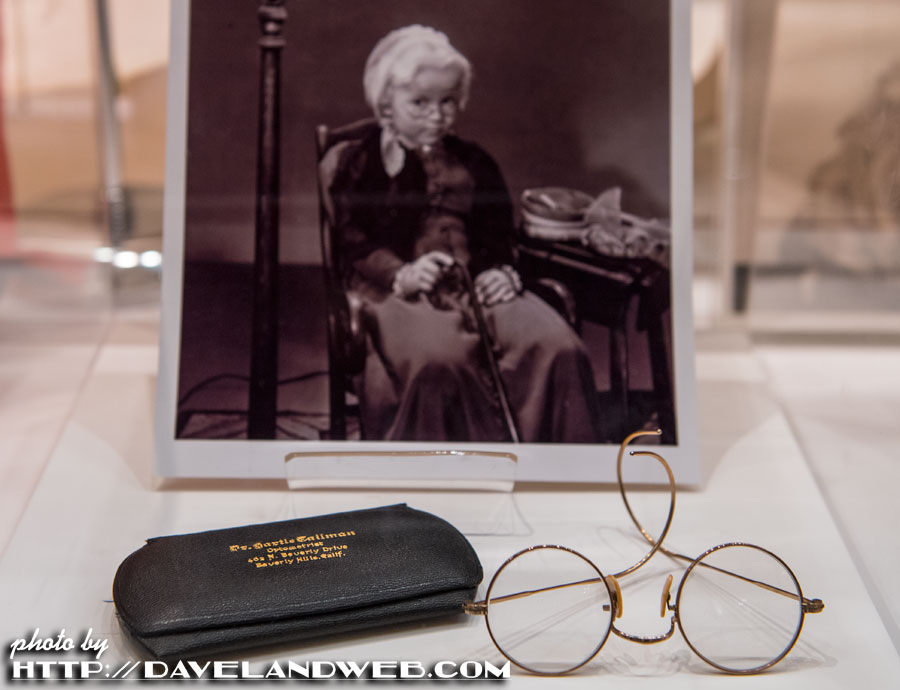
Shirley’s final incarnation is an old grandmother. Her performance in this segment is incredible; the subtle nuances of both her movements and voice show that she had a gift for mimicry.


The makeup crew aged both her forehead and hands, visible in this detailed view:


While the outfit didn’t surface, the spectacles did! From Theriault’s:

The owl-eyed gold rim spectacles are presented in their original black leather case bearing the label of Dr. Bartle Tallman, Optometrist, Beverly Hills, along with a handwritten note "Shirley's specs worn in Curly Top".


Just when you think the number is winding down, Shirley bounces out of the chair, lifts her skirt, and does a lively tap number for the ages, choreographed by Jack Donohue.


Granny exits, and Shirley returns in the daisy dress again, doing more taps WHILE she jumps rope! If it sounds like it’s over the top, well…it completely is, but Shirley manages to pull it off.


Here’s the number in case you haven’t seen it for yourself. Unfortunately, it’s a colorized version!


See more Shirley Temple photos at my main website.

Tuesday, June 03, 2025

Temple Tuesday: Shirley and the Duck Dress


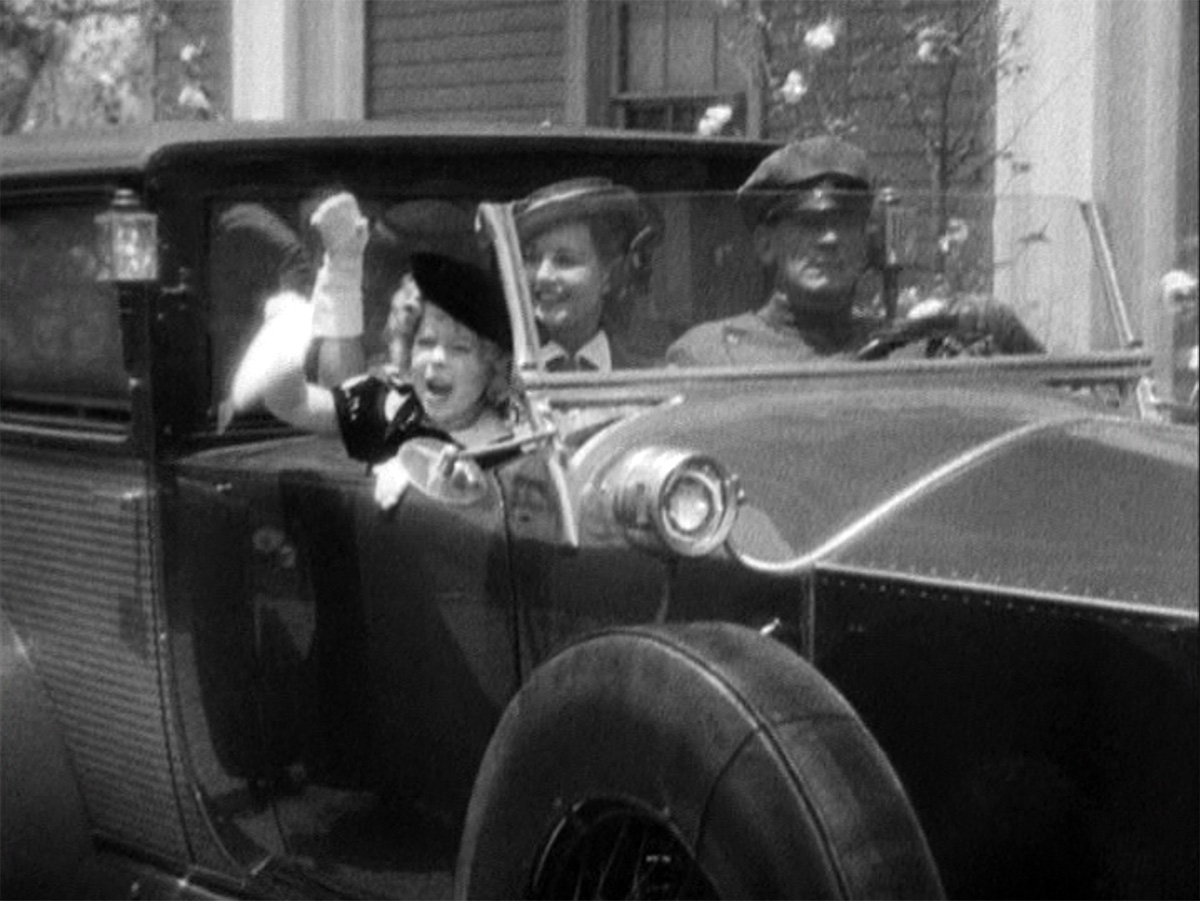
In the 1935 film, “Curly Top,” Shirley Temple has a brief sequence where her character exits the orphanage and is whisked away to a seaside cottage where she will lead a life of luxury with her sister, played by Rochelle Hudson. Costume designer René Hubert created the outfit known as “The Duck Dress” (because of the embroidery detail on the velvet bolero top) for Shirley and the chic outfit that Hudson models. As with anything Shirley did, photographers were on the spot to capture every detail. In the shot below, according to the blurb that accompanied it…

Shirley Temple and her pet pony, “Spunk,” are shown in an affectionate pose. Shirley is being starred in the Winfield Sheehan production, “Curly Top,” at Fox Film studio.


In the film, she refers to the pony as “Spunky.”


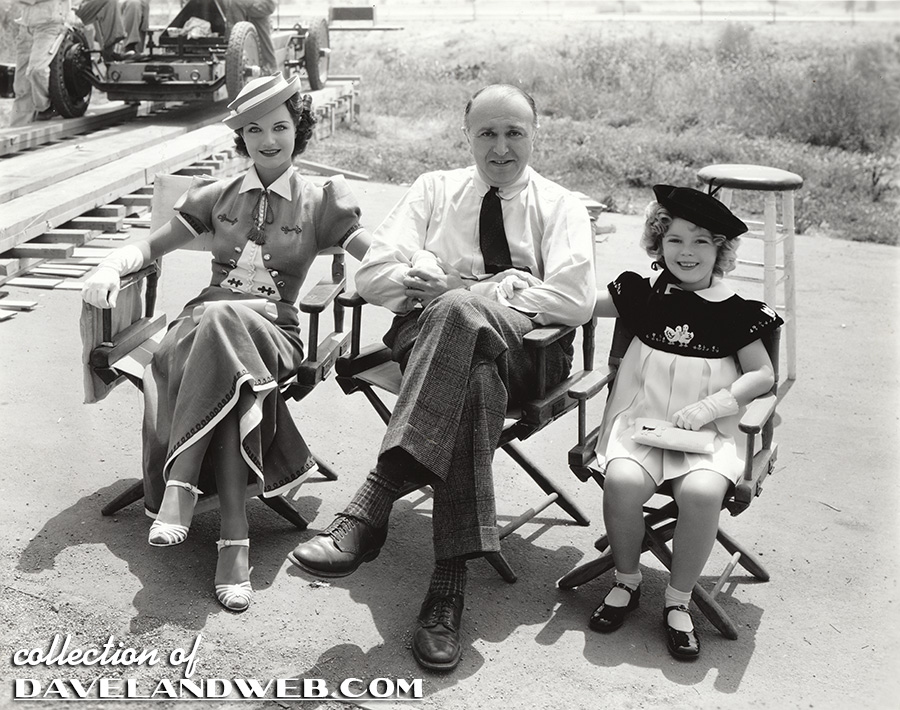
In between takes, Shirley and Hudson take a breather with director Irving Cummings. Note the track for a dolly shot at left, and the shot as it appears in the final film (below). The orphanage they are leaving was located on the backlot at Fox.


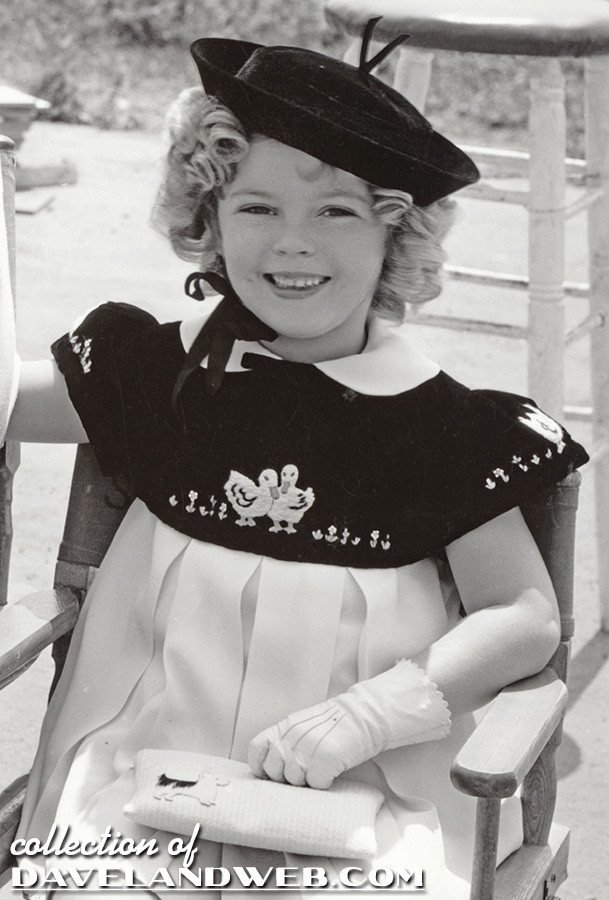
Zooming in, we can see all the details of Shirley’s adorable outfit, including the purse that appears to be made out of corduroy with a felt and fur Scottie dog attached.


The highlight of the sequence is when Shirley arrives at the cottage, she sashays up to the front door with her hand on her hip, demonstrating that she is now part of high society!


The outfit came up for auction, but the only original part that survived was the velvet bolero top. The skirt belonged to Shirley, but the pleating is different from the one used in the film. The tam hat and purse do not appear to have survived.


From the Theriault’s Catalog:

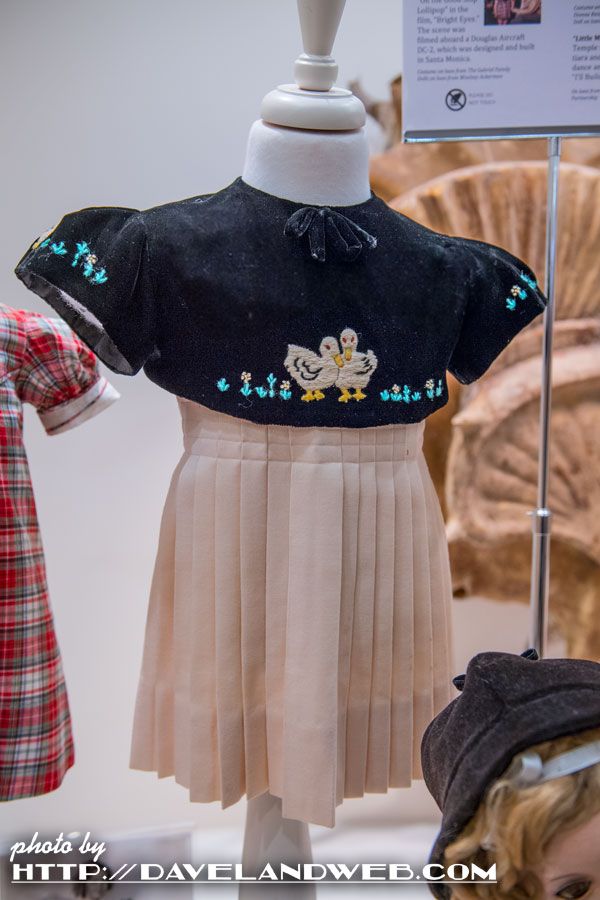
A short black velvet bolero top is embroidered with yellow ducklings on the bodice and sleeves, with a border of green leaves and flowers, and has a black silk lining. The bolero is worn over a sleeveless dress with pleated skirt. The bolero has studio tag 5943 and the dress has studio tag 4759. The costume was worn by Shirley Temple in the 1935 film "Curly Top" upon leaving the orphanage and arriving at her new home. In various studio promotional photographs of the film, the under-dress appears to have a collar and different pleats, suggesting that this dress was likely an alternate.


In fact, the dress was one used in “Our Little Girl” (1935, pictured above) which also had costumes designed by René Hubert. A detail of the embroidered ducks:


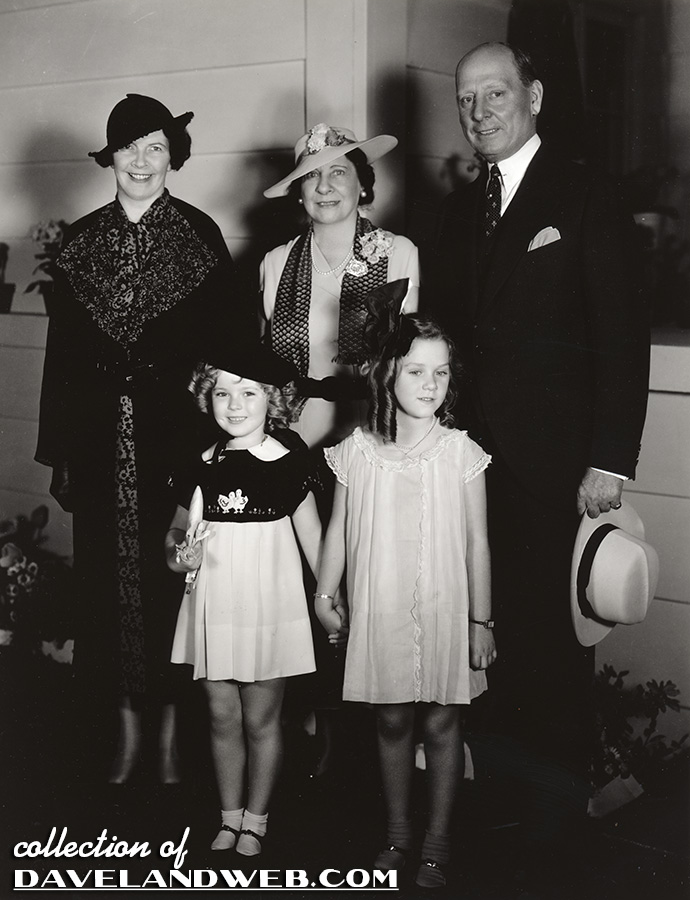
Shirley typically had visitors to the sets of her film. For any dignitaries visiting Hollywood, Shirley was at the top of the “must see” list. From the caption:

Mayor Frank Hague, of Jersey City, N.J., and prominent in Democratic party councils, with Mrs. Hague and Peggy Ann Hague visit with Shirley Temple and Mrs. Temple at Fox Film Movietone City, where “Curly Top,” Shirley’s latest picture, is now in production.


Hague supported F.D.R., who in turn not only supported the Mayor, but helped keep him out of scandal for many years. It was amazing at his lowly salary how he was able to amass quite a bit of wealth during his political career! At his funeral, one lady held a sign that read, “God have mercy on his sinful, greedy soul.” From his January 1956 obituary:

The blustery master-politician, whose temper often was as quick as his speech was ungrammatical, was called by his intimates an efficient executive and a friend of the poor. Some referred to him as a benevolent despot. But others termed him a “machine boss,” an “absolute monarch,” and a dictator.…During his reign, Boss Hague did a lot for the 300,000-population city at New York’s back door. He gave the poor a magnificent medical center and modernized the police and fire departments. He also gave them the highest tax rate in the nation and made a fortune for himself.…Trouble followed him…into his big mansion on his estate at Deal and his place at Miami Beach. Twin final blows were a $15,000,000 suit to make him repay alleged kickbacks from city employees and the death of his nephew and heir-apparent, Frank Hague Eggers, both in 1954.

Back to Shirley, with this color image of her in the duck outfit:


Shirley has a quick chat with beloved humorist Will Rogers, also working on the Fox lot:


Another close-up of Shirley’s purse:


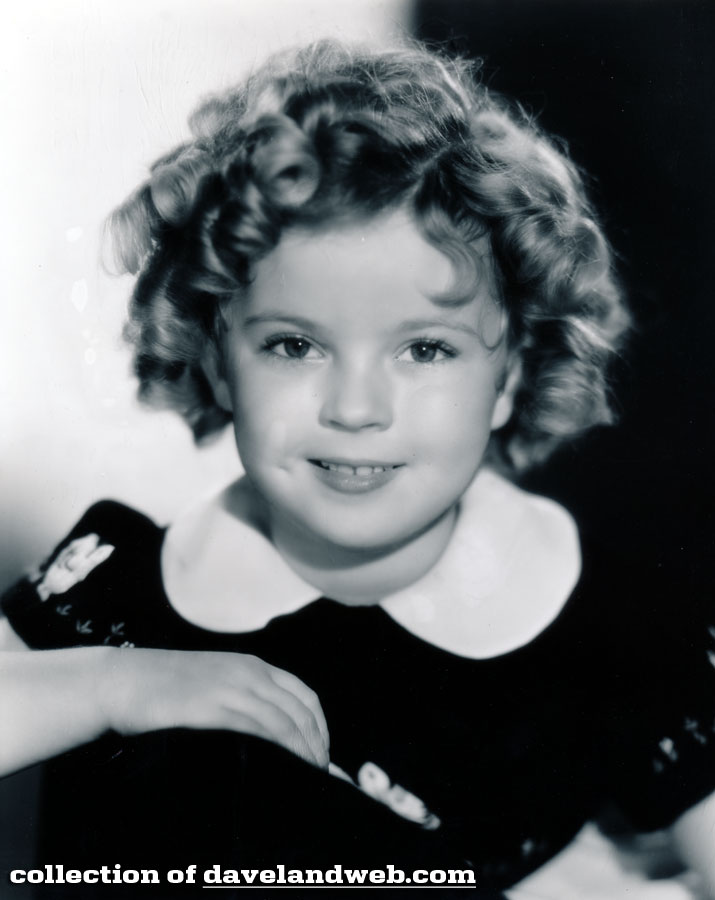
A publicity shot of Shirley in the duck dress, sans hat:


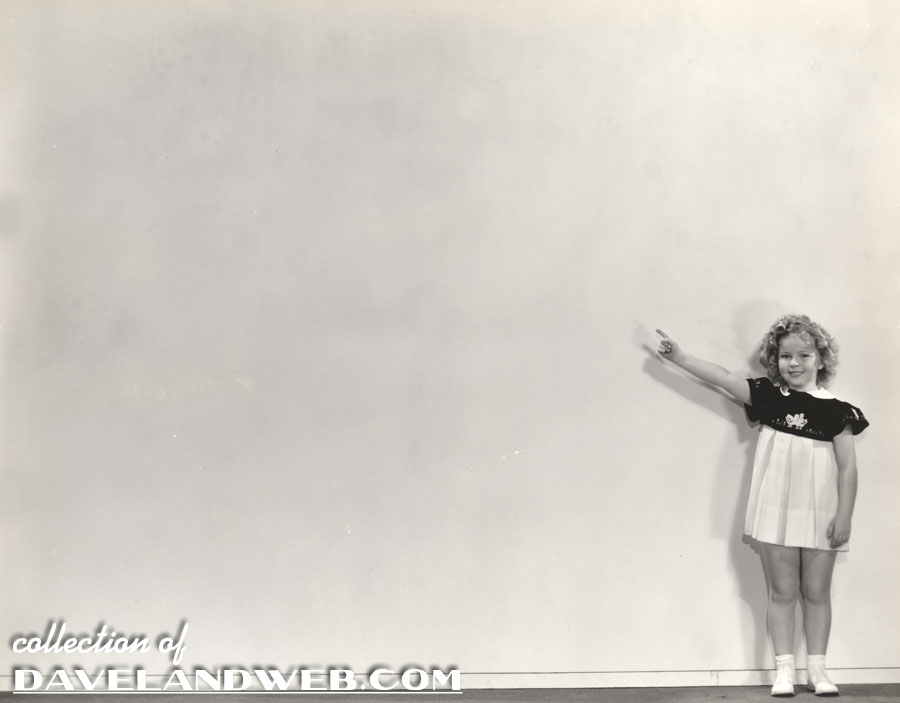
This image served many purposes; anything could be added to the blank wall behind her:


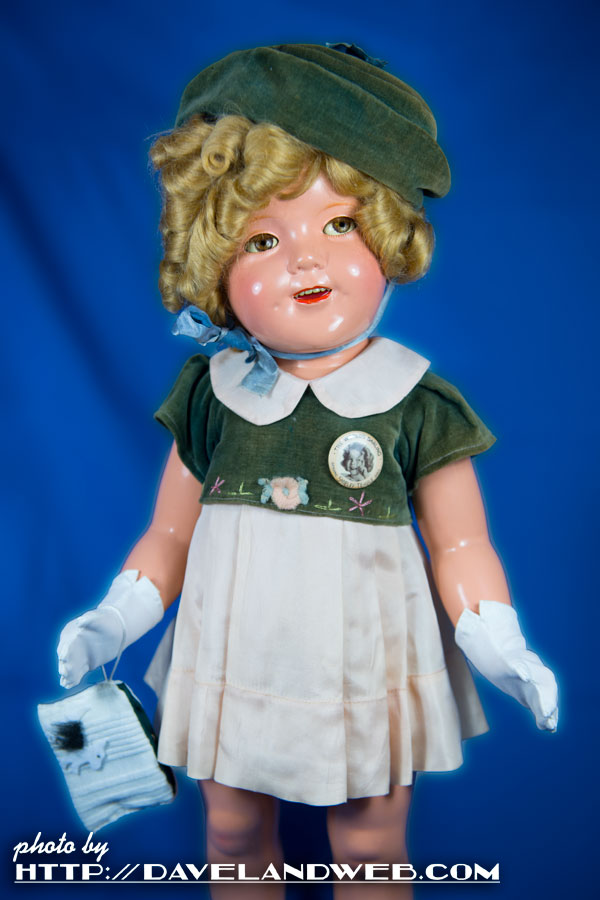
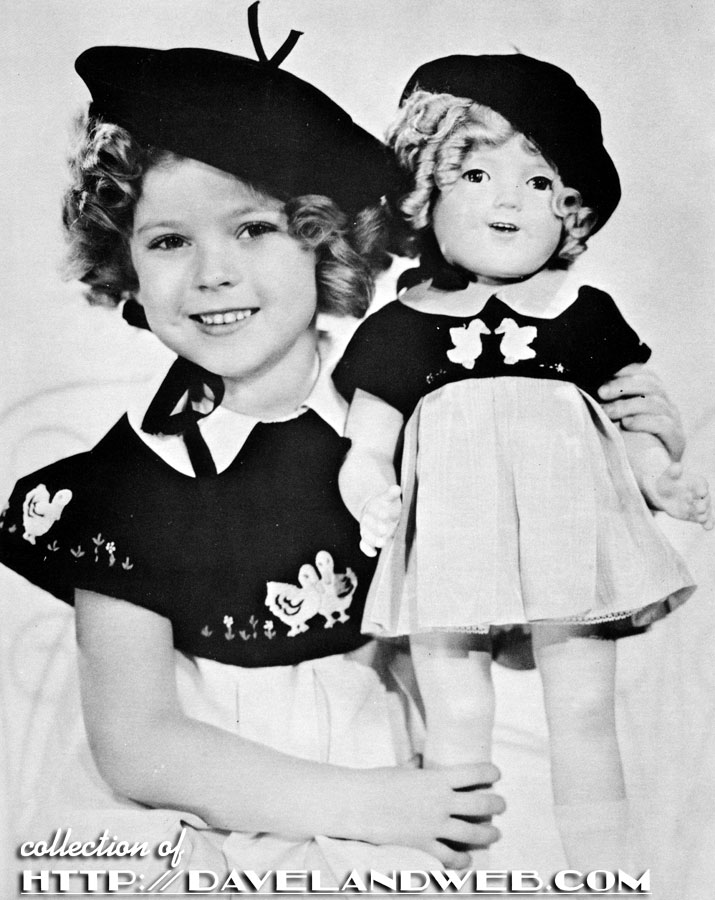
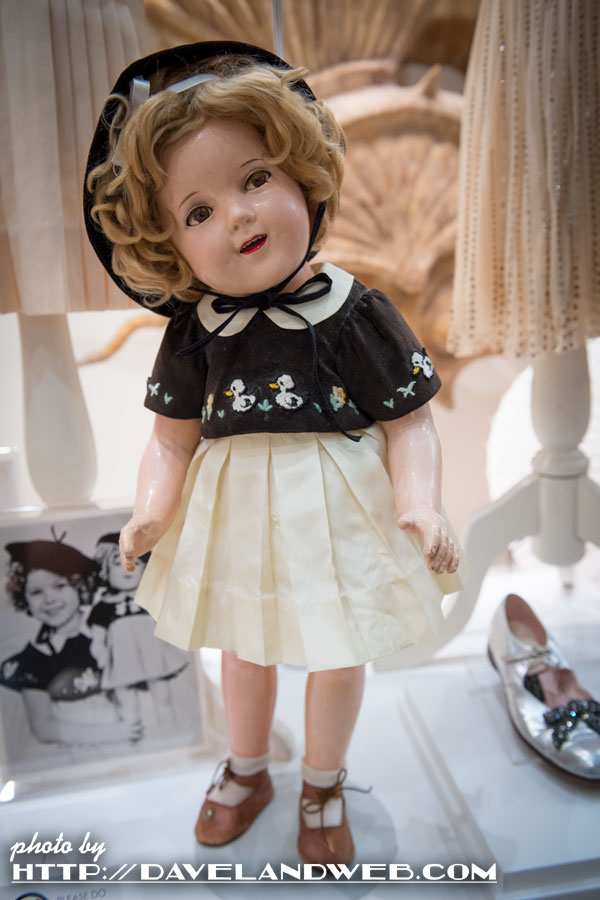
Ideal produced a composition doll wearing a matching outfit; here Shirley poses with a 27" high version:


The designs on the bolero for the dolls varied, as seen here:


Some of them had flowers instead of ducks (the purse and gloves were additions; the rest is all original):


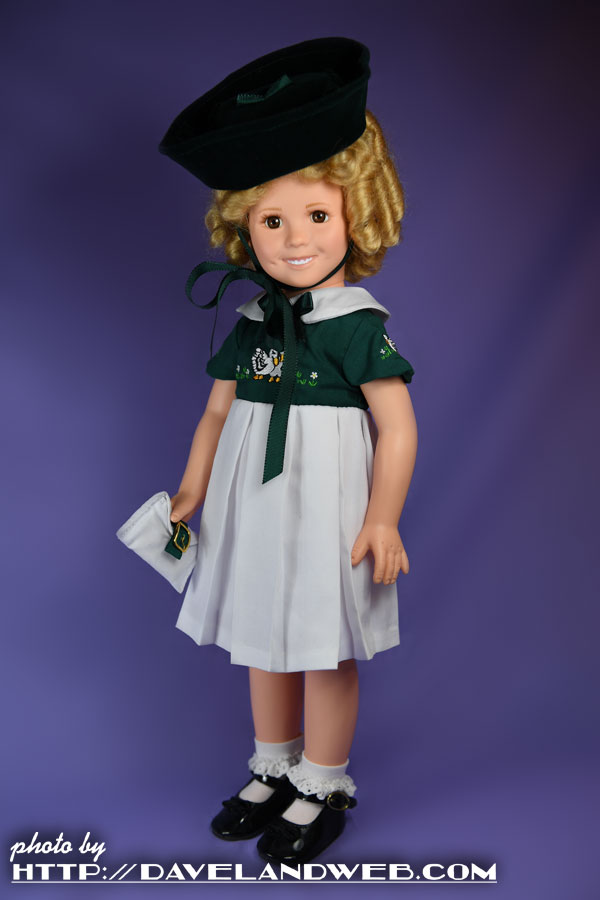
The Danbury Mint put out its own version for a vinyl doll:


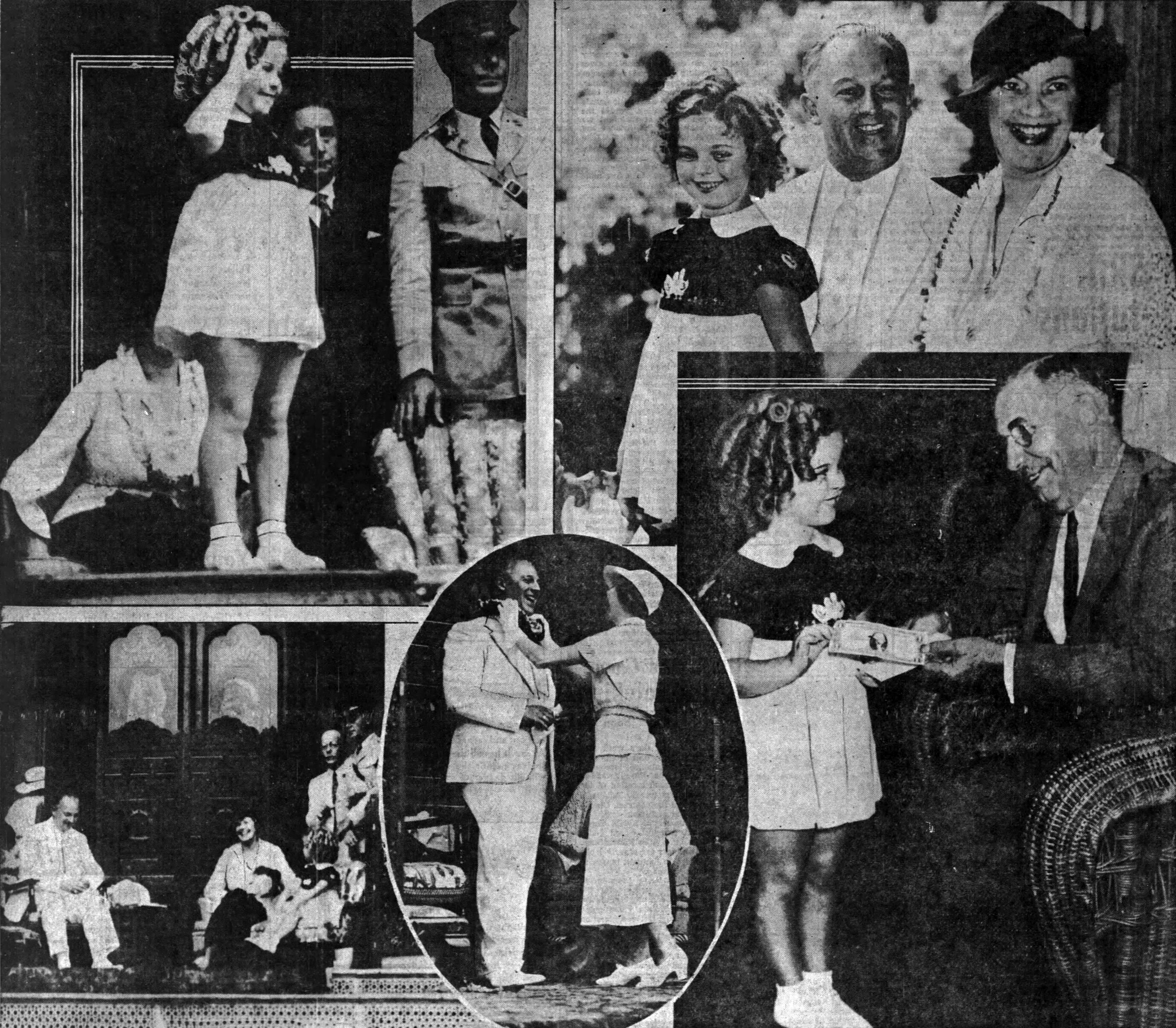
It would appear that Shirley (or at least her parents) truly liked this outfit, as she wore it in public on her first visit to Hawaii in 1935, specifically at the Royal Iolani Palace on Saturday, August 10. Below, she sings “On The Good Ship Lollipop” to her throng of fans, which numbered more than 15,000! The dress she wore here matched the one in “Curly Top;” it had not been paired up with the “Our Little Girl” skirt just yet.


In the montage below, you can see middle left, Shirley makes her first salute to the throng. At right she is shown with her parents, Mr. and Mrs. George Temple. Bottom left, a view of mauka steps of the palace where Shirley held “court.” Center, Miss Helen Poindexter places a lei on Shirley’s father while at lower right Shirley is shown selling a ticket to Governor Poindexter, after her public appearance, for the army benefit ball game for war veterans.


By May 1945, the bolero had been mismatched with the “Our Little Girl” dress, as seen in this LIFE magazine photo when Shirley was sorting through her collection to see what she was going to give away for a clothing drive.


And that’s it today for the duck dress!

See more Shirley Temple “Curly Top” photos at my main website.