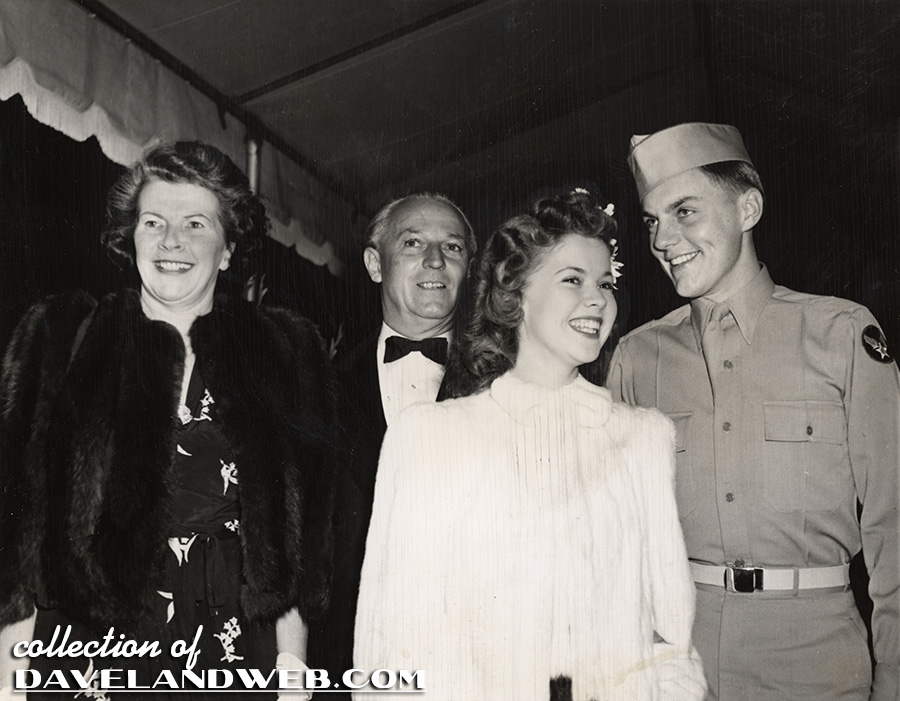
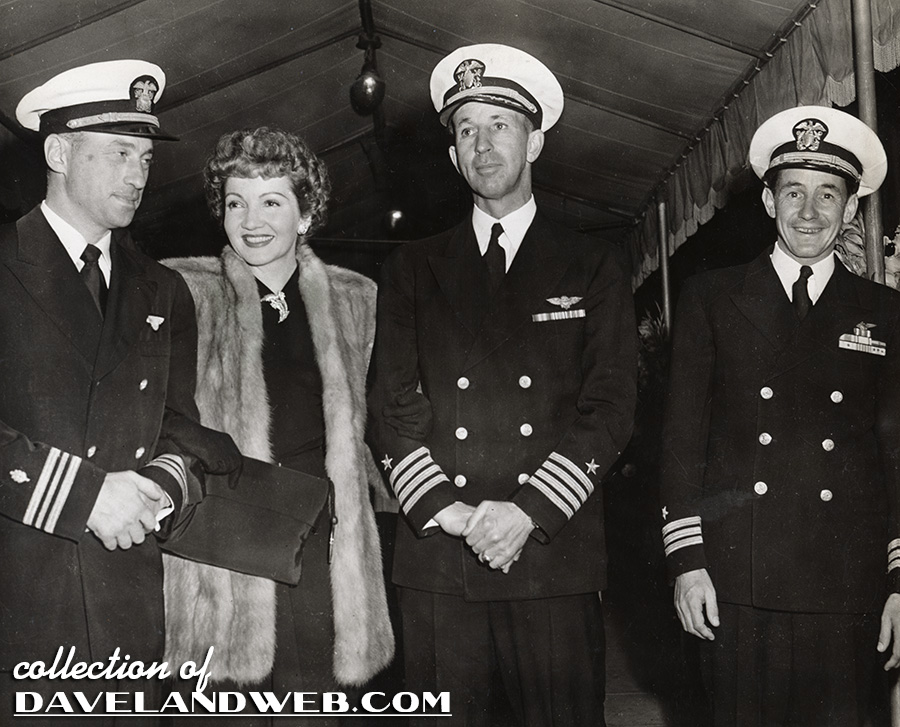
“Since You Went Away” (1944) was David Selznick’s blockbuster follow-up to “Gone with the Wind.” Clocking in at nearly three hours, it is a beautiful portrait of how one family (all women) survived at home with the father away at war. For Shirley Temple, it was the film that put her back on the Hollywood radar after a string of disappointing vehicles. Above, parents Gertrude and George Temple, Shirley, and Private Andy Hotchkiss (Shirley’s date) attend the “Since You Went Away” premiere, July 18, 1944. It was held at the Fox Carthay Circle Theatre. Below, the star of the film, Claudette Colbert, arrives at the premiere, surrounded by Lt. Commander Joel Pressman (Colbert’s husband at the time), Captain Don Wilcox, and Commander Michael Sanchezat.
Just for reference, here’s a previously posted shot of the Fox Carthay Circle Theatre, circa 1947:

Selznick kept Shirley (and her parents) busy with the release of the film. The three traveled to Dayton, Ohio, to attend the Midwest premiere of the film. Why Dayton? Trust me, I wondered that as well! From the Journal Herald Dayton, September 14, 1944:
We of Dayton know that the original story was written by erstwhile Daytonian, Margaret Buell Wilder, and appeared first in the pages of The Herald. We also know that the roles portrayed by Claudette Colbert, Shirley Temple and Jennifer Jones were in real life those of Mrs. Wilder and her own two daughters.
Dayton was all abuzz about Shirley’s arrival, as the local press reported:
Manager Bill Reisinger [for the Dayton midwest premiere theatre, Loew’s]
and Bob Goodfrie, United Artists representative here in the interests of the picture, are so excited over the news that it is pretty hard to pin them down on basic facts in regards to the visit of the biggest movie star Dayton has ever entertained. Of course, much has yet to be arranged but from what is known now, it is likely Miss Temple will arrive from New York during the morning [September 13, 1944]
, be met by representative citizens and the press, escorted through the city to her hotel. Later in the day she will hold a tea—not a cocktail hour, for Shirley is just new at the sweet sixteen stage—for the press.The press photo below was snapped of Shirley as she traveled from Columbus, Ohio to Dayton on the “American.” She visited with Sailor Carl Johnson and Captain John Harrison and the three signed their “short-snorters.”

Want to know what a “short-snorter” is? From
Wikipedia:
A banknote inscribed by people traveling together on an aircraft, a tradition started by Alaskan bush flyers in the 1920s and spread through the military and commercial aviation. During World War II, short snorters were signed by flight crews and conveyed good luck to soldiers crossing the Atlantic. Friends would take the local currency and sign each other’s bills creating a “keepsake of your buddy’s signatures.”Here’s a sample of some WWII short snorters:

Another shot (from San Francisco) shows Shirley signing some short snorters. From the accompanying caption:
Shirley Temple, star of “Since You Went Away” and “I’ll Be Seeing You,” autographs a long Short Snorter Bill belonging to Bernard Abramson. Abramson is a Pharmacist Mate First Class who was shot down in the Caroline Islands near Truk. Shirley autographed literally thousands of these bills for the boys at the San Francisco Stage Door Canteen, on a recent trip to visit the hospitals in that area.

A closeup of the bills:

Back to Dayton! From the Dayton Herald, Wednesday, September 13, 1944:
 SHIRLEY TEMPLE, lovely Hollywood star, won over everybody within sight when she arrived in Dayton this morning to appear in person at the premiere of “Since You Went Away” at Loew’s tonight, in which she is one of seven stars. Here she is, shown on arrival at the Union Station, with Mayor Frank Krebs (left) handing her “the key to our city and our hearts,” while Mrs. Krebs, at the right, is handing her a bouquet of roses “from the womanhood and young people of Dayton.” Immediately back of Shirley is her father, George Temple, and at left, her mother. Broadcasting back of Mayor Krebs is Martin Starr, Hollywood commentator and head of United Artists radio department.
A few vintage shots and postcards of Dayton’s Union Station, which first opened in 1900, and included a seven-story clock tower, visible in the below photo:


Back to Shirley and her 1944 Dayton trip. From the local headlines:
Star Captures Dayton’s Heart
Shirley Temple Arrives For Tonight’s Premiere
Youth at its most captivating stage, sweet 16, made an overwhelming conquest at noon today when Shirley Temple arrived in Dayton to spend a couple of hectic days filling local engagements. Several thousand persons, mainly teen-age girls and feminine adults, but a considerable number of men as well, crowded the interior of the Union Station and swarmed around the entrances as Shirley, accompanied by her parents, Mr. and Mrs. George Temple, made their way from the train to the cars waiting to parade them through the city to the Van Cleve hotel [shown below]
.

“Isn’t she sweet” went up from the crowd as Shirley, smiling bewitchingly all the time she was jostled about, made her way through a narrow path cleared by the police. Everyone, it appeared, was struck by the manner in which she had traversed the years when she played child roles on the screen to her present status and did not hesitate to give audible expression to their sentiments. On the train from New York she was the idol of a carload of soldiers.…Despite “advancing” years, Miss Temple has held her admirers and there are claims in some quarters that she is the No. 1 pin-up girl of the armed forces of the U.S.A., including soldiers, sailors and marines. As Brig Hilton in “Since You Went Away,” Shirley plays her first role for Selznick, who, we are told, regards her as his most precious movie property.Shirley poses with her mother and father below as they arrive at the hotel. Shirley is mustering a smile, but she does appear a bit weary after greeting the throngs of fans.

And if you want to see what made her weary, just look at her itinerary for one day! Local ads announced Shirley’s appearance to help sell War Bonds at Rike’s Department Store, one of the many locations the young teen visited that day:

The trio of shots below give a small representation of all that Shirley did in Dayton when she arrived. Shirley sang “Roll Out the Barrel” with the ATSC quartet at Patterson Field (below left). Apparently, all singing on Shirley’s trip was forbidden by Selznick, who preferred that she not become typed. He wanted to build her into an all-round actress. Mrs. Temple told reporters that Shirley might do another musical in a few years. This never happened. At Patterson Field hospital, Shirley spread a little cheer for Sgt. Francis W. Robechard, while surrounded by Nurses Aides Mrs. L.F. Baker and Mrs. Florence Bombard (below center).Dayton Journal reporter Kay Kunka interviewed Shirley Temple at a tea for members of the press at the Van Cleve hotel and found Shirley “sweet and sixteen, gracious and unassuming” (below right).

As Kunka reported:
…since her arrival at the Union station during the noon hour, she had been greeted by Mayor Krebs, whisked away to be paraded through the city, spent her lunch time at Patterson Field, and attended a press tea t the Van Cleve hotel at 4:30pm. Critics from Cleveland, Toledo and Cincinnati, as well as representatives of Dayton papers, pressed the young lady with questions of all kinds, which she answered with a frank and unassuming graciousness. She seemed prouder of the adventures of her two brothers in the service than of her own successes, but was enthusiastic over he new part in “Kiss and Tell.”Another reporter, W. Ward Marsh of The Plain Dealer, added this to Shirley’s comments about her brother:
She pointed to her two brothers. “Little fellows,” she describes these two strapping men well over six feet, and she wonders why women can’t do as much as men are doing in these war days. Her older brother, George, is a marine sergeant in the Mojave right now, but he was a tail gunner in the South Seas and was in service at Pearl Harbor during the sneak attack. Her younger brother, Jack, is in Culver City now, taking a military intelligence course. Shirley deprecates her efforts at entertaining—not only in hospitals here but in California and her own camp tours—and all the other things she does which make her contributions to the war effort far, far greater than she knows.Local papers showed Shirley primping for the premiere in her hotel room. The caption:
TYPICAL of all young girls, Shirley puts finishing touches on her golden-red (natural) hair, which she wears at shoulder length.

Her arrival at the premiere had this caption:
REWARD FOR THE THOUSANDS who impatiently awaited Shirley Temple’s arrival at Lowe’s theater. last night was her introduction from a rostrum before the theater by Martin Starr of United Artists.
The lovely gown Shirley wore underneath her fur coat can be seen in the promotional photo below. Selznick got his use out of the dress by having Shirley also wear it in his next film, “I’ll Be Seeing You,” another wartime drama.

Here are two previously posted shots showing Shirley in her fur coat and an orchid in her hair as she arrives at the Wednesday, September 13, 1944 Dayton premiere held at the Loew’s theater at 8:30pm:

Local reporter Kay Kunka breathlessly wrote about the premiere the next day in the papers:
Inside the theater, Martin Starr, head of the United Artists radio department, introduced Miss Temple to a capacity audience of 2,200 persons.…[Shirley] turned to greet the expectant audience. Citing the need for nurses’ aides in the country’s hospitals, she appealed for more volunteers. “I hope you brought your handkerchiefs,” she concluded, “for this is a very sad picture. And watch for the little bulldog—he steals the show.” The repeated demands of a throng of teen-agers drew her to the upper lobby for a brief greeting.
And that wasn’t it for Shirley, the next day was just as busy, as Kunka continued with her feature:
Today will also be a busy day for Shirley, for she has a date at 11 a.m. at the hospital in the Veterans Administration Facility; at 6:15 p.m. she will take part in the dramatic presentation covering the nurses’ aide work for the Red Cross over WHIO; Club Co-ed will hold a special party for her at 8 p.m., and at 8 p.m. she will attend the enlisted men’s dance at Wright Field. Her few spare moments have been spent autographing war bond purchases at downtown stores.Shirley and her parents departed Dayton on the morning of September 15, 1944, leaving for Chicago first on their way back to Hollywood, where Shirley would begin her senior year studies at Westlake High School the following week.
As a footnote: a portion of Dayton’s Union train station was demolished in 1964, with the rest getting removed in 1989; Rike’s Department Store was imploded in 1999; and the Hotel Van Cleve was town down in June 1969 to make way for a parking lot. Joni Mitchell would not be happy.
Thanks to Melissa (aka “The Colonel”) for digging up all the vintage newspaper clippings!
See more Shirley Temple photos at my
main website.


