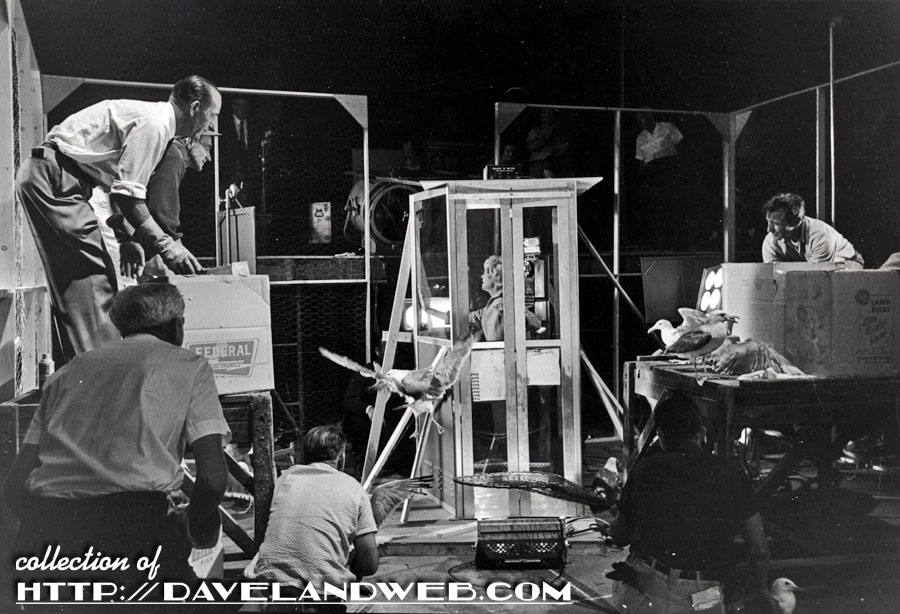
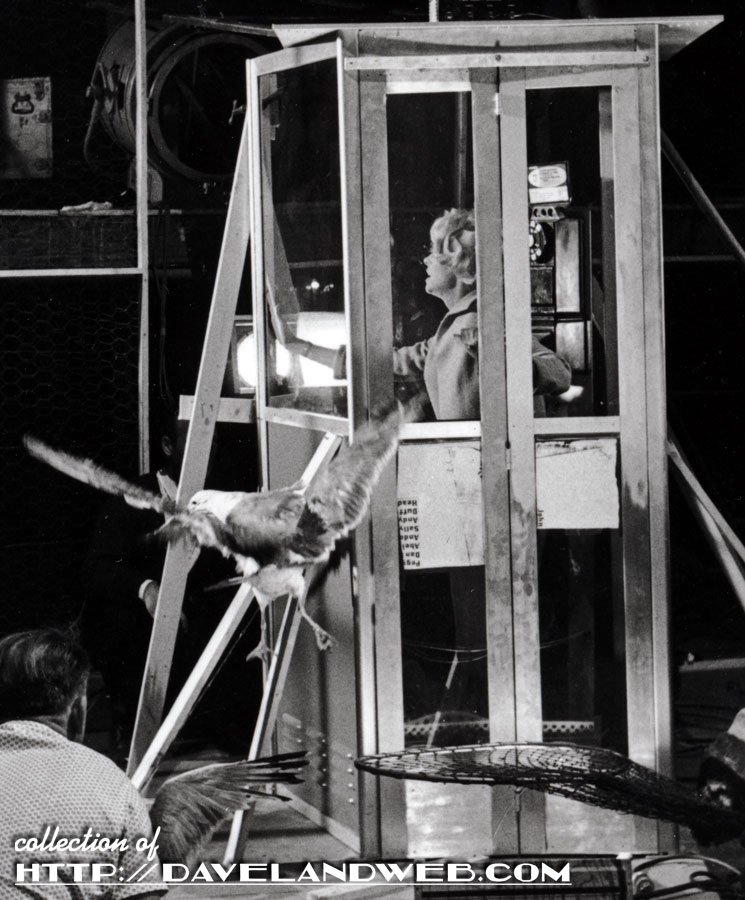
Today's image shows a rare behind-the-scenes shot from the 1963 Alfred Hitchcock movie, "The Birds." Tippi Hedren is seen in the prop phone booth, getting ready to shoot one of the more harrowing scenes from the film. In the detailed view, you can see that yes, they really were throwing "live" birds at Tippi. Hollywood is not always so glamorous!
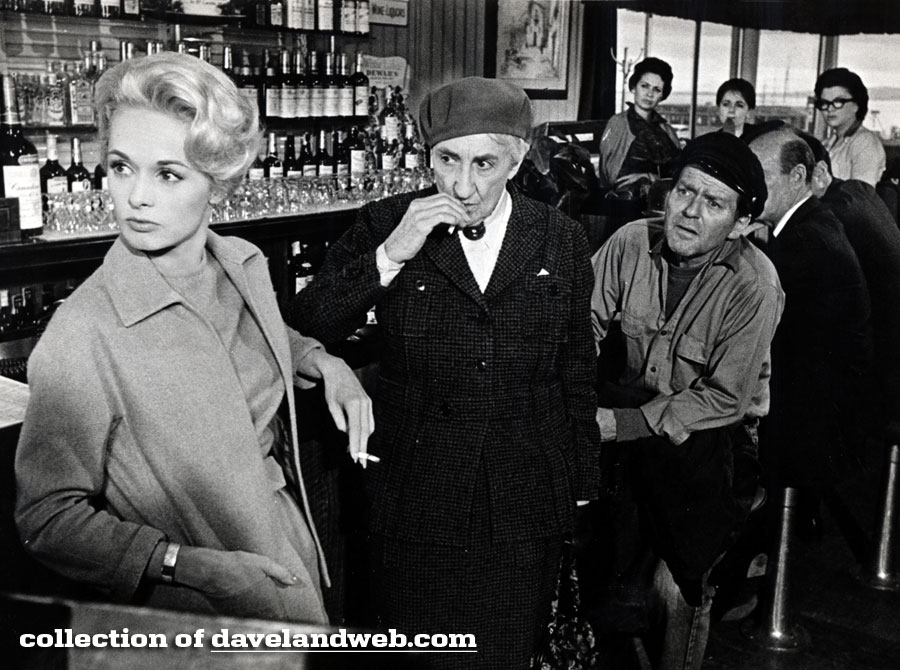
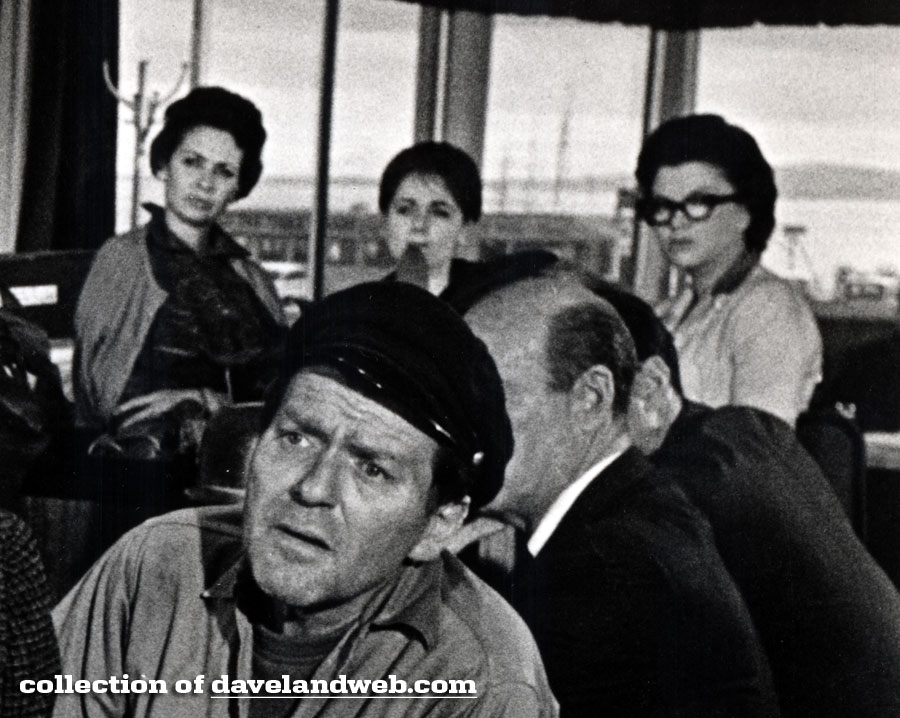
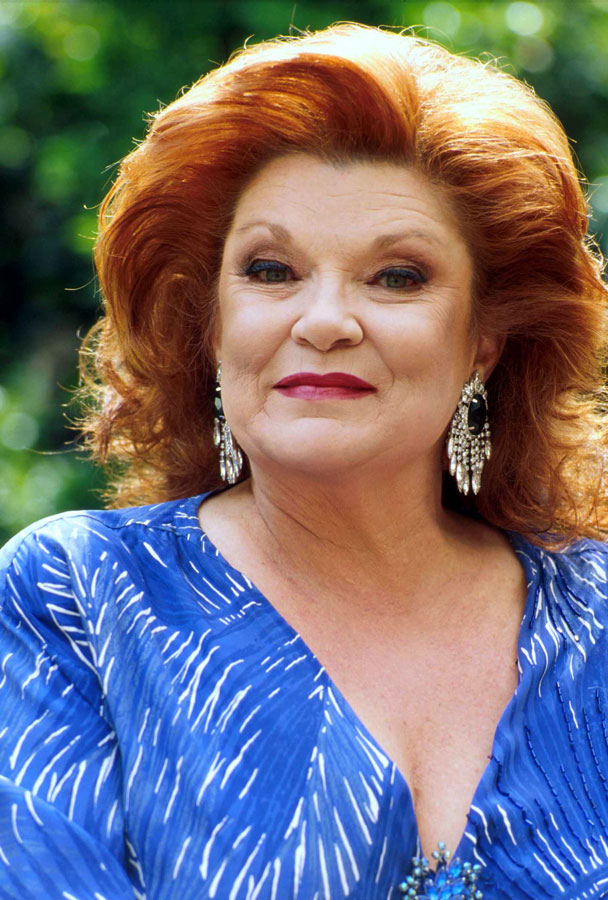
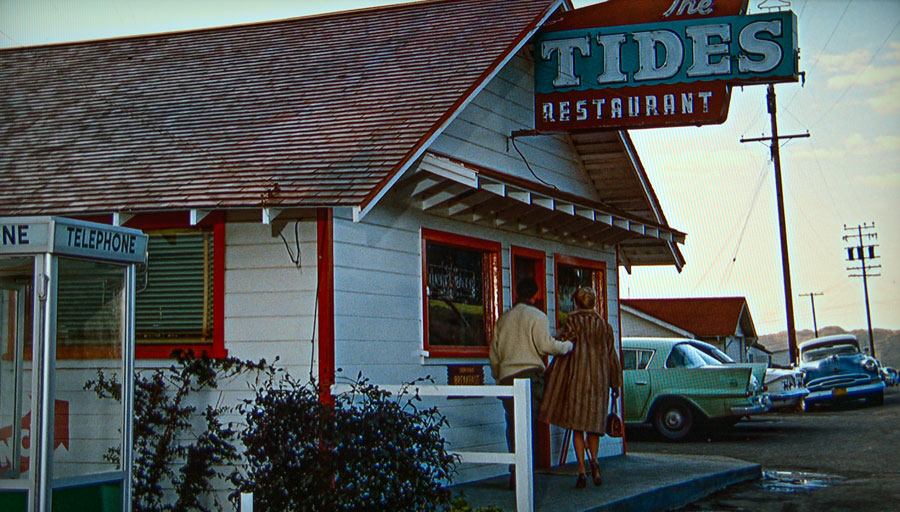
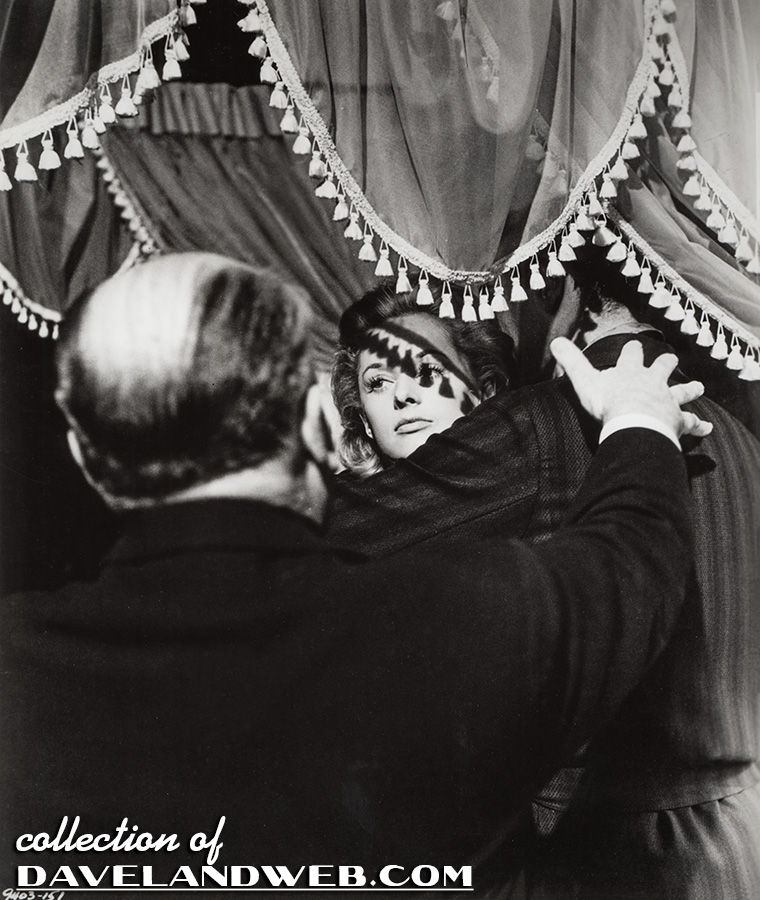
One of the most famous scenes in Alfred Hitchcock's "The Birds" is the one that takes place in the Tides Restaurant. While trapped inside, the patrons attempt to make sense of the avian attacks, most notably Mrs. Bundy, played by Ethel Griffies. Also notable in this photo is the bespeckled waitress, played by an uncredited Darlene Conley.
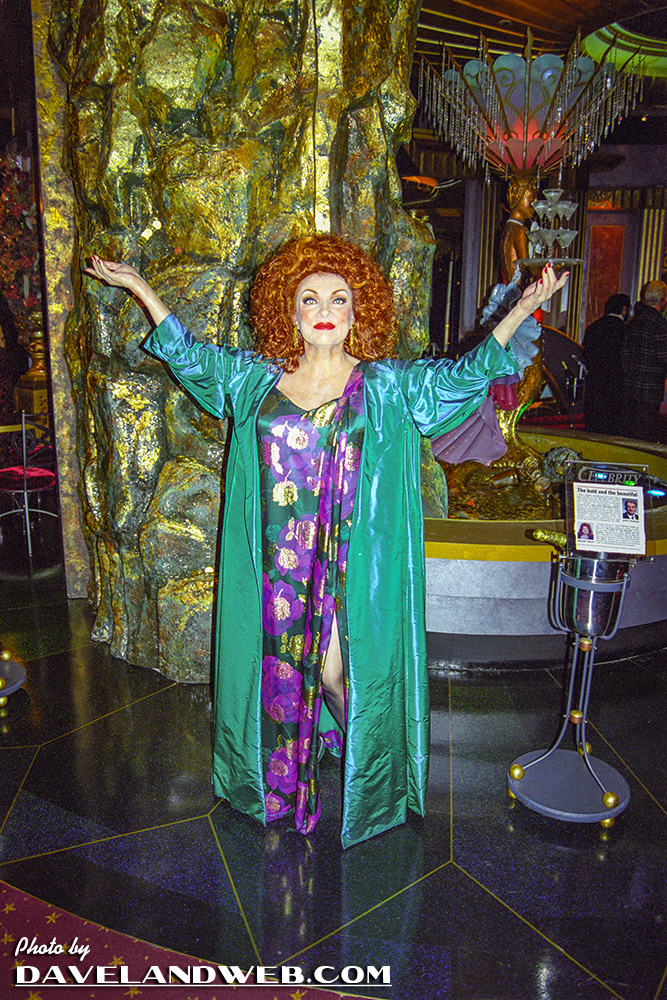
Best known to soap opera fans as flaming redheaded fashion designer Sally Spectra in "The Bold and the Beautiful," Conley's larger than life portrayal made her a fan favorite. This is why watching the scene from "The Birds" is so funny, as her character seems so nerdy and shy. Amazing what a pair of thick glasses can do for you!
Conley passed away in 2007, but her tribute in wax can still be seen at Madame Tussaud's in Las Vegas.
"The Birds" has always baffled me; it's considered by many as one of Alfred Hitchcock's best movies, but overall, it does very little for me. Its uneven mixture of screwball comedy and suspense/horror makes it one of my least favorite Hitchcock movies. Evan Hunter's screenplay doesn't help either, nor has it aged very well. Some scenes are absolutely brilliant, while others seem flat and dated. Despite that, I was very excited to find myself in Bodega Bay recently, affording me the opportunity to see some of the locations used in this movie.
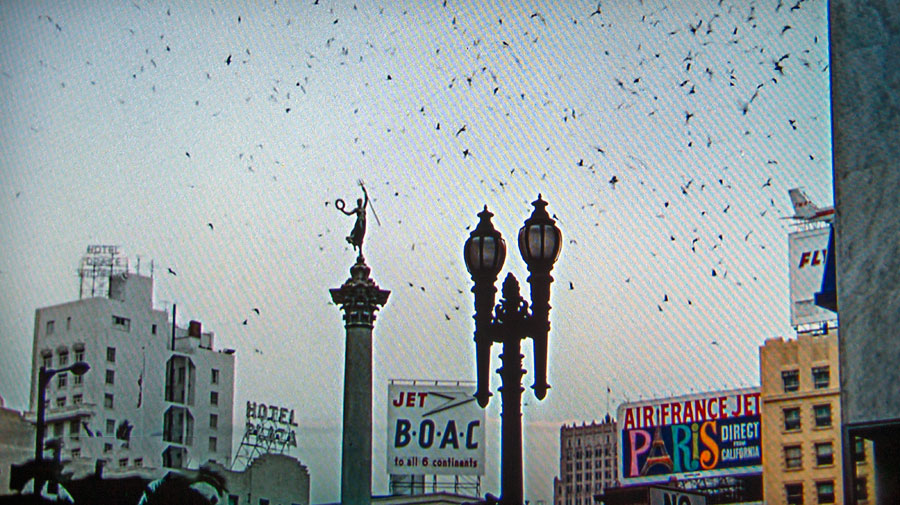
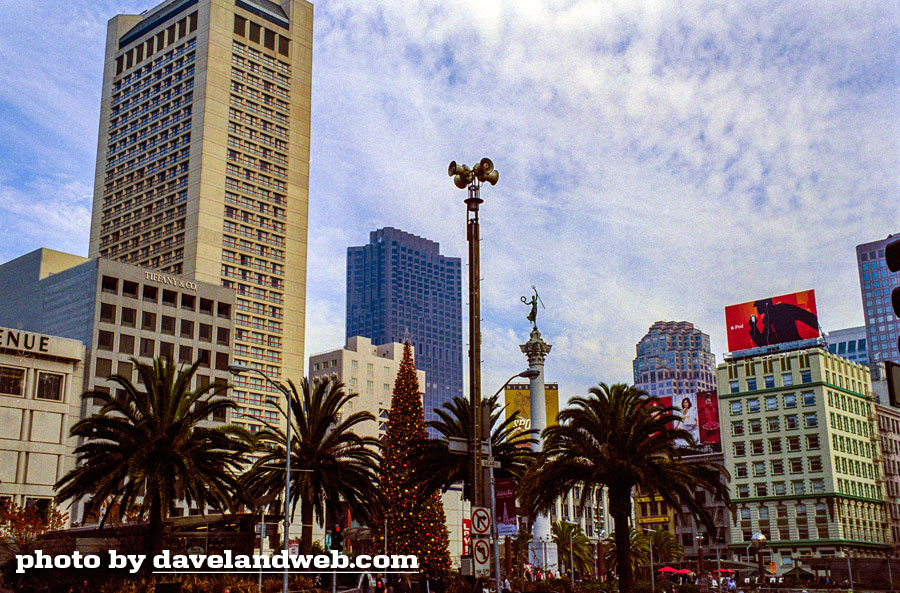
The first comparison shot is where the movie begins, in San Francisco's Union Square:
A December 2005 view from the same angle:
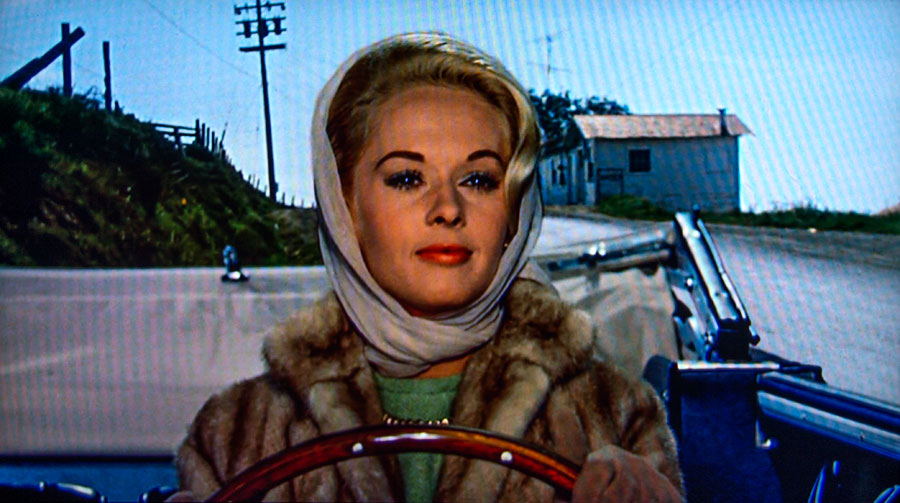
Recklessly driving up the coast, our heroine, Melanie Daniels (Tippi Hedren), is going to a lot of trouble to flirt with attorney Mitch Brenner (Rod Taylor).
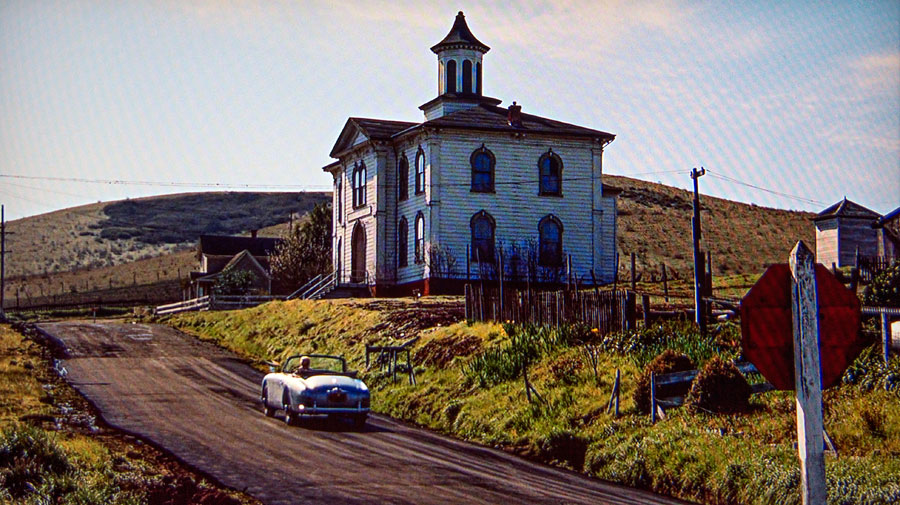
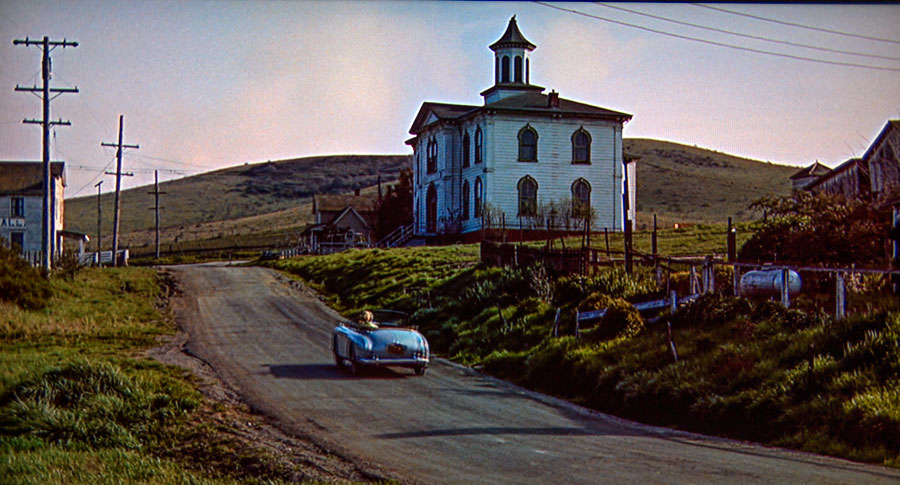
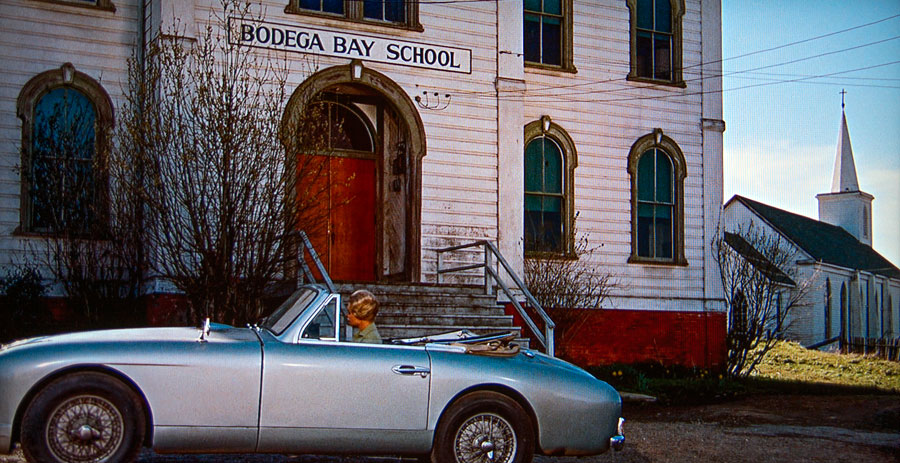
Melanie approaches the Schoolhouse in Boedga:
The Potter Schoolhouse as it looks today:
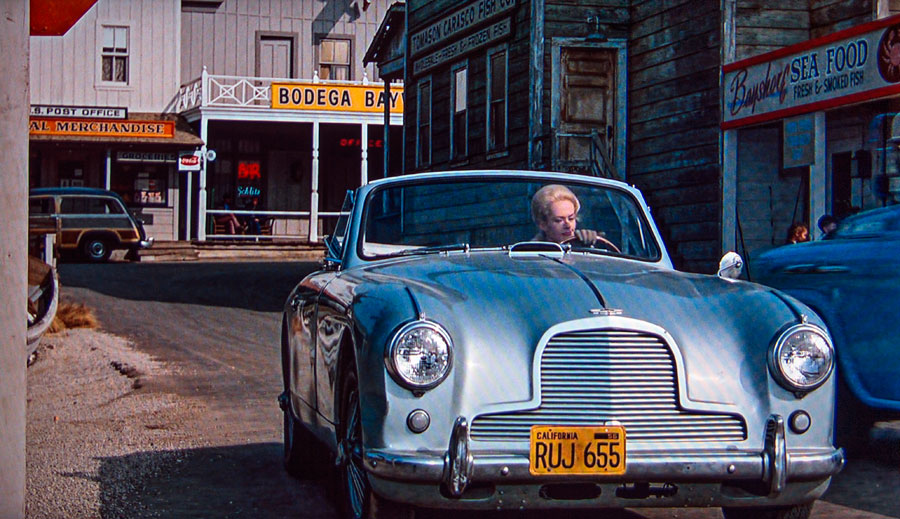
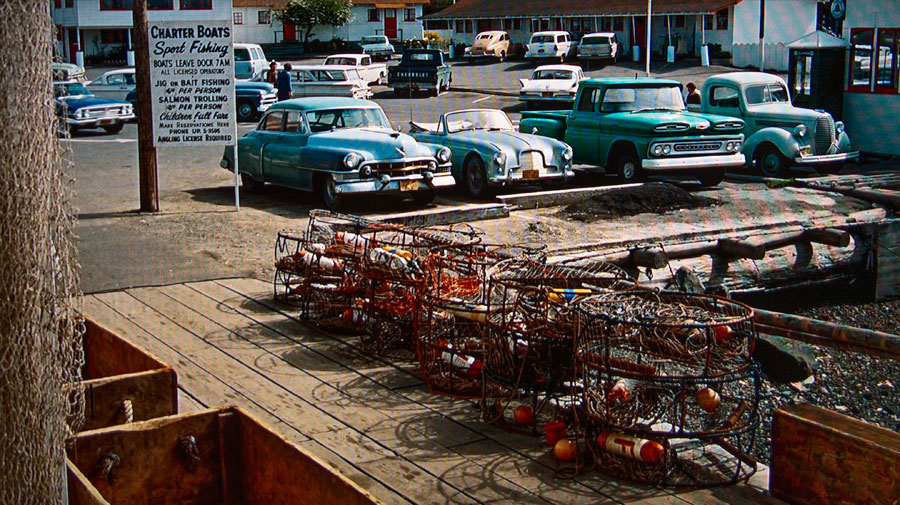
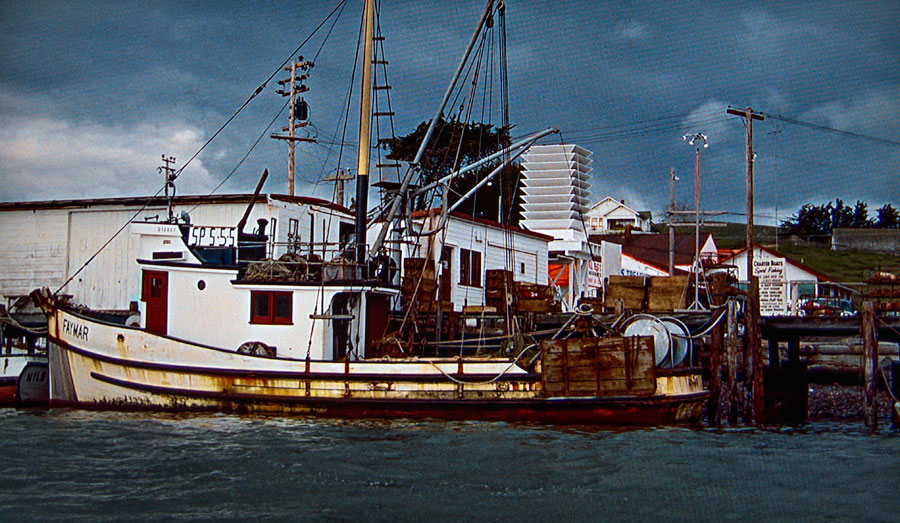
Bodega and Bodega Bay are approximately 5 miles apart, but thanks to a little movie magic, Hitchcock stitched them together to form one little community. For downtown Bodega Bay, Hitch used the Universal backlot:
as well as the real Bodega Bay:
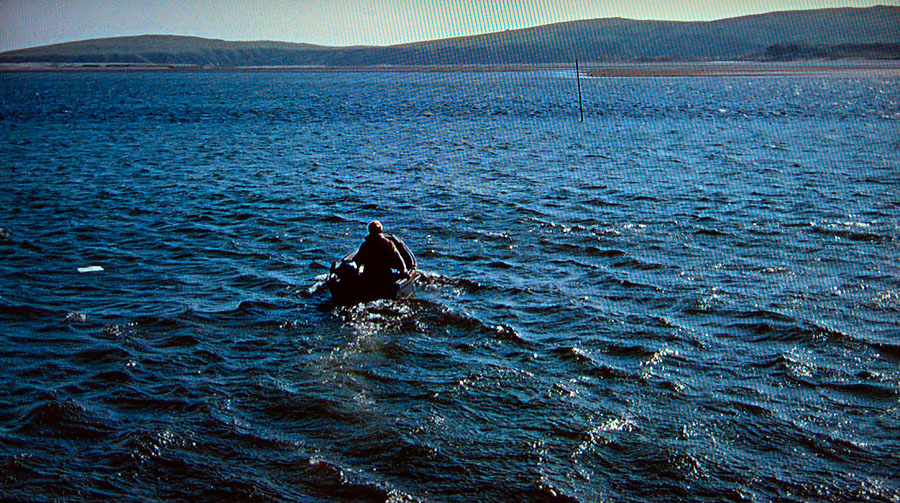
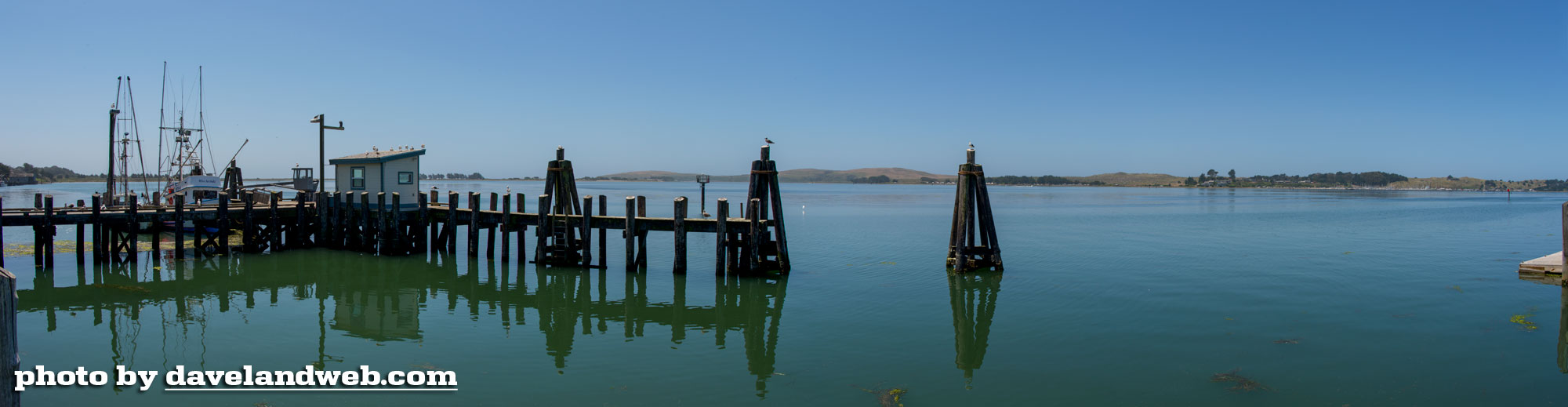
Melanie rents a boat so that she can sneak up on the Brenner house with her lovebirds:
A contemporary panoramic view of where Melanie piloted her outboard motorboat:
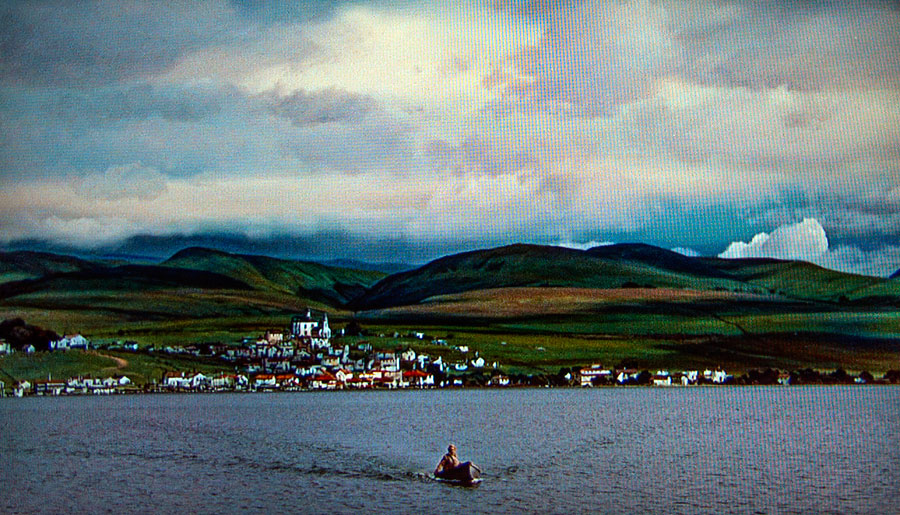
Melanie cruising through "Bodega Bay," with a scenic matte painting behind her:
The real Bodega Bay:
Just before getting dive-bombed by a gull, Melanie gives Mitch a haughty (but flirtatious) look as he waits for her on the dock.
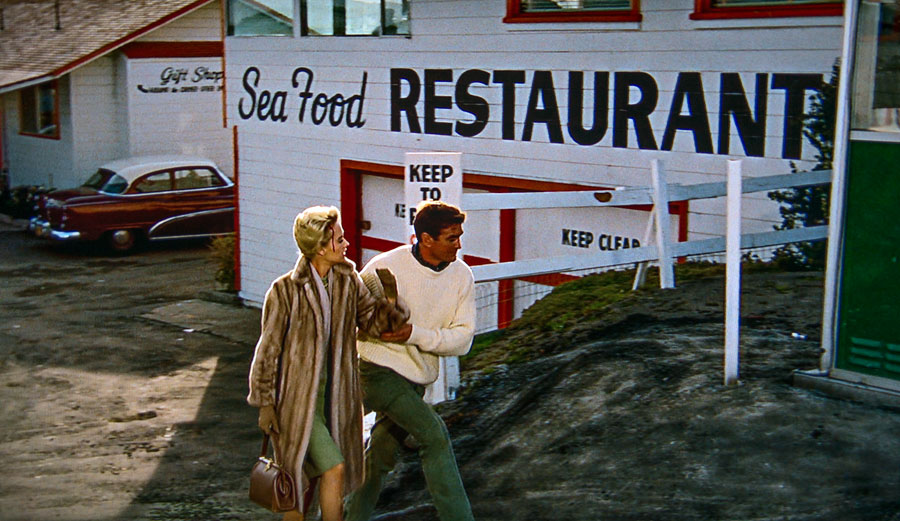
End of flirtation; Melanie needs medical attention, as Mitch whisks her off to the Tides Restaurant:
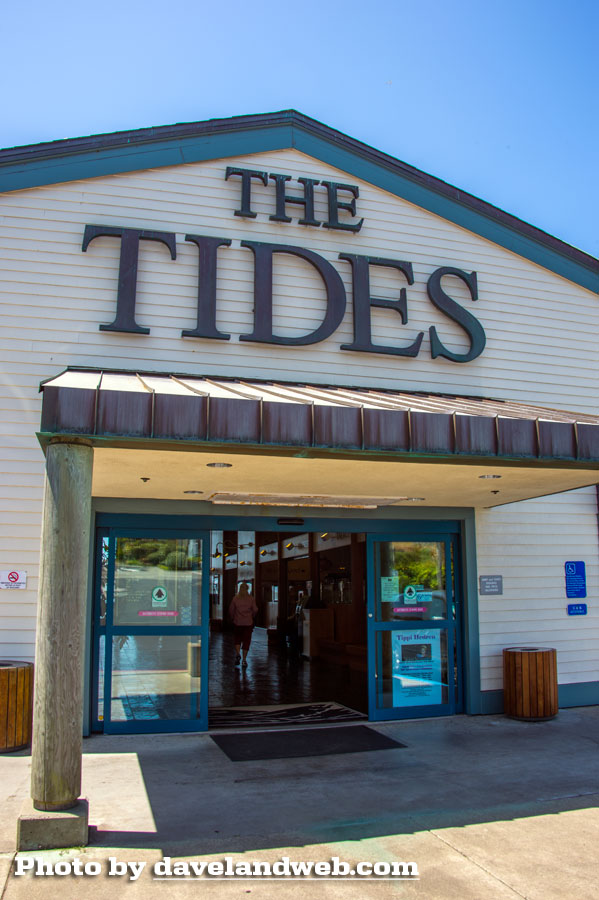
The new and improved Tides Restaurant, which is a completely new structure:
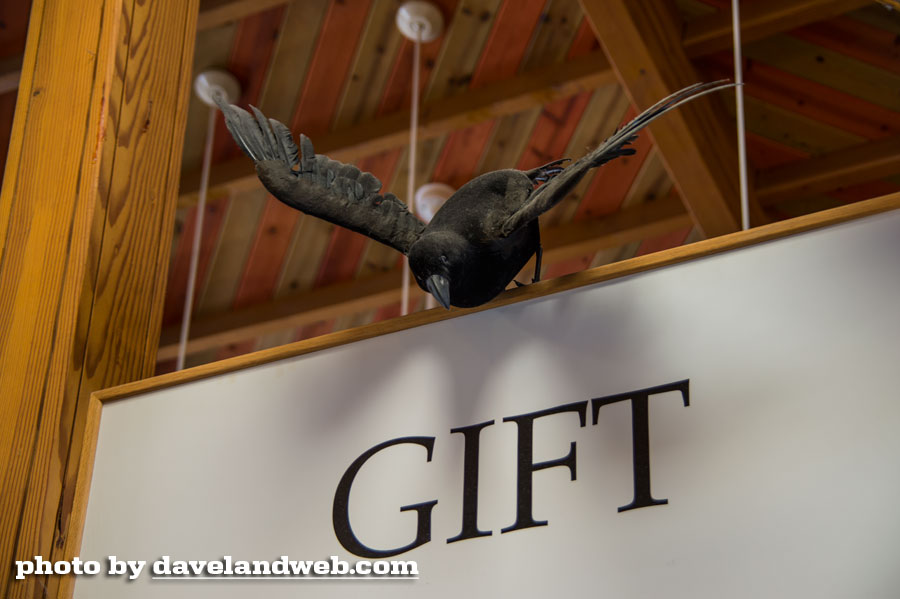
Embracing the film, and continuing to earn a bit of coin from it, this stuffed "bird" looms over the gift shop entrance:
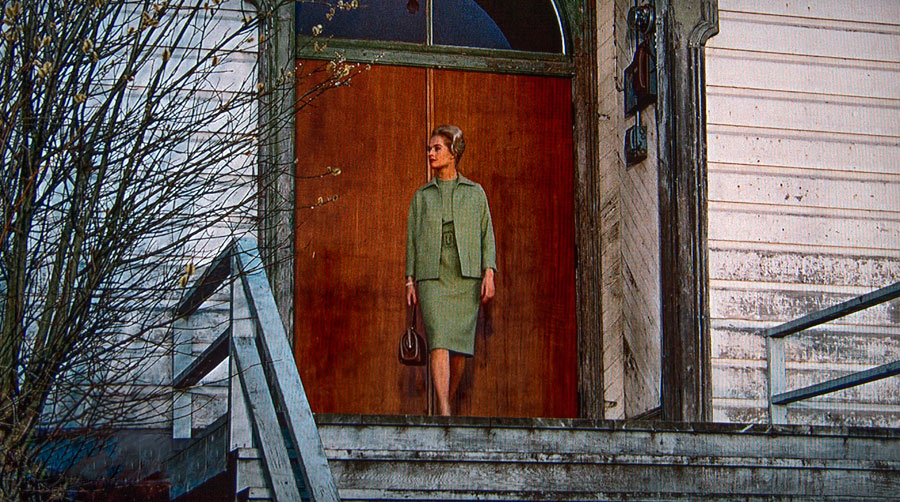
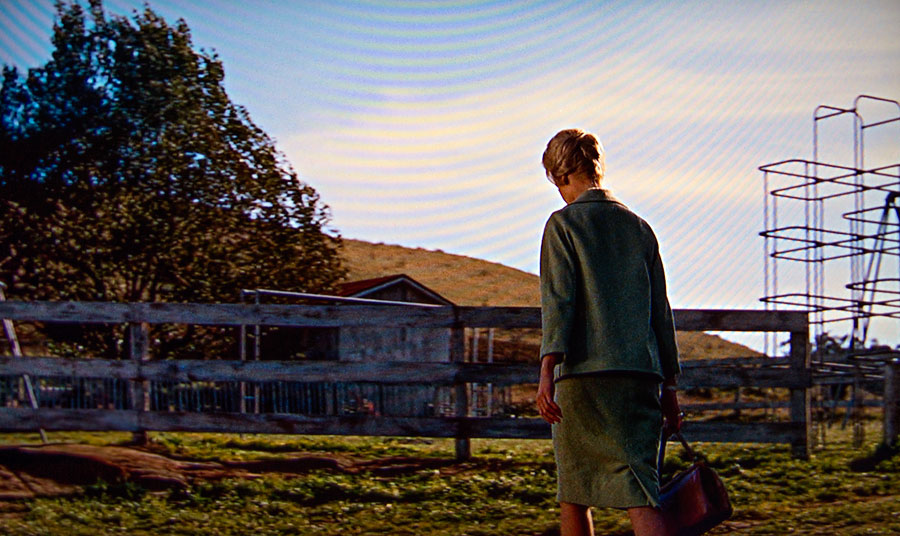
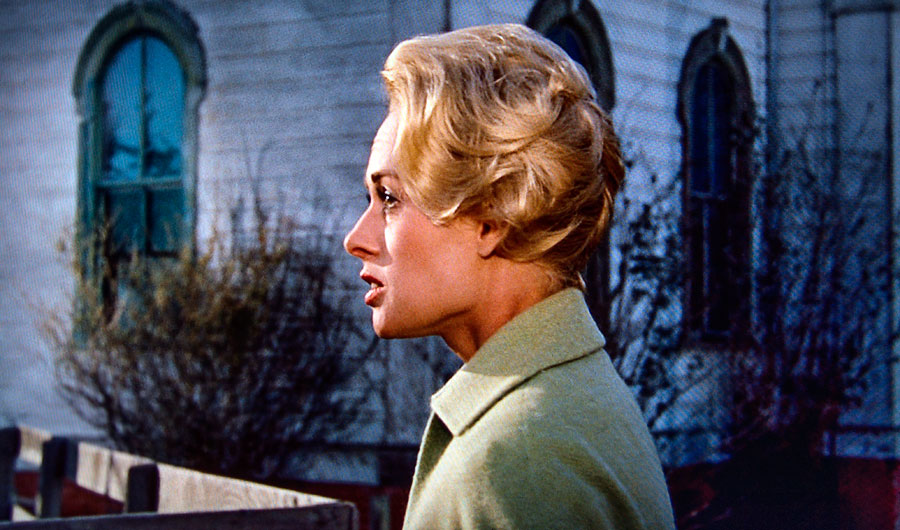
Later in the movie, Melanie heads back to the schoolhouse to check on the safety of teacher Annie Hayworth (the husky-voiced Suzanne Pleshette) and the children:
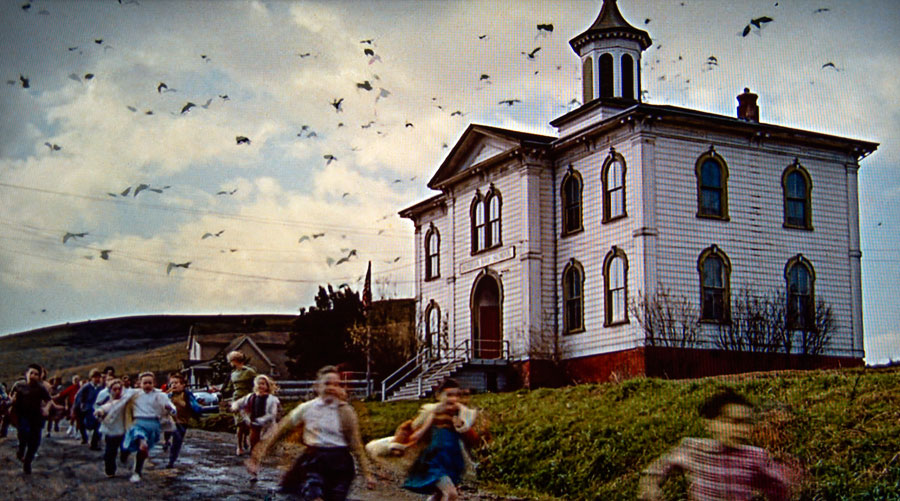
A front view of the schoolhouse today.
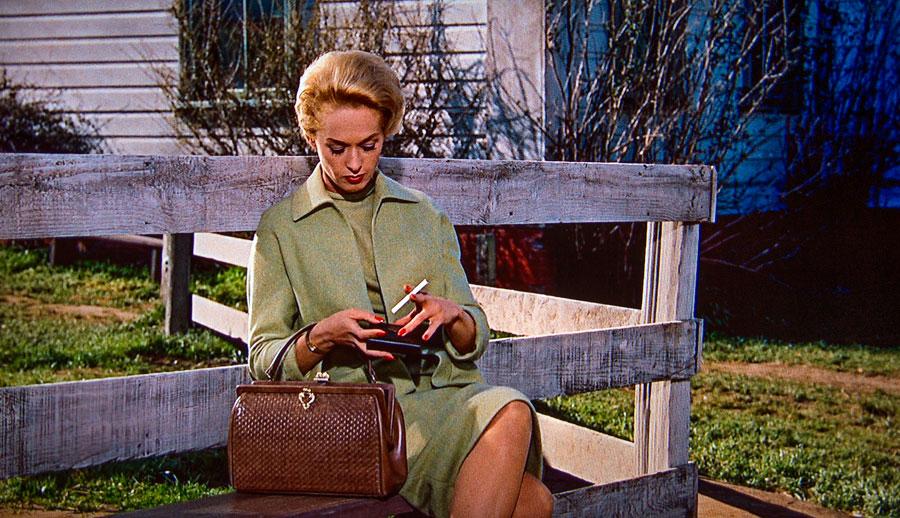
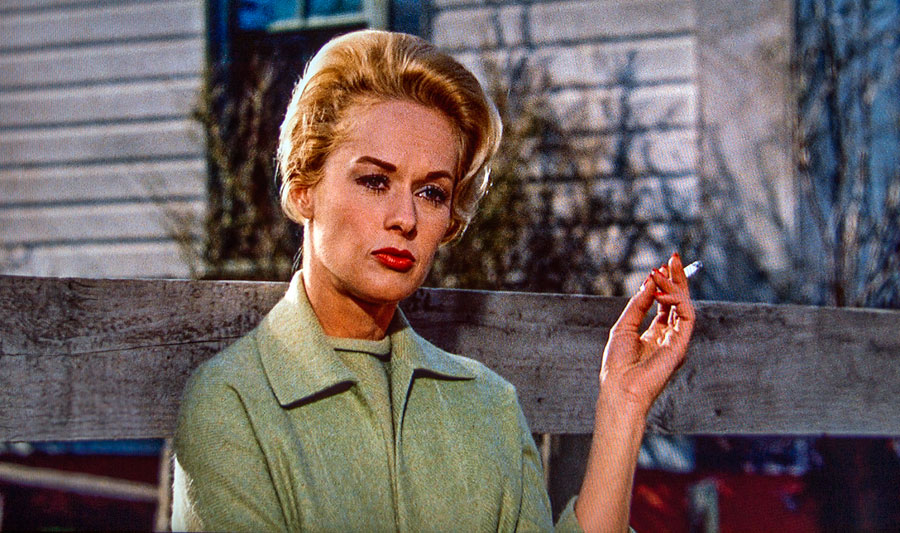
Melanie heads off to the side of the building to get a smoke while she waits for school (and specifically Mitch's younger sister) to be dismissed.
This is where the brilliance of Hitchcock's suspenseful style is at its peak, with the intercutting of Melanie getting increasingly more nervous while the birds begin to pile-up behind her.
Only the audience knows about the birds.
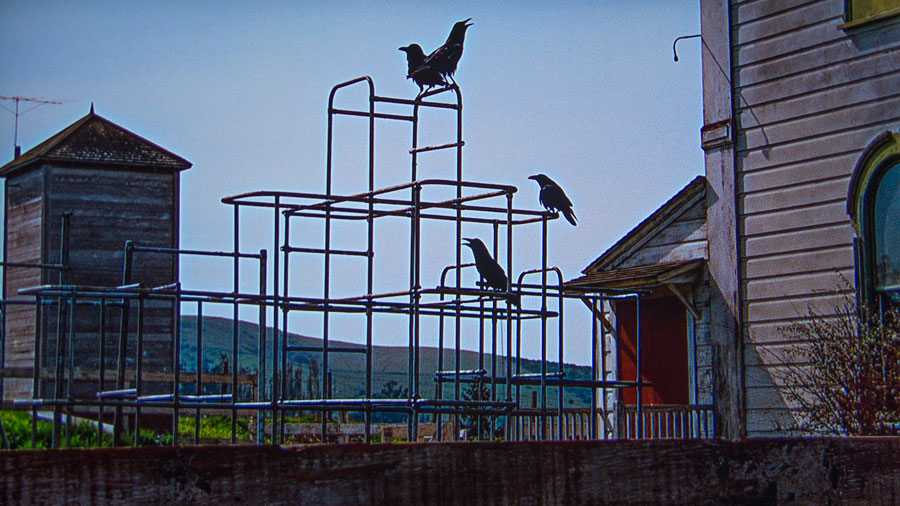
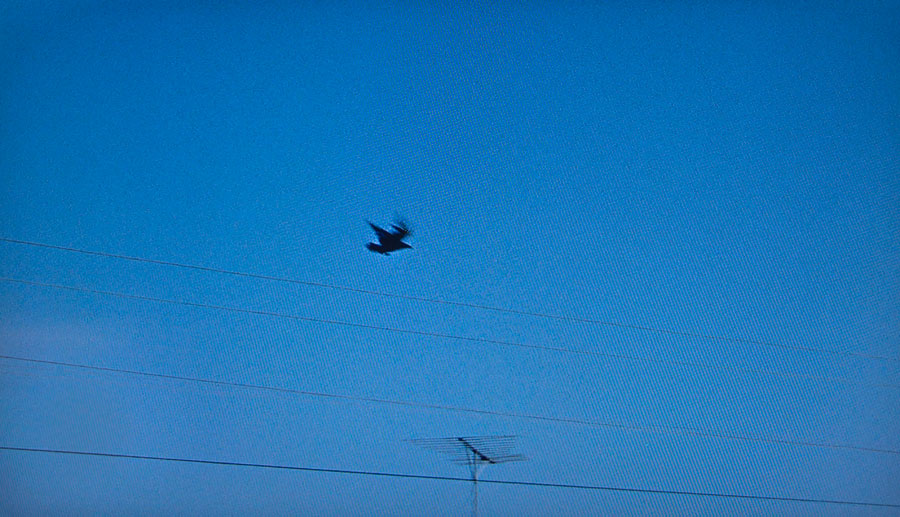
That is, until a single crow flies overhead.
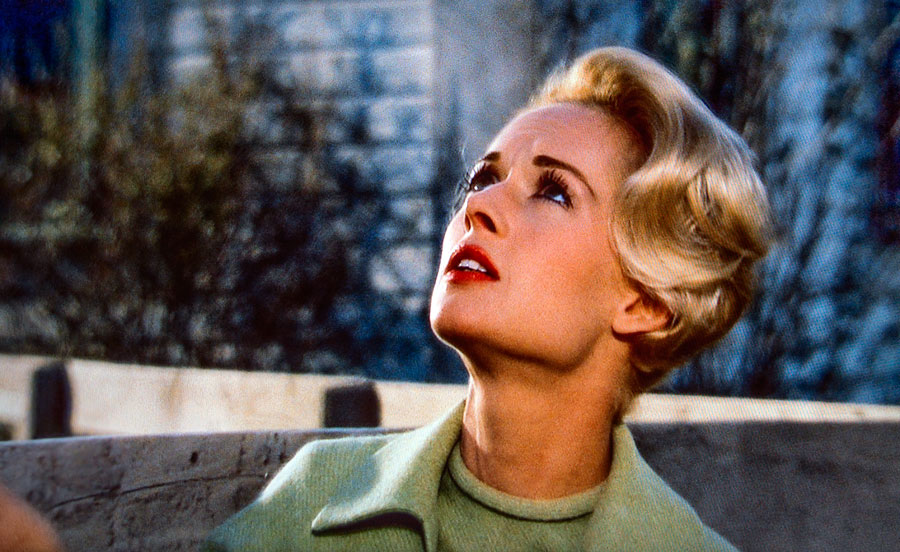
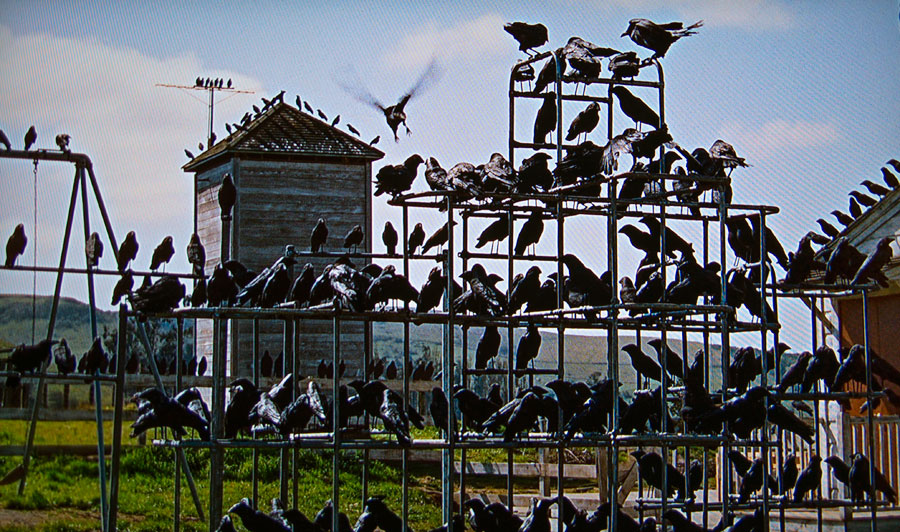
Melanie follows the crow visually until she sees it descend upon the playground jungle gym.
Oops!
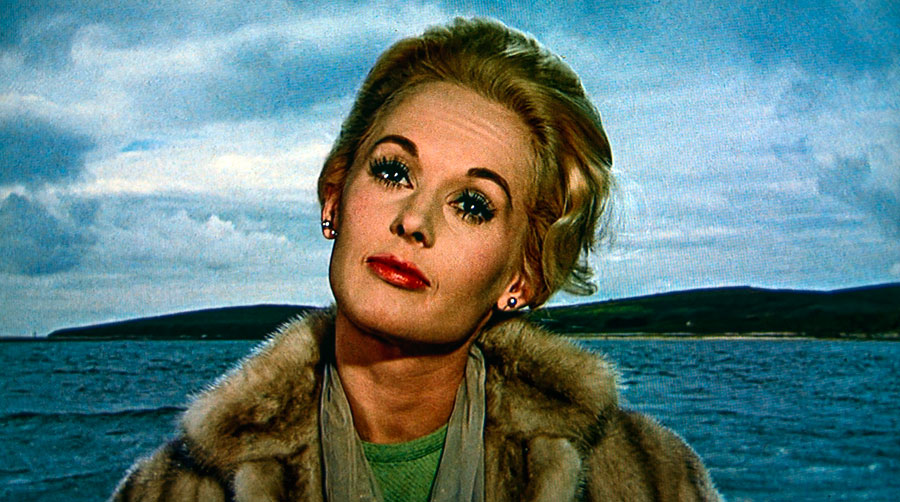
I have to hand it to Tippi Hedren. In her first starring role, she is fantastic. The controlled horror she displays is so natural. Hitch did a great job coaching her.
A contemporary side shot of the schoolhouse. No jungle gym. No playground. And no Tippi.
A few shots from the film showing the children frantically running away from the birds:
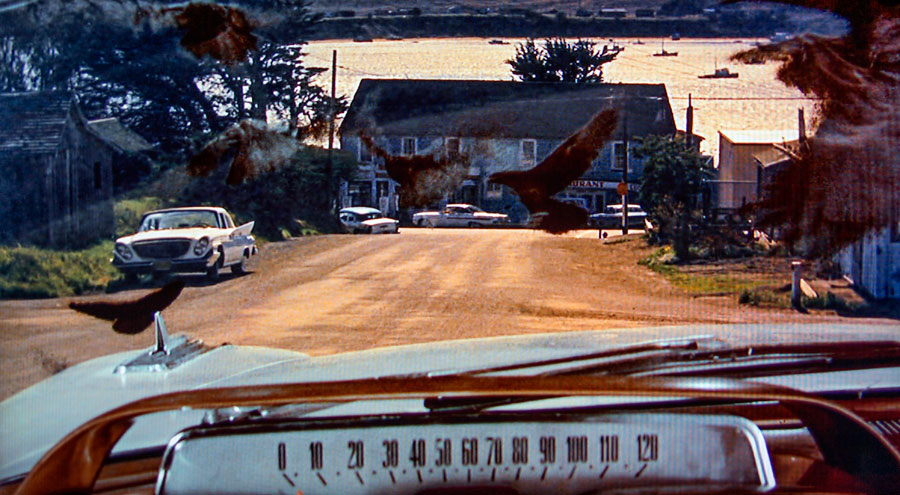
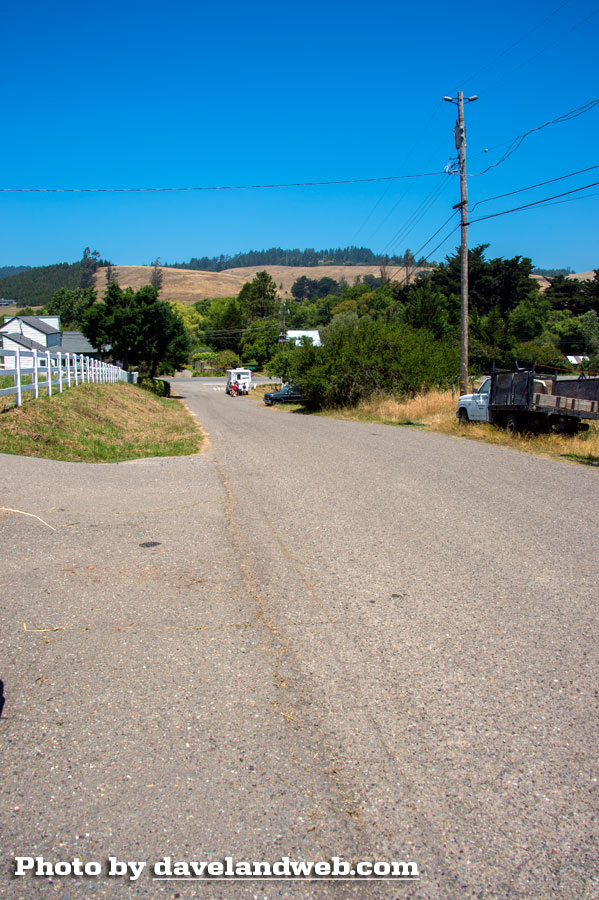
Had the little darlings actually been running down the street away from the schoolhouse, THIS is what they would have seen:
Instead, Hitch filmed that viewpoint in a different area, and spliced the two together.
Buckle up readers...this is a long one if you can make it through the whole thing.
Alfred Hitchcock's "Marnie" is one of my very favorite films. Taking some of the themes explored in "Vertigo," Hitch pushed the limits of the censors with a variety of hidden meanings and subtexts. In addition, its leading lady, Tippi Hedren, happens to be one of the most gorgeous icy blondes ever to grace the screen.
Because of a chance meeting with author Donald Spoto in Fairmount, Indiana, while he was researching his James Dean biography back in 1995, I was able to meet Hedren in the flesh.
Spoto and I met at the Back Creek Friends Church during the annual tribute service to James Dean on the anniversary of his tragic passing at an early age.
In the parking lot of the church, Spoto quizzed me about my thoughts on Dean, and then I turned the conversation to Hitchcock, since I had read both The Dark Side Of Genius: The Life Of Alfred Hitchcock and The Art of Alfred Hitchcock. What I liked most about Spoto's books were his thoughtful reviews of Hitch's films as well as the fact that he was one of the first people to actually "get" "Marnie" and enjoy it.
When "Marnie" was first released in 1964, it was savaged by the critics:
Los Angeles Times: "naggingly improbable."
NY Times: "A strong suspicion arises that Mr. Hitchcock is taking himself too seriously—perhaps the result of listening to too many esoteric admirers."
New York Herald Tribune, Judith Crist: "New it isn’t, in form or content. Mr Hitchcock himself made this kind of movie nigh on to twenty years ago, and made it a lot better;...pathetically old-fashioned."
Sight and Sound: "one of Hitchcock's sham-Freud gambles in the field of audience gullibility."
Newsweek: "nothing less than a disaster."
Time: [paraphrased] if an unknown director turned out a suspense melodrama "as dreary and unconvincing as this," one would express the wish that Hitchcock might have directed it, And here, Hitchcock had directed it!
Saturday Review: [paraphrased] another of Hitch's "Psychology I primers" and how Hitch had, it seemed, "lingered too long in the neighborhood of the small screens"
Films in Review on Tippi Hedren: "I don't see what Hitchcock sees in her."
On the financial side, “Marnie” was a disappointment. It was #30 out of 73 films for 1964, and made $7 million. Compared to "The Birds," which raked in $11.4 million, it was considered a flop.
Over the years though, it has gained admiration and continued analysis, as many of the hidden layers of meaning (whether intentional or not) have been revealed and examined. It is often viewed as the last true Hitchcock film, put together by the crew that Hitch typically worked with during the previous decades of his success.
Spoto was the first person to publicly "reveal" in depth the tension between Hitchcock and Hedren during the making of "Marnie." All the director ever said about it was, “She did what no one is permitted to do. She referred to my weight.” Hitchcock often spoke to interviewers about his movies, but he typically brushed “Marnie” aside—and he rarely (if ever) mentioned Hedren.
Vera Miles had previously spoken about how controlling Hitchcock was in his attempt to mold her into a star, but nothing more serious than that. Spoto's interviews with Hedren went much further; it was claimed that Hitchcock had made verbal advances after months and months of controlling behavior, and that when the final showdown occurred, Hedren refused to make movies for him and Hitch threatened to ruin her career, keeping her under contract but not allowing her to work for other directors. This information caused a minor flurry of publicity and put Spoto's book on the map, giving it a controversial moniker that certainly didn't hurt sales.
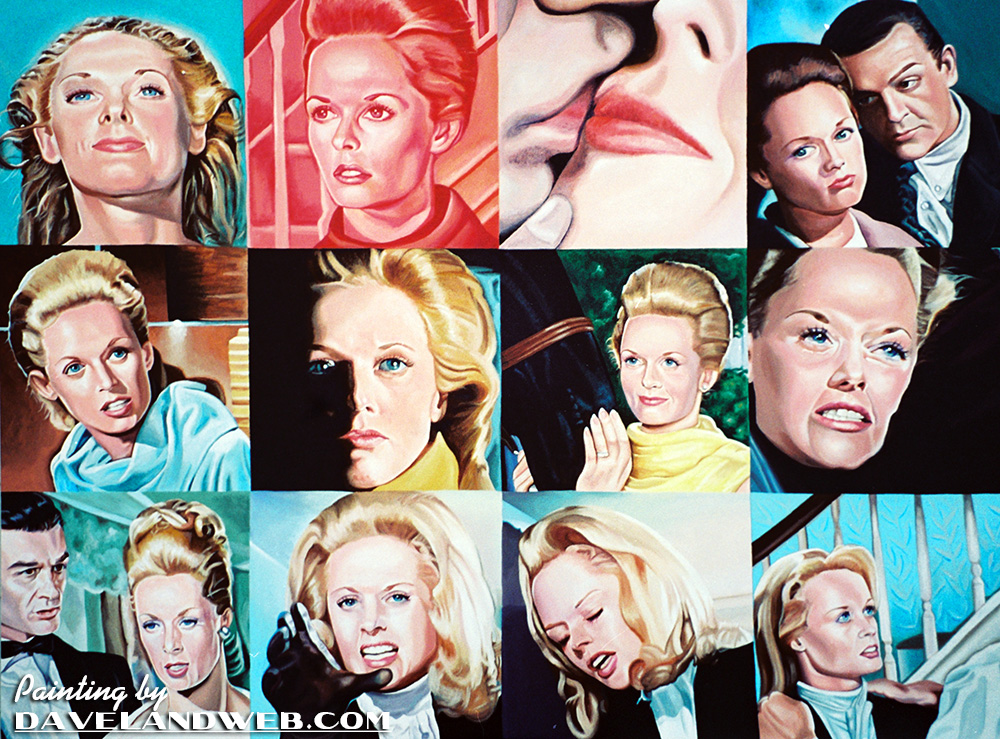
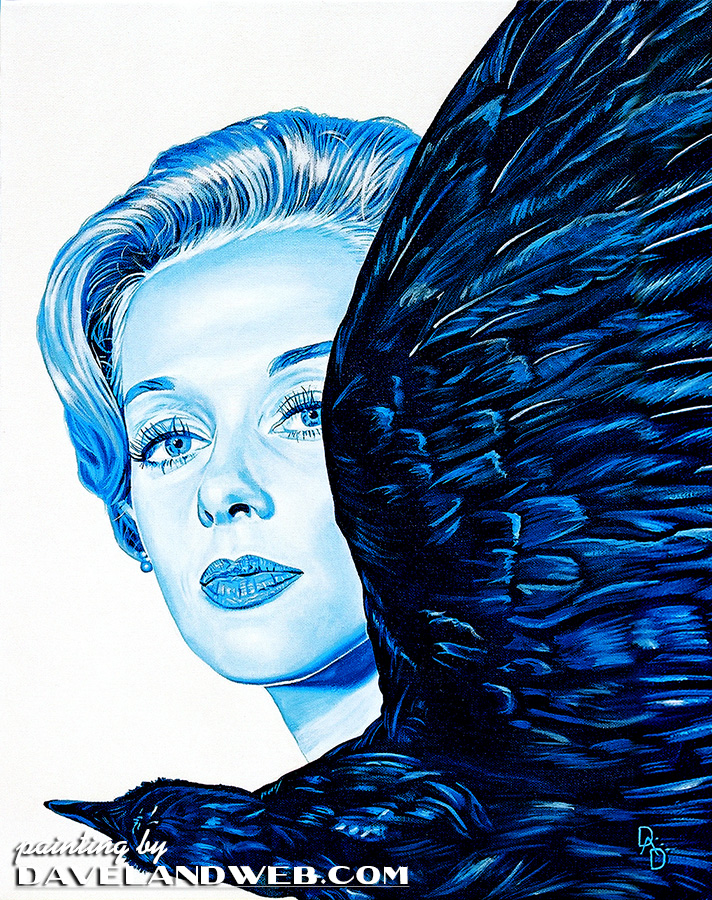
When I asked Spoto if he actually knew Tippi, the reply was immediate. "Know her? Why...I am one of her best friends!" His attendance at a recent wedding as the guest of Tippi was his verbal proof. I told him that I'd done a number of paintings of Tippi, including a rather large one (3' x 4') of "Marnie," which he seemed anxious to see. When I sent him photos after our meeting, he expressed an interest in buying the original painting on the spot. To say I was pleased was an understatement.
His purchase also came with an invitation to visit him next time I was in the L.A. area, as he maintained residences on both coasts.
As it turned out, I was in California about a month later on vacation and Spoto was there as well, doing interviews for his most recent book. We arranged to meet at his Los Angeles condo for the day with a blank itinerary.
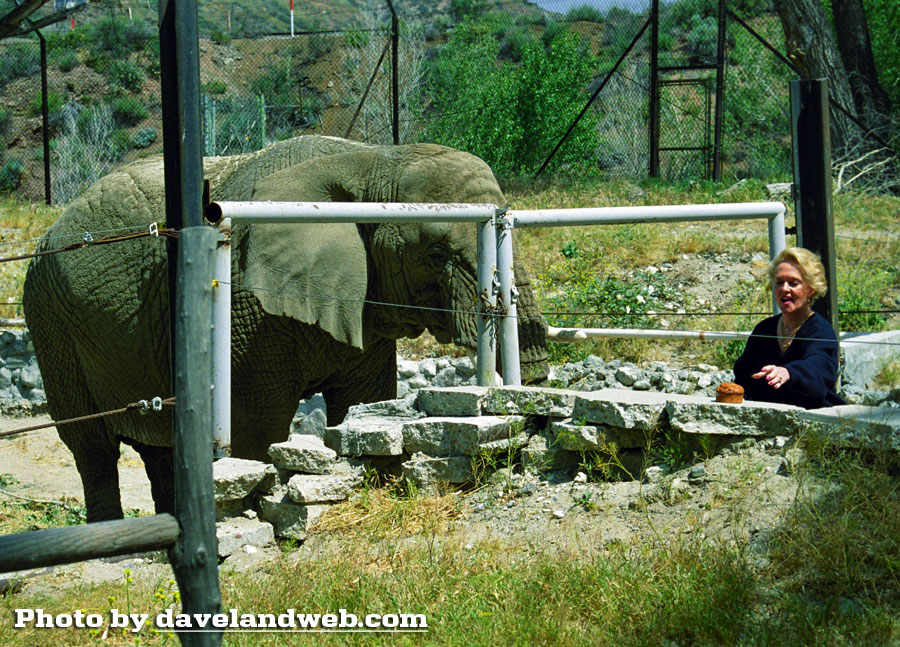
Shortly after he welcomed me in he told me that it was a shame I hadn't been in L.A. the night before as Hedren had been doing a dramatic reading with Robert Guillaume. Disappointed that I had missed my chance to meet her, I was quickly buoyed up when Spoto offered to take me to Shambala, her home and wildlife preserve.
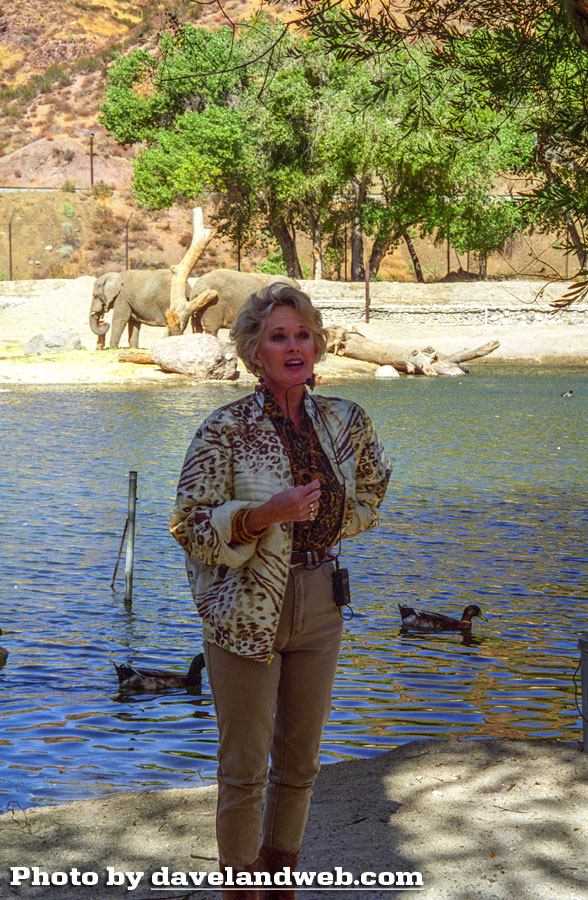
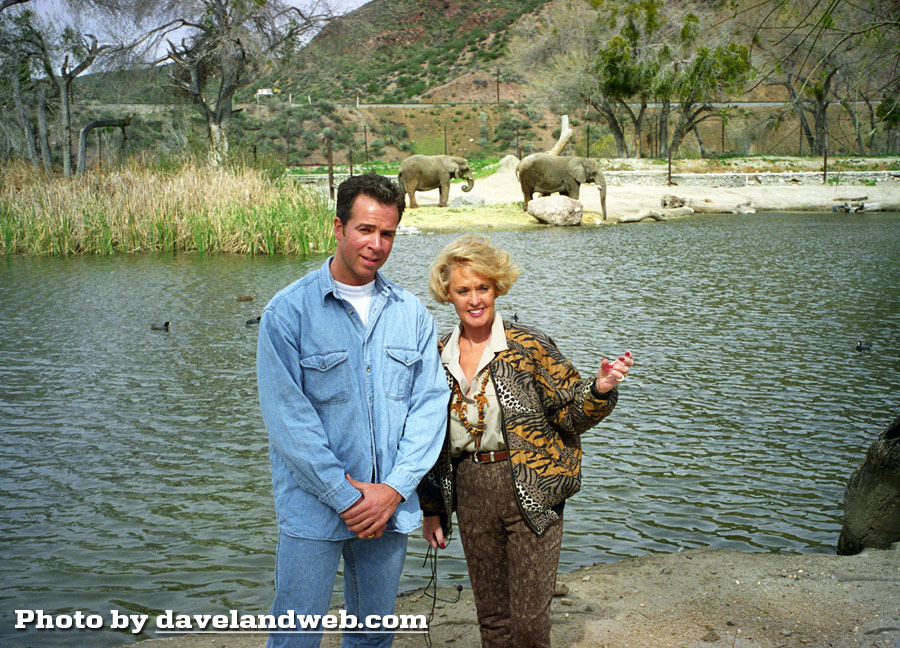
Warmly shaking my hand, Tippi looked as if she hadn't aged a bit. Petite but full of positive energy, she was absolutely radiant as she showed off her beloved animal sanctuary.
Mirroring the stories that other actresses had told, Tippi sat across from me at lunch, discussing how Hitchcock used to micro-direct her, advising when to look up, when to look down, and which way to have her eyes staring.
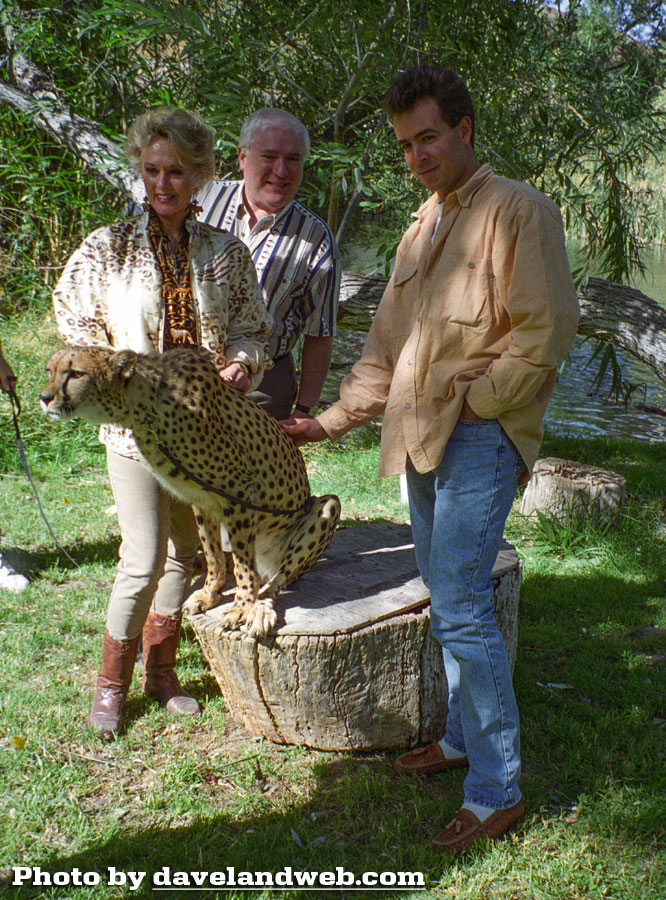
At the same time we were visiting, there was a tour of Shambala going on. Tippi, Donald, and I posed with her 3-legged cheetah, Subira. Beforehand, I was given specific directions about not touching the animal above the neck. If I look cautious, it’s because I was...chain or no chain!
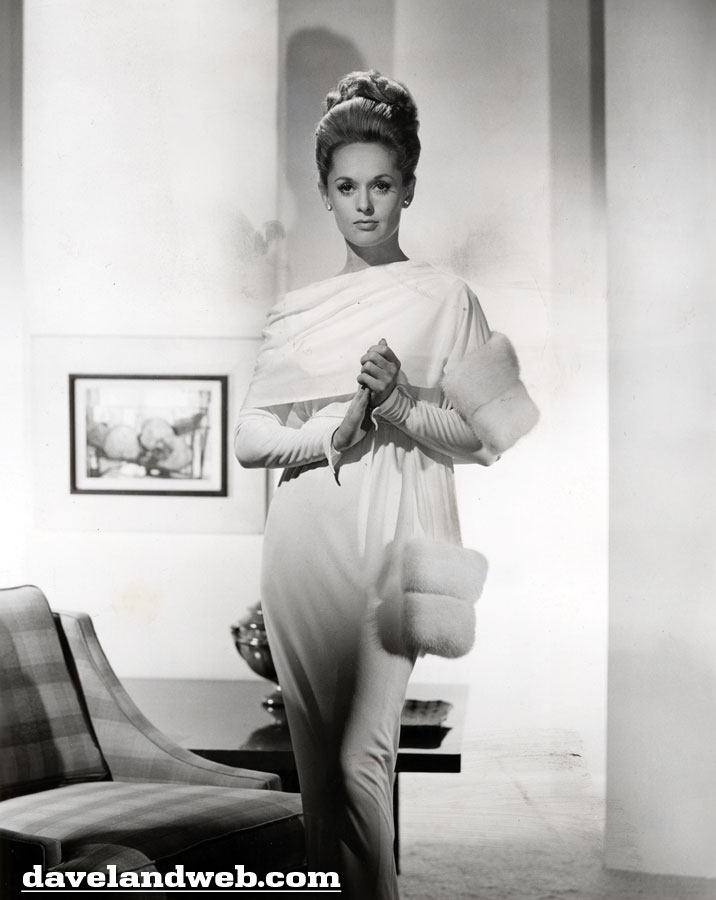
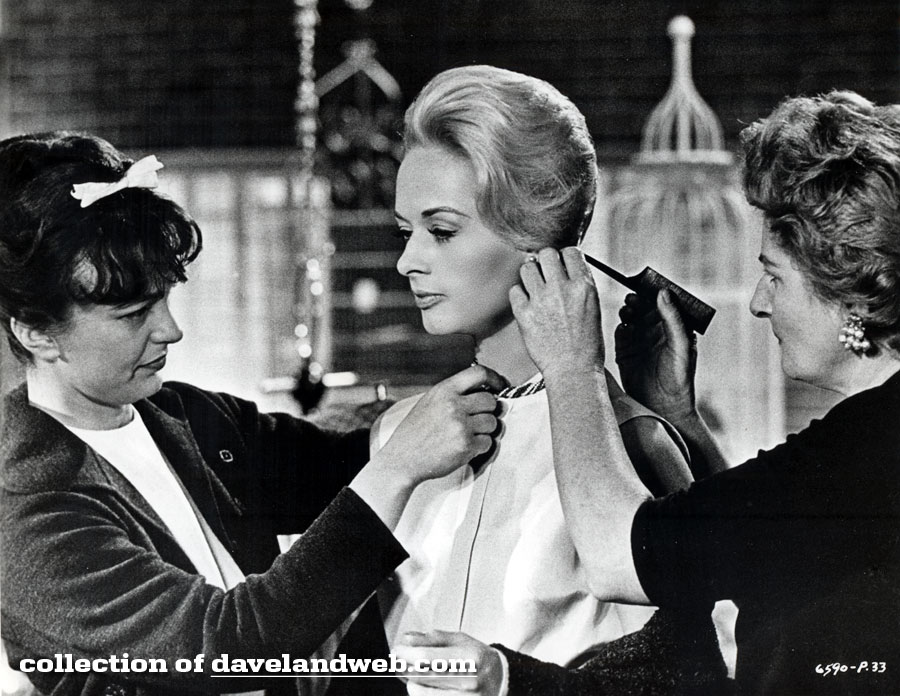
Tippi took us into her home (a converted double-wide trailer), and showed me the Edith Head wardrobe that Hitch had designed for her personal use (which she could still fit into!) as well as the hairstyle sketches by Alexandre de Paris that were used in "Marnie." Hitch obviously spared no expense in transforming Tippi into his next leading lady of choice since Grace Kelly had flown his coop for Monaco. When I showed her the photos of my "Marnie" painting that Donald had bought, her eyes welled up with tears and she said, "That was a very special time for me." When I told her how much I'd enjoyed her book on Shambala but had forgotten to bring my copy for an autograph, she immediately pulled out one from her stash on the shelf and put a lovely handwritten inscription in it, complete with birds. When it came time to part, she gave me a warm hug and invited me back. I couldn't have been more thrilled; to have spent the afternoon at Tippi Hedren's Shambala was a total treat. Warm, gracious, kind, and full of passion for her animals, she was a lady to be admired.
This is why I found it so surprising that almost 50 years after the fact, she has come forward with a vengeance about how awful Hitchcock was to her. It seems hard to believe that this was the Tippi I had met back in 1995 (and continued to meet up with over the next ten years as I attended her fundraising events). In those intervening years, Spoto had returned to the Hitchcock well and dipped a poison pen into the reservoir with Spellbound by Beauty: Alfred Hitchcock and His Leading Ladies. This particular book slammed Hitchcock and portrayed him as a sexual deviant who put Hedren through absolute misery. With each telling of the Hitchcock/Hedren story, it became more salacious and horrifying. Now that an HBO movie titled "The Girl," based on Spoto's account of the Hedren/Hitchcock incident, is being released, Tippi has found herself to be the darling of the media again. In a recent NY Times Interview, she is quoted as saying:
Tippi: He was a misogynist. That man was physically so unattractive. I think to have a mind that thought of himself as an attractive, romantic man and then to wake up in the morning and look at that face and that body was tough. I think he had a whole lot of problems....I have a strong Lutheran background, and my parents instilled in me strong morals. [Sleeping with the director] was something I could never have done. I was not interested in him that way at all. I was fortunate enough to work with him, and as far as I was concerned, he ruined everything.
Andrew Goldman: There is a scene in “The Girl” — as well as in the Donald Spoto book it’s based on — in which Hitchcock informs you that you are to be sexually available to him any time, any place. How do you even respond to that?
Tippi: I said, I’ve got to get out of the contract. He said, I’ll ruin your career. And he did. He wouldn’t let me out of the contract. I’d be a really big star if he hadn’t stopped my career. There were so many people who wanted me for their films. All he said was, “She isn’t available.” That’s a mean, mean man.
After condemning Hitchcock for supposedly attempting to put her on the casting couch, Hedren concludes with:
He ruined my career, but he didn’t ruin my life. That time of my life was over. I still admire the man for who he was.
Huh? She still admires him? Where was all this hostility back in 1995 when she warmly shared what a great experience she had with Hitchcock and how it was such a special time for her?
Over at the Alfred Hitchcock Geek, Elisabeth Karlin, a playwright living in NYC, thoughtfully writes:
I have heard Hedren's story and can imagine the anguish she might have felt. "[Hitchcock] was almost obsessed with me," she once claimed, "and it's very difficult to be the object of someone's obsession. I never talked about it for twenty years because I didn't want people to think about it in the wrong light. I felt such empathy for Hitch, to have such strong feelings and not have them returned is very difficult." How did this honest, reasonable and rather touching assessment of their troubled partnership mutate into her recent characterization of Hitchcock as "evil and deviant to the point of dangerous?"
I can only imagine two scenarios; one is that Shambala needs money, and anyone who knows Tippi knows that she would do (or sell) just about anything to keep her beloved sanctuary going. I heard her say numerous times that she didn't even own the "house" she lived in. The other scenario is that the years have made her susceptible to the persuasions of Donald Spoto, who has done his best to coax a money-making story out of her. His previous attempt to get a film made of his Marilyn Monroe biography (with Tippi's daughter, Melanie Griffith, as Marilyn and Tippi as Monroe's mother) had failed, but it appears that he hit pay dirt with the HBO movie.
Personally, I have reason to doubt the integrity of Spoto. My first clue was what happened after he introduced me to Tippi. After gushing about my talents as an artist and how he could arrange an exhibit of my work in NYC, he also printed out the acknowledgement pages for his upcoming Dean bio. He proudly proclaimed that my name was in there (which I saw as he pulled the pages out from his printer), and that he felt our chance meeting in Fairmount was destiny. I politely declined his next offer, and after that, the exhibit as well as my name in the book disappeared.
James Dean's cousin expressed to me his displeasure for Spoto's Dean bio, stating that a number of important factual errors were put in the book that were not very favorable to his family. He was especially disheartened after he had been so cooperative with him during the interview phase.
I also thought it was in poor taste for Spoto to release a book on Diana Spencer when her body was barely cold in the ground. We continued to keep in touch, and by 1998, he confided with pride that he was done with Hollywood biographies, would be moving overseas, and would be concentrating on books with a much higher purpose, such as "The Hidden Jesus" and "Reluctant Saint: The Life of Francis of Assisi" (2002). By 2006, Spoto must have had a change of heart, as he released a biography of Audrey Hepburn, followed by one on Alan Bates in 2007, the Hitchcock Spellbound book in 2008, Grace Kelly in 2009, and Joan Crawford in 2010. Therefore, it would not surprise me if Spoto, as creative consultant for the HBO project, had orchestrated the Hitchcock smear campaign and used Tippi as his mouthpiece.
More from Elisabeth Karlin's well-written post:
In the 1970s there was a round table interview of Hitchcock leading ladies. It's a jolly gabfest with Suzanne Pleshette, Janet Leigh, Eva Marie Saint, Karen Black and yes, Tippi too. And while Hedren does come off as the least bubbly and most self-conscious of the bunch, she says nothing to indicate that she doesn't share in the group's affection for Hitch. Interestingly, asked by the moderator about having called Hitchcock "fat" to his face, Hedren responds: "I may have done that. I don't remember. That could have happened. I honestly don't remember that."
Well, it did happen. There was a set full of witnesses on the day when Hitchcock refused to interrupt the filming of Marnie so that Hedren could go to New York and pick up Photoplay's "Star of Tomorrow" award. She in fact called him a "fat pig" and that showdown resulted in their official falling-out.
"He ruined my career but he didn't ruin my life," has been a refrain wafting through Tippi Hedren's publicity soundbites (and to her credit, she has impressively put her life to good use with her Shambala Preserve for Big Cats.) (Full disclosure: Spoto serves on the Shambala Preserve's Board of Advisors.) To that, Hitch defenders have retorted, "Ruined her career? He gave her a career." But it is true that after their estrangement he kept her locked in her contract, drawing a salary but unable to work for those years. Still, I don't think other directors ever shared Hitchcock's entrancement. She insists that Francois Truffaut wanted her. If he did, my guess is that it was in homage to Hitch. And with Jeanne Moreau on hand and Julie Christie and Catherine Deneuve waiting in the wings, I doubt the French director was much vexed by her unavailability. We all hold our own opinions of Tippi Hedren as an actress—and they tend to vary widely. But as for Hitchcock ruining her career, I will concede that he obstructed it for a time, but as anyone who has seen Hedren in Charlie Chaplin's "A Countess From Hong Kong" can attest, she is blaming the death of her acting career on the wrong genius.
"'A Countess From Hong Kong' is Tippi Hedren's first feature film after her break with director Alfred Hitchcock. She had high hopes for the film, until she received the script. When she realized that she had a small part as Brando's estranged wife, she asked Chaplin to expand her role. Although Chaplin tried to accommodate her, he could not, as the story mostly takes place on a ship, which Hedren's character boards near the end of the film. In the end, she remained in the film and later said that it was a pleasure working for him."
Watching Tippi during her brief scenes in "A Countess From Hong Kong" will show you just how much work Hitchcock must have done to draw out her performance in "Marnie." Sadly, her performance for Chaplin is flat as a pancake, despite the fact that she looks like a million dollars.
The NY Times Film Review by Bosley Crowther (March 17, 1967) said this about Hedren's performance in "Countess":
"Tippi Hedren is pitifully sallow as his estranged wife."
Tippi has also recently claimed that Hitchcock blocked her Oscar nomination for "Marnie." Here is the list of nominees for Best Actress in 1964: Julie Andrews for "Mary Poppins," Anne Bancroft, Sophia Loren, Debbie Reynolds, and Kim Stanley. Based on the awful reviews and poor box office that "Marnie" did, I have a hard time believing that Hitch even needed to say a word to the Academy to dissuade them about leaving Tippi off the list. As much as I love "Marnie," back in 1964, it was viewed as an amateur psychological primer done on the cheap.
It is sad that most of the people who could (and would) stand up for Hitchcock are now dead. Although I have no doubt that Hitchcock exerted a controlling eye on Hedren during the making of "The Birds" and "Marnie," I do severely doubt the necessity for Hedren and Spoto to be so acid-tongued about it some fifty years later.
Compare these two clips of Tippi and how she talks about Alfred Hitchcock. Here she is in 2007:
And in 2012:
Amazing what a difference five years can make.
If you get a chance, catch the short film that Tippi made back in 1997 called "Mulligans!"; it’s delightful and probably the best work she has done outside of Hitchcock.