Showing posts with label dorothy parker. Show all posts

Wednesday, November 23, 2022

Dorothy & Gram: Room 47


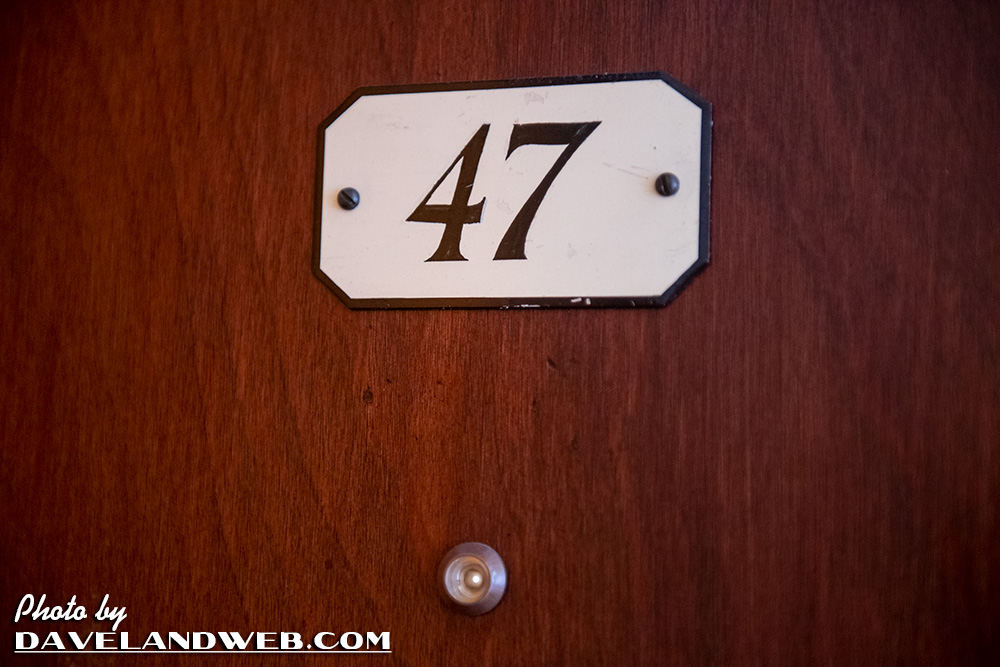
My recent post about Gram Parsons mentioned that he had stayed in Room 47 at the Chateau Marmont hotel in Hollywood. The photo below that I found online was supposedly shot there, but now that I’ve stayed in 47, I can say that the window placement doesn’t really match up to anything.
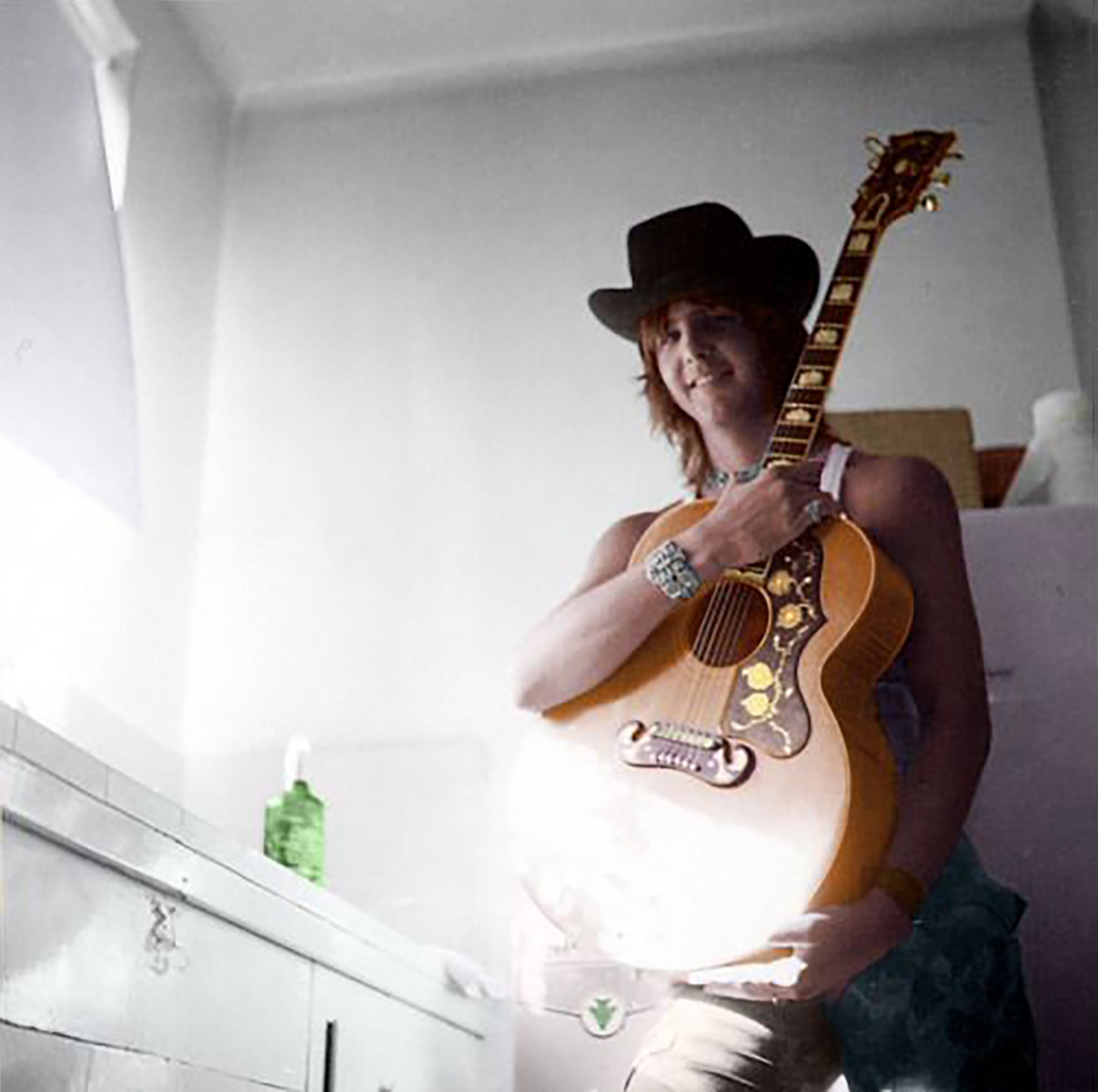

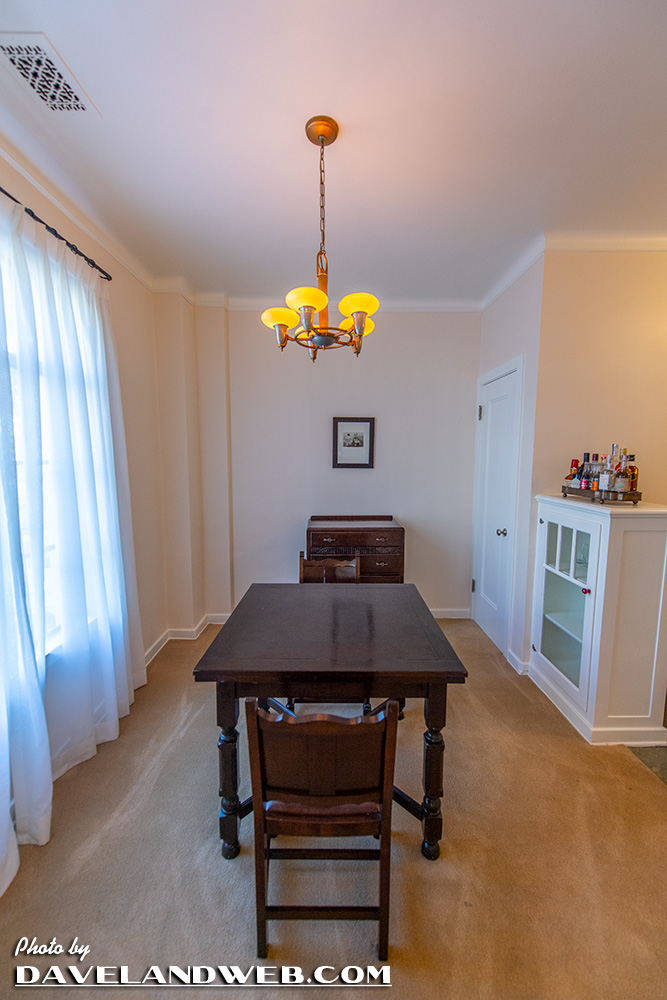


Willis didn’t sense Gram in the room, either. Maybe it wasn’t even 47 where Gram and his wife lived.
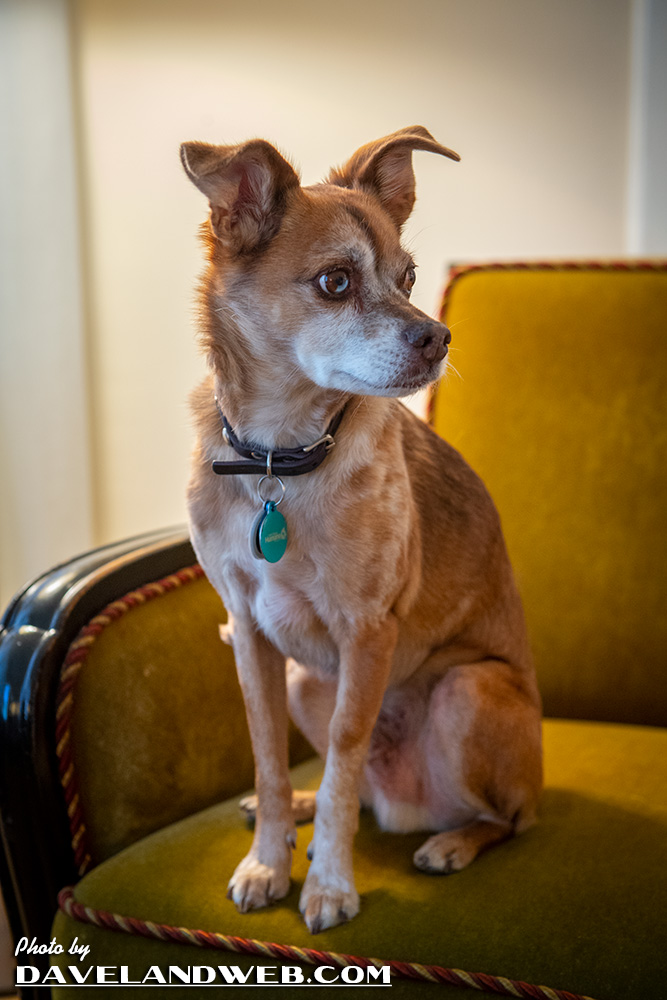


The other thing I had read about Room 47 was that writer and critic Dorothy Parker had stayed there and injured herself in the bathtub, circa 1948. Here’s where it happened:




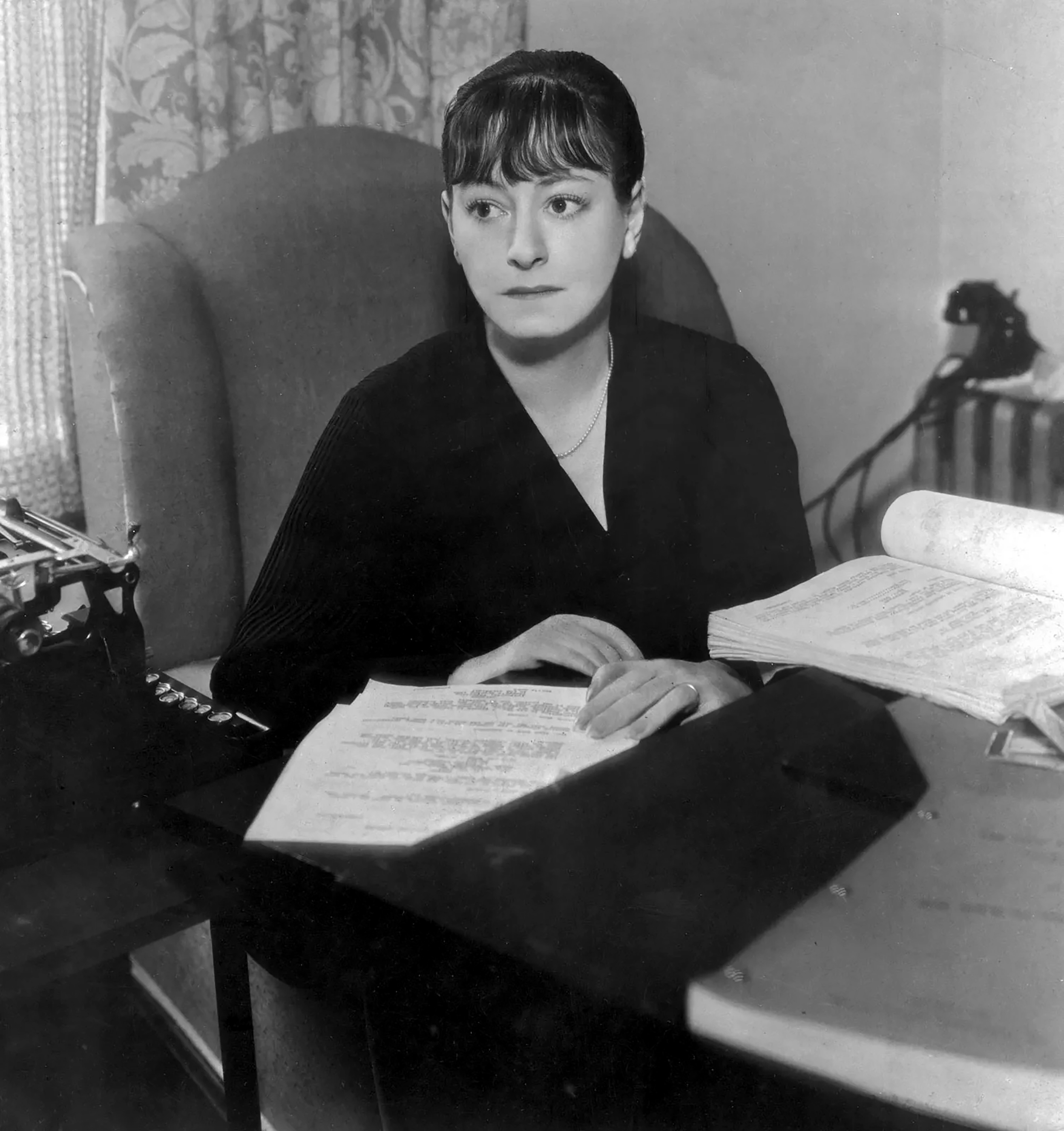
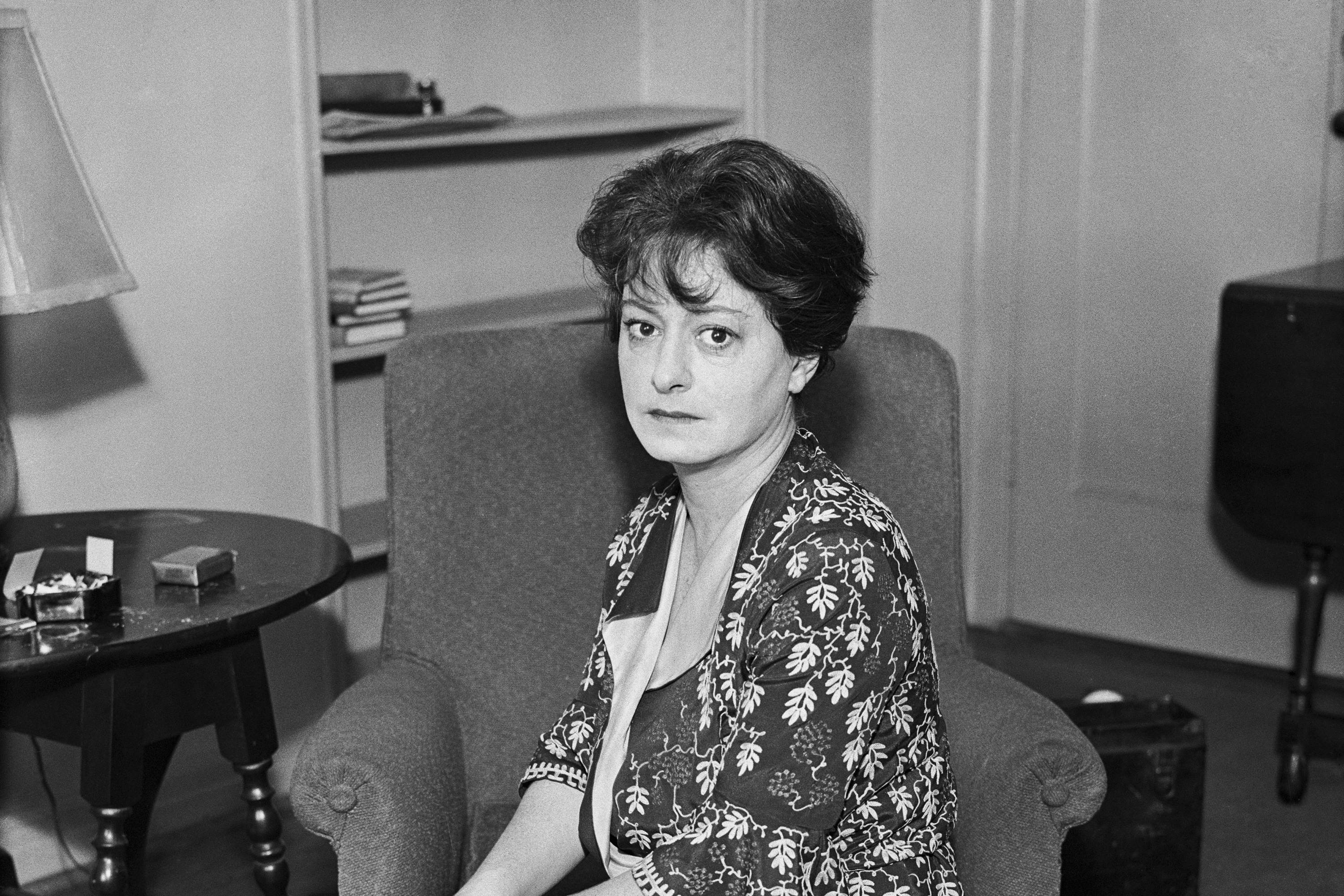
Here’s a shot of Dorothy (unknown location) from 1939:


It seems that Dorothy first stayed across the street at The Garden of Allah hotel, which is currently a mound of dirt, awaiting construction of another Frank Gehry monstrosity. In a chapter titled “The Grim Weeper” from her book The Garden of Allah, Sheila Graham wrote:

Dorothy Parker used to announce that she was half Jewish, so if anyone said anything against the Jews, only half of her would walk out. She was the most unpredictable woman I ever met in the Garden of Allah or anywhere else. I had met her in New York before I came to Hollywood.…She was staying at The Lowell Hotel, and when she could not pay her bill there, she ordered an ambulance and was carried out on a stretcher. Who would dun a dying woman?
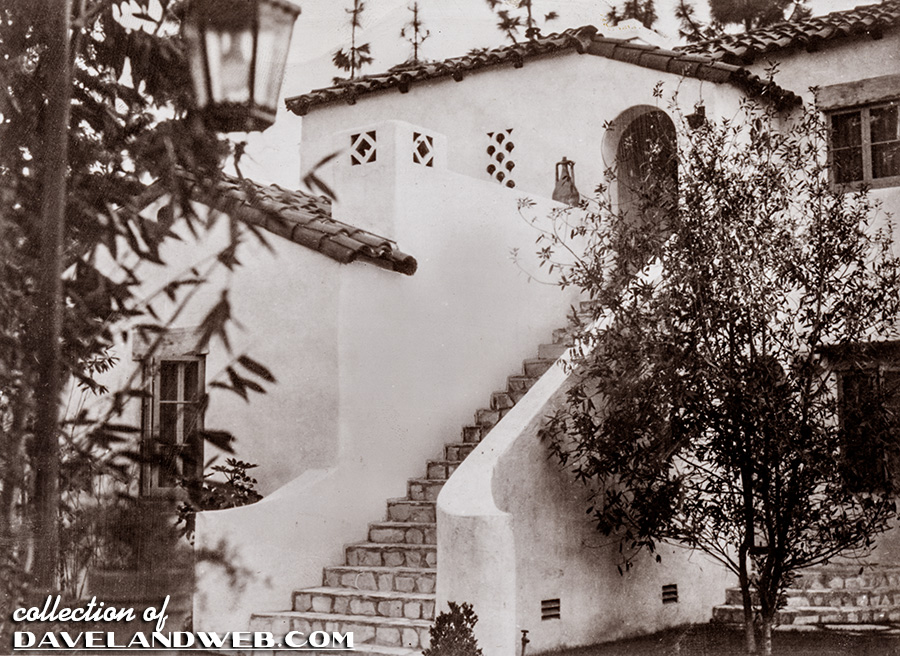


Years later, Graham would see Dorothy at The Garden of Allah (photo above), hanging out (drinking) with F. Scott Fitzgerald and Robert Benchley.

Dorothy frequently put her head in the oven, making sure that she had called someone first. I doubt whether she even turned on the gas. She often slashed her wrists. She wore bracelets to hide the scars. Benchley once said to her, “Oh Dottie, if you keep on committing suicide you’re going to injure your health permanently!”

“Being friends with Dottie,” said George Oppenheimer [screenwriter], “was like living on a volcano. She eviscerated you when your back was turned. Nonetheless, I remained close friends with her through all the ups and downs.”

Artie Shaw met Miss Parker when he lived at the Garden and thought she was a sad, strange lady. “These people who are supposed to be enormous wits, they have constantly to live up to their reputations. I found many of Dottie’s remarks quite lame, but of course one only remembers the good ones. I think she outlived her period.”


When her husband Alan Campbell died, a friend approached Dorothy and asked, “Is there anything I can do for you?” “Yes, you can get me another husband.” Shocked, the friend exclaimed, “You can’t mean that!” Dorothy replied, “Then get me a ham sandwich and hold the mustard.”

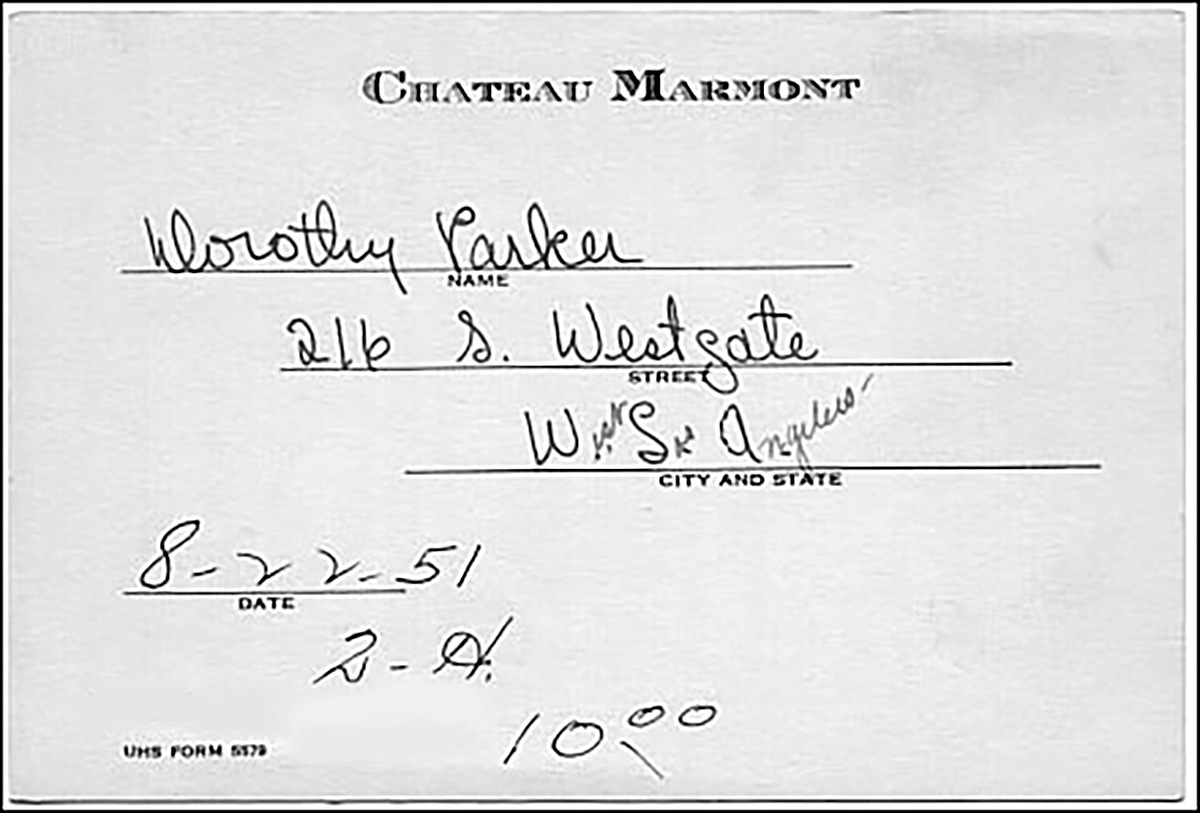
Here’s her Chateau Marmont registration card, which I found on the Dorothy Parker website:


And now we come to the bathtub incident, as relayed in the book Life at the Marmont:

When Dorothy checked into the Marmont in 1948, she brought with her a little dog, but not her husband, Alan Campbell. They had recently separated, and Parker was attempting to carry on without him, bolstered by. heavy sessions with a bottle in her suite, 47. She was often so desperate for companionship that she would pick up the telephone and chat with the switchboard operator. It wasn’t long before Parker began inviting her newfound friend to join her for drinks after work. “I would stay about a half hour, long enough for several cocktails,” the operator recalled, “then scramble for the bus.” When the operator told her sister about her visits with the famous Dorothy Parker, the duo stretched into a threesome. The women would meet for lunch—and drinks, always”then adjourn to 47, where they experimented with various hair-styles to try to brighten Parker’s ever-gloomy mood.


One Sunday afternoon, following a get-together, the operator’s sister phone Parker in her suite to thank her for “a lovely time.” Luckily, the third member of the trio had returned to her post at the switchboard. “It was a long conversation,” she remembered, “or so it seemed. The board was very busy, and an hour had passed before I realized that the connection was still up. I don’t know what possessed me, but I opened the key to make sure they were still talking. The only voice I heard was Miss Parker’s, and she sounded so far away,…crying for help. I called Gene Gordon, the garage man, and told him to hurry up to the fourth floor and see what was wrong.” Gordon found Dorothy Parker lying semi-conscious in her bathtub; she had slipped and fallen, hitting her head. An ambulance was quickly summoned, and Parker was rushed to the hospital, where she was examined and released, wrapped in bandages that all but covered her perky new hairdo. The next day, the operator spotted Parker wandering through the lobby with her bandaged head. “I left the switchboard and tried to console her, but she brushed me aside and kept on going.” The operator was at a loss to explain Parker’s sudden coolness, but then, there were other unanswered questions. In Parker’s despondency, had her slip in the tub really been accidental? If so, why was she so angry with the person who had responded to her pleas? If not, why had she cried out? And why had she left her phone off the hook? There were insiders at the hotel who wondered if the mishap had been staged simply to gain attention and sympathy.

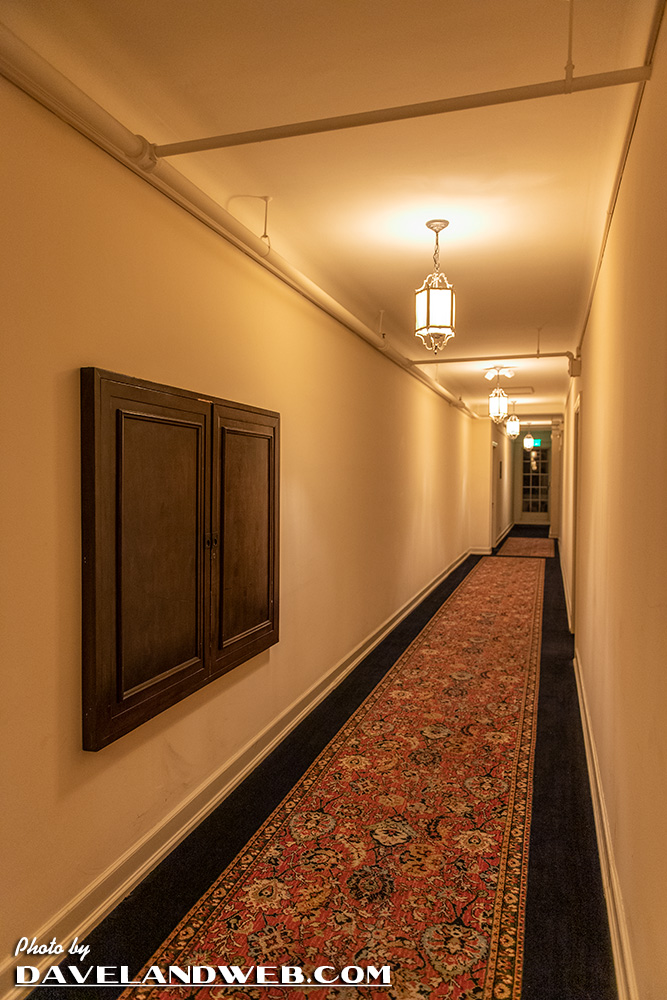
Any ghosts when I stayed in the room? No. The only time I feel an otherworldly presence is when I am in the hallways at night.


See more Chateau Marmont photos at my main website.

Thursday, September 08, 2022

Gram at the Chateau Marmont


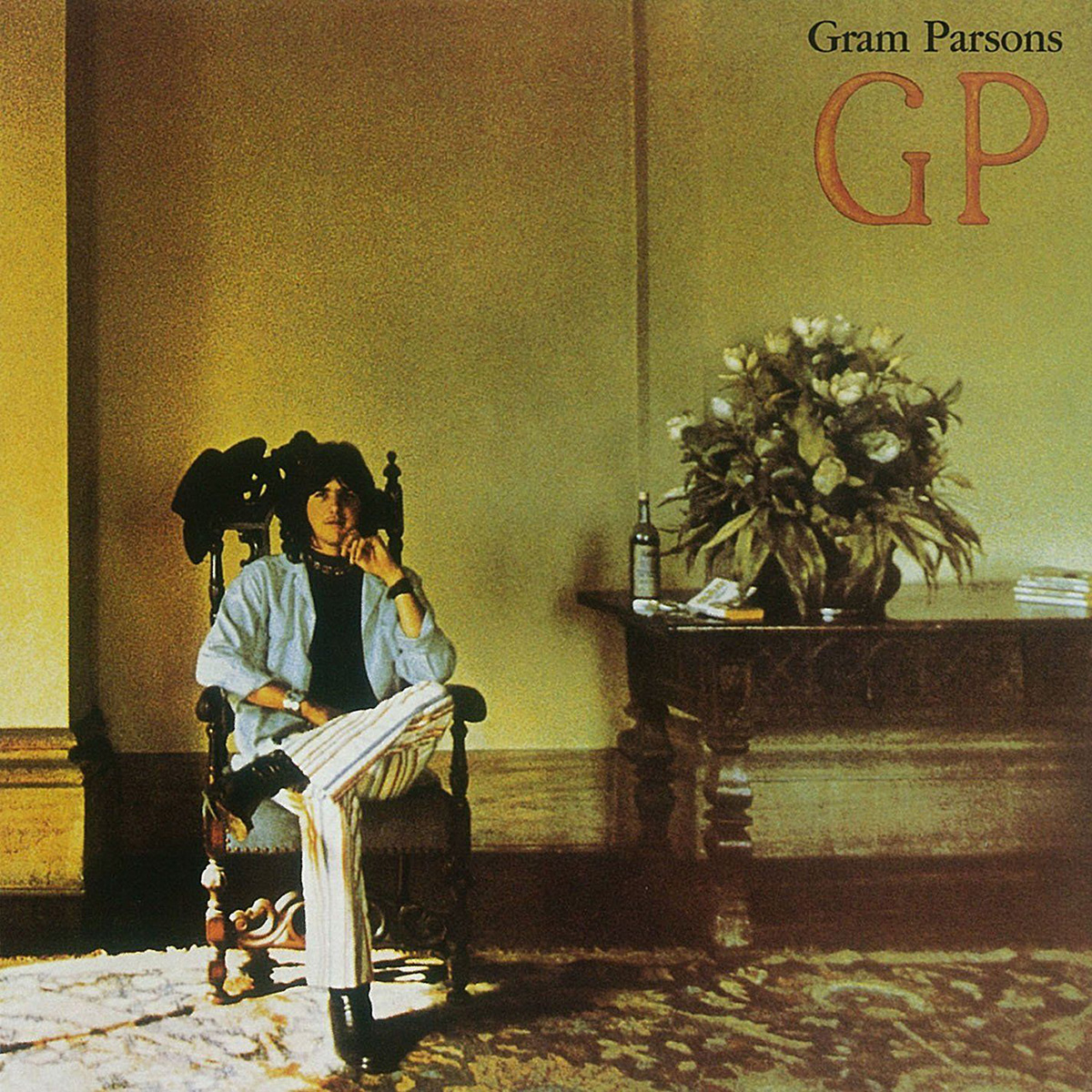
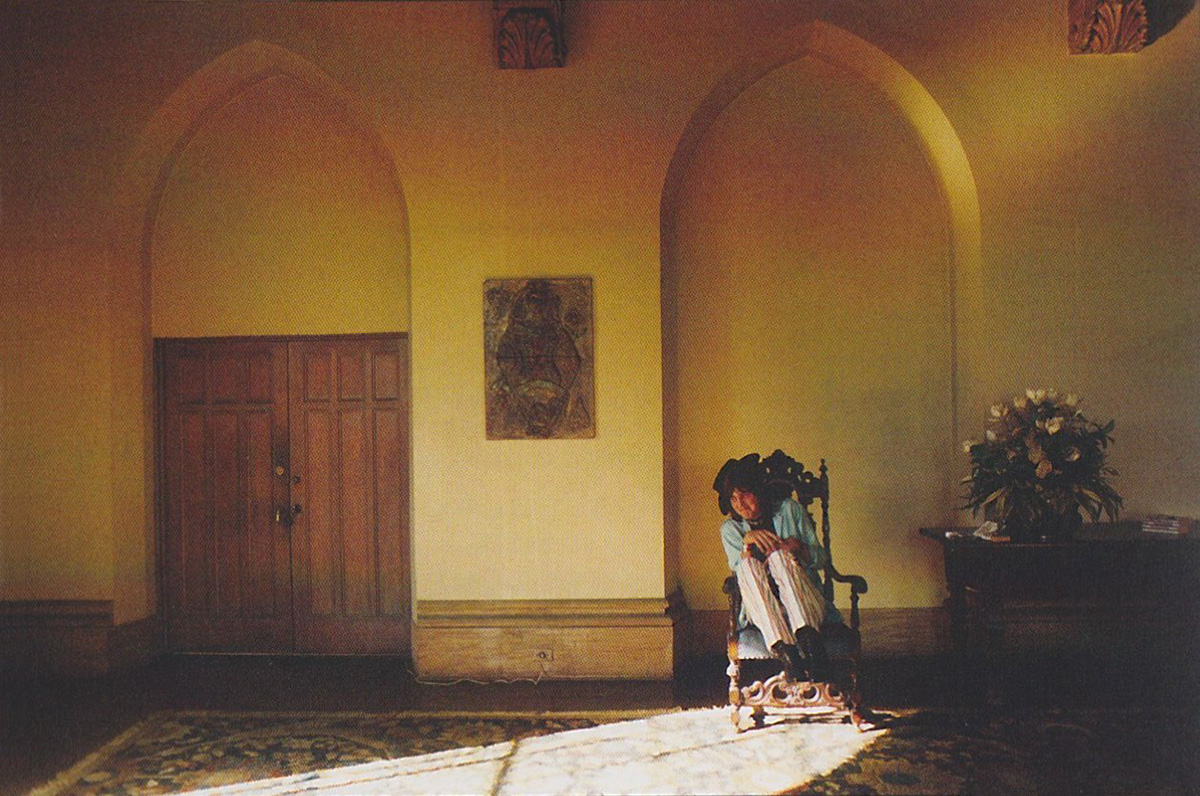
For the cover of his 1973 debut album titled GP, Gram Parsons posed in the foyer of the Chateau Marmont for photographer Barry Feinstein. At the time, he was living there with his wife in Room 47, which is one of the few rooms I haven’t stayed in and also known as the room where writer/critic/satirist Dorothy Parker hit her head on the bathtub in 1948. Parker was quoted as saying at the Chateau front desk when picking up her mail, “Life would be a bed of roses if it weren’t filled with pricks!” But I digress…In the contemporary shot below, you can see that the archways leading to nowhere have been covered with drapes. Wonder where that table ended up?


Another photo from the session shows that one of those archways actually had a doorway leading outside; next visit, I need to pull back the drapes!


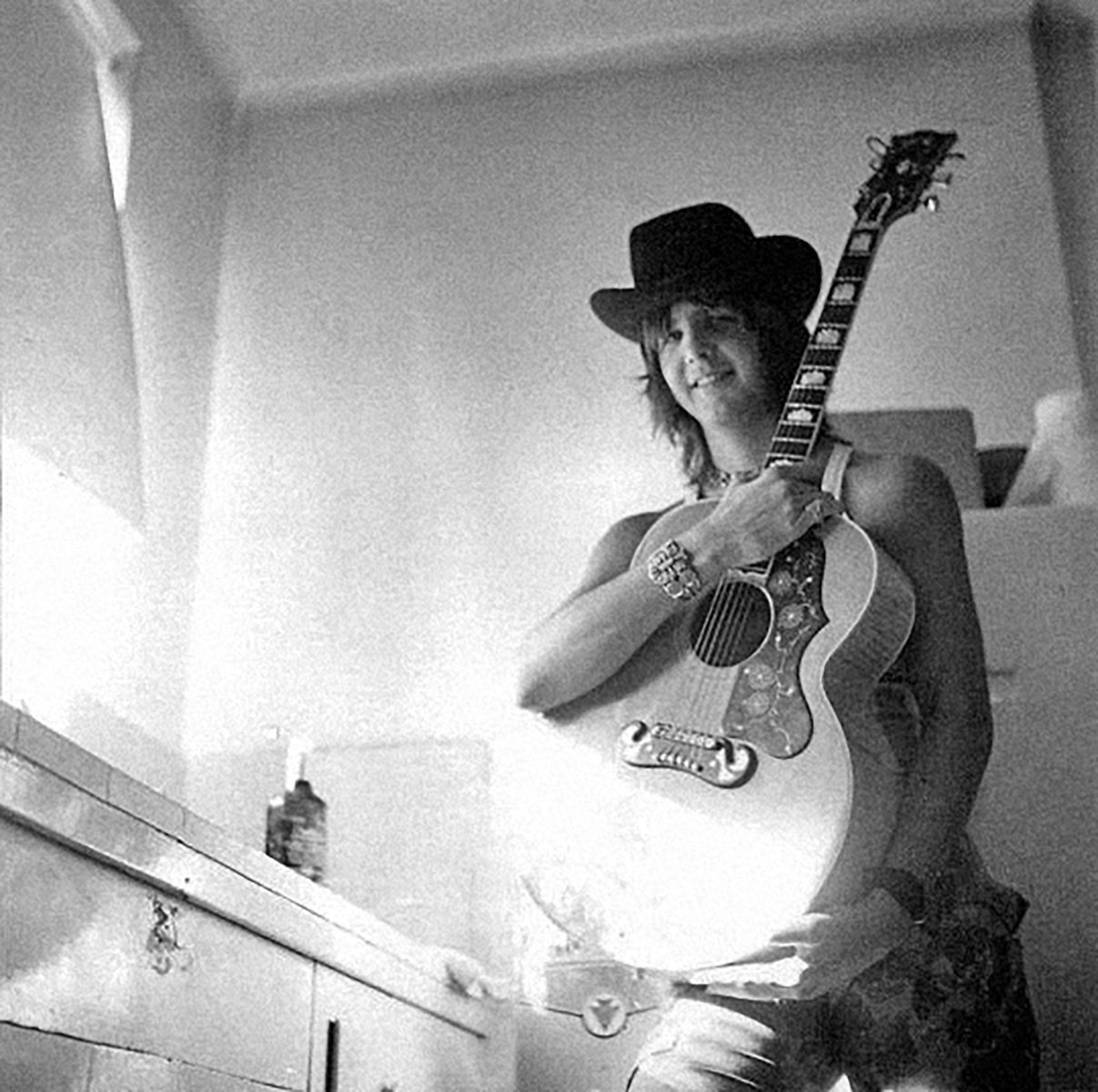
The image below was also supposedly from his room at the Chateau; by the tile on the counter, I am guessing either in the kitchen or the bathroom. I’ll let you know once I’ve seen it!


In the 1987 book Life at the Marmont (still the Bible of Chateau history), Parsons is mentioned in a section about the hotel during the early seventies:

An advertising executive from New York cleaned up the mess when a large chunk of plaster fell from the ceiling in his suite during the night. Myrna Loy and Gram Parsons carried on as though nothing had happened, after lobby chairs collapsed under them.…It is easy to understand why the owners were hesitant to spruce up the place. Why bother when no one complained? With so much plastic and glitz along the Strip, they had every right to believe that part of the Marmont’s attraction was its slightly tarnished splendor. An incoming New Yorker compared the Marmont to a theatrical backdrop. “It’s the stars who are supposed to glitter,” she said, “not the sets.”

The bottle of booze in this Chateau shot (and on the album cover) is explained by this text from Wikipedia:


The sessions for GP ran from September through October 1972 and were produced by former Blind Faith bassist Ric Grech. Parsons was beside himself with excitement at being surrounded by such stellar musicians but also severely intimidated by their presence; in a February 2013 cover story for Uncut, David Cavanagh recalls the singer’s reticence:

“Rehearsals for GP descended into drug binges. The songs were coming together – ‘Still Feeling Blue’ (a Parsons original), ‘Kiss The Children’ (by Grech), ‘Streets of Baltimore’ (a 1966 composition by Tompall Glaser and Harlan Howard) – but Gram was falling apart at the seams. He was in the grip of alcoholism. He gorged on cocaine. He was bloated and sweaty; friends in Los Angeles estimated he'd put on three stone [42 pounds] since his [Flying] Burrito [Brothers] days, Singer and rhythm guitarist Barry Tashian remembers him being ‘nervously excited’ about the album, but strangely paralyzed by inaction.”

In the 2004 documentary “Gram Parsons: Fallen Angel,” Harris admits, “Gram was drinking a lot during that recording, and so there were times when he was together and times when he wasn't. I hadn't done that much recording in my life but I thought, ‘If this is the way people make records, I just don't get this.’” Realizing he could be blowing his big chance, Parsons cut back on his drinking and finished the sessions.


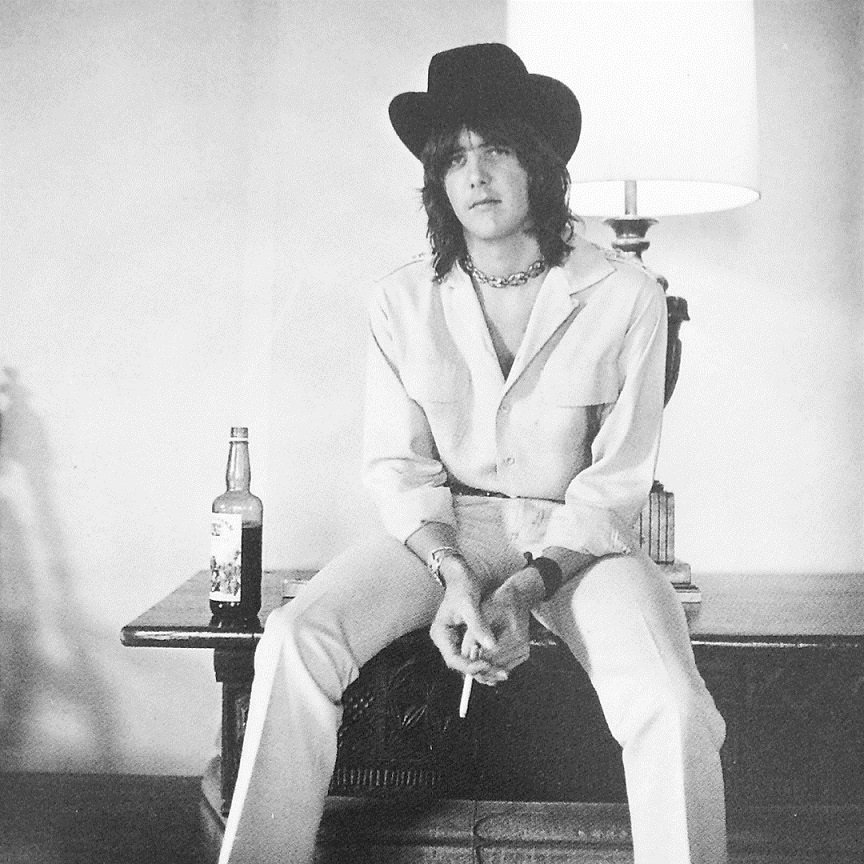
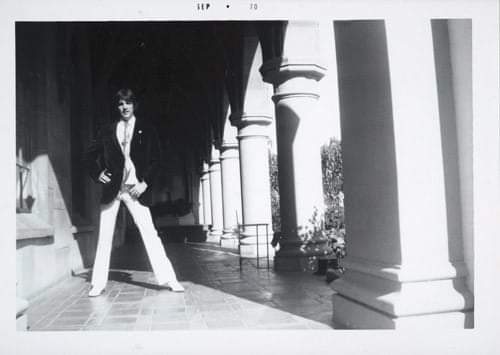
I found the September 1970 photo above on Facebook, where the poster purports it to be of Gram at the Chateau, but based on the comments it may not be. The location is definitely the Chateau, though:


The photo is from the Huntington Library’s recently acquired Eve Babitz collection. Edited from the Huntington website:

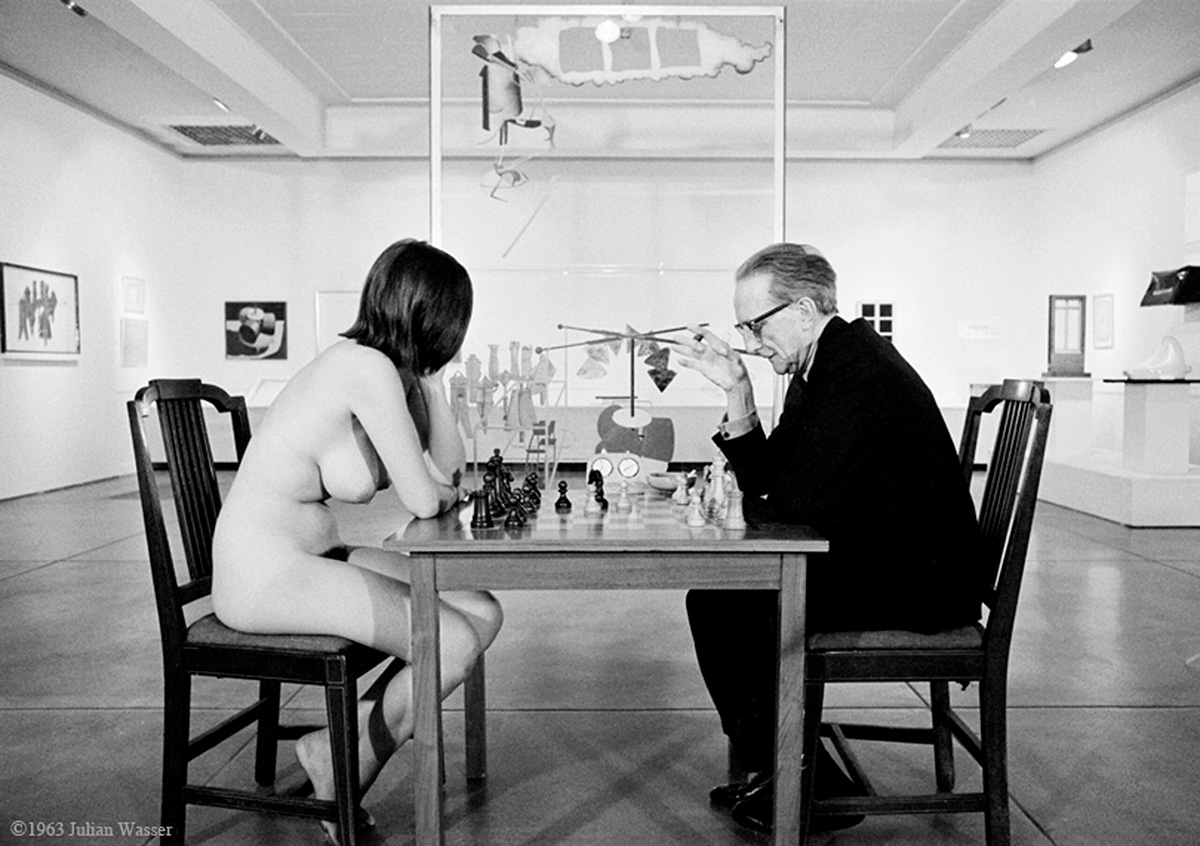
Eve Babitz was born in Los Angeles in 1943. Raised with her sister, Mirandi Babitz, in a world of painters, authors, and composers—her godfather was composer Igor Stravinsky—she attended Le Conte Junior High School and Hollywood High School. Babitz wrote, “In most high schools, you learn social things along with the rest of it. In mine, I learned irrevocably that beauty is power and the usual bastions of power are powerless when confronted by beauty.” Babitz was never shy about leveraging her own attractiveness, famously writing to Joseph Heller, author of Catch-22, “Dear Joseph Heller, I am a stacked 18-year-old blonde on Sunset Boulevard. I am also a writer.” Later that year, she was sitting for a now-iconic photo in which she plays chess in the nude with a fully dressed Marcel Duchamp.


Babitz’s young adulthood was the stuff of Hollywood fantasy: She partied with Jim Morrison, the Eagles, and other rock and rollers who passed through the Chateau Marmont; hobnobbed with the literati at Joan Didion’s house; interviewed Janis Joplin; and was invited to an endless stream of parties surrounded by the bohemian beau monde of her time. Not just a groupie, but an artist among artists, she first pursued collage, and many of her works appeared in magazines and on record albums. But Babitz wanted to be a writer, and after early encouragement from Heller and Didion, she published her first piece, “The Sheik,” in Rolling Stone magazine in 1972. Two years later, she published her first book, Eve’s Hollywood (1974), and followed it with Slow Days, Fast Company (1977), Sex and Rage (1979), L.A. Woman (1982), and Black Swans (1993). In addition to Rolling Stone, Babitz contributed articles to The Village Voice, Vogue, Cosmopolitan, and Esquire, bringing to light an “only in LA” world of rock star lovers and over-the-top parties from the epicenter of cool.

In 1997, Babitz was severely burned when she accidentally dropped a lit match onto her skirt. She soon stopped writing and disappeared from public life. Then, in 2014, Vanity Fair published Lili Anolik’s retrospective on Babitz, “All About Eve—and Then Some.” That article was followed by a stream of others, which—along with the reissuing of most of Babitz’s books—brought about an Eve Babitz renaissance of sorts. Babitz, who died on Dec. 17, 2021, from complications of Huntington’s disease, found a new generation of readers in the last decade of her life. The Los Angeles Times and the New York Times published laudatory obituaries, notable achievements for an author who felt snubbed by the New York literary establishment earlier in her career.

According to Mirandi Babitz, “When I told Eve that The Huntington was very interested in her archive, she said, ‘I would love to be with Blue Boy and Pinkie again, like when we were kids. It’s as classy as the Beverly Hills Hotel so I know I’ll be happy there.’”

The acquisition of the Eve Babitz archive is supported in part by a generous contribution from Steve Martin and Anne Stringfield.


And what happened to Gram? He sadly died of an overdose at the age of 26 on September 19, 1973. From a vintage October 1973 article from Rolling Stone magazine:

The pile of stone [at Joshua Tree] is known as Cap Rock because of the flat, ten-foot, oblong boulder that rests at a slightly cocky angle at the peak of the formation. At the base of its north side, Cap Rock’s light gray coloring is charred black, and visible in a patch of sand are bits and pieces of burnt wood the size of barbecue briquets. The debris is the remains of a coffin that contained the body of Gram Parsons, who died September 19th while vacationing at a Joshua Tree motel. The singer-songwriter-guitarist, a former member of the Byrds and Flying Burrito Brothers, was 26 years old. The San Bernardino County coroner’s office said Parsons apparently died of heart failure due to natural causes, but the exact nature would not be known until after a toxicology report was received.

Although described as a person who “lived hard” – he drank heavily at times; there was talk of heroin use – his death shocked friends and business associates. Even more startling was the series of events culminating in his cremation in the desert on the morning of September 21st. Parsons’ family had planned a New Orleans burial, but his coffin was stolen from Los Angeles International Airport. Friends claimed the cremation near Joshua Tree had been Parsons’ wish. The family – Parsons’ wife, mother and stepfather – went into seclusion.

Initial news reports made reference to a “ritual” at the cremation site, but Los Angeles Detective Sgt. John Hamilton said later the reports were “completely false.” Within a week police arrested Phil Kaufman, 38, Parsons’ road manager, and Michael Martin, 26, reported to have been a roadie with the Byrds during Parsons’ one year with the group. They were booked on suspicion of grand theft and released on $1000 bond. Two days after the cremation, and before the arrests, an anonymous source, in a telephone conversation arranged through a known associate of Parsons, told Rolling Stone: “It was done by people who really loved him . . . .

“They had this old hearse and they thought they’d wear suits and pretend to be hearse drivers, but that didn’t work, so they decided to be off-duty hearse drivers, and they made up this story about how they didn’t really want to go get this body when they had a girl all ready someplace to fuck them out of their minds; so they played that out to the guy –’Come on, we gotta get to this girl, we’re working overtime, let’s get out of here’ – like that, so they signed a name, ‘Jeremy Nobody,’ to the slip and took the body off.

“It was Gram’s request, just something he had told them not too long before he died –’If I go, I want to be in Joshua Tree and I want my ashes scattered here’ – that sort of thing.

“They resented the stepfather [Robert Parsons] who came in and arranged for burial in New Orleans and didn’t even invite the friends . . . .” Yet to be determined is just when, if at all, Parsons made his request. Was it an offhand remark, a moment of melancholy? And if so, why was the request undocumented, leaving friends open to prosecution?


Truth is definitely stranger than fiction. Stay tuned for a report from Room 47 some time in the future [note: that report can be found here: https://davelandblog.blogspot.com/2022/11/dorothy-gram-room-47.html]. Looks like I’ll need to check out the Joshua Tree Inn as well.

See more Chateau Marmont photos at my main website.