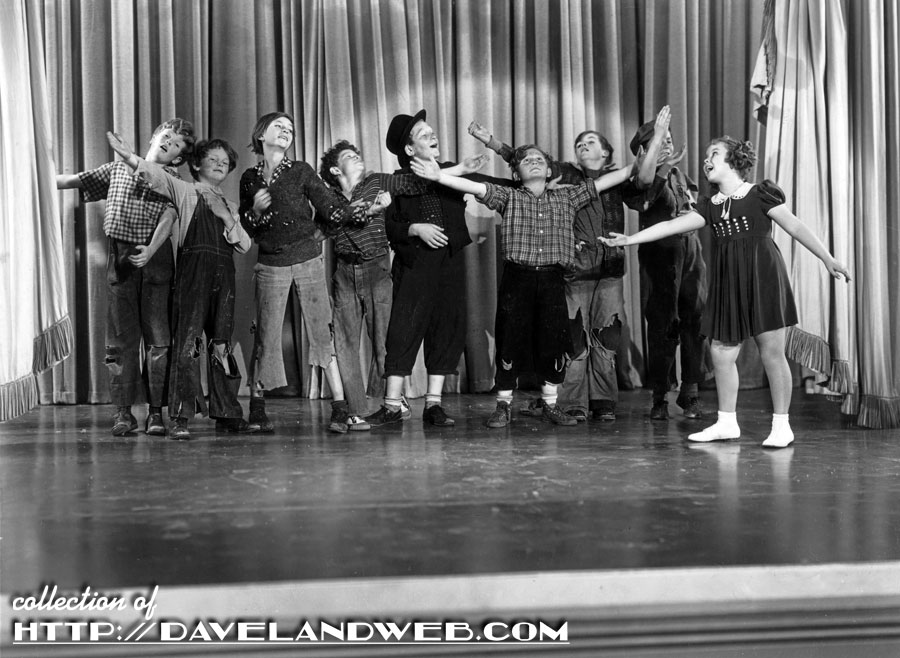
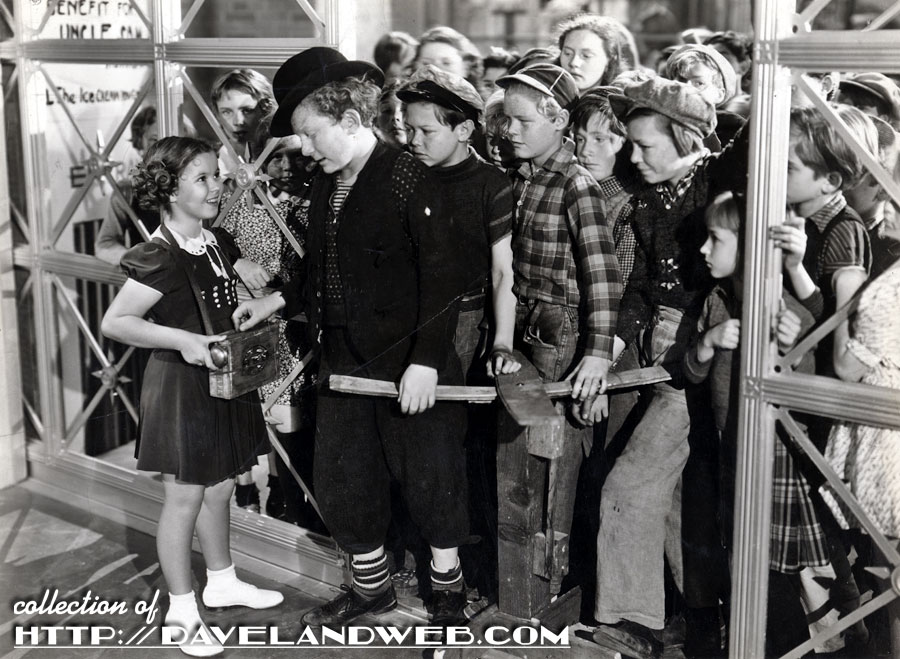
“Runt Page,” a Jack Hays production for Universal with the Baby Stars, released April 11, 1932. A spoof of the popular film, “The Front Page” (1931), it was a ten minute short that used toddlers with dubbed voices. It’s fairly painful to watch, but you can see that even at the tender age of three (turning four on April 23), Shirley and the camera had a love affair. Hays would go on to produce a series of “Baby Burlesks” shorts for Educational Pictures that continued to spoof famous Hollywood productions, but this time around utilized the actual voices of the children starring in them (which included Shirley). The picture above shows Shirley with the supporting cast of “War Babies” (1932), her first film in the series. Below, Hays poses with the kids while Shirley attempts to take a picture.

Educational Pictures was founded in 1916 by Earle Hammons; it is most famous for the Temple shorts as well as some featuring Buster Keaton, made when the great comedian’s career was on the downward trend. Educational folded in 1940, when Hammons’ attempt to enter features failed to secure backing. Astor Pictures purchased the sound shorts and took advantage of Shirley’s popularity by combining some of them into a longer film titled, “Our Girl Shirley” (1942). Here is a photo of Hays with Shirley; it is a bit disturbing, but makes for a good lead-in for today’s post.

In the May 1936 issue of Rural Progress magazine, there is an interesting story about Shirley’s rise to fame and who deserved the credit for it. The Al Hicks article is titled, “Who Made Shirley Temple?”

I have just left a guy in front of the Roosevelt Hotel on Hollywood Boulevard who assured me, in no uncertain terms, that it was he who was responsible for Shirley Temple’s success.…He is exactly the eighty-third in six months to tell me the same tale—to say nothing of a half dozen children’s dramatic and dancing schools, out here in the “Violet Ray Belt,” assuring prospects they were the ones who trained the wonder child! I am about fed up on this wholesale hitch-hiking upon the little darling’s reputation.…Before I swing into action, let me assure you I am not a member of the Temple menage, nor am I on the publicity staff of any organization remotely connected with Shirley’s activity. Occasionally, when I am in the neighborhood, I drop in to see George Temple, Shirley’s father, at his desk in the bank he manages. Our conversation is usually general, with little or no reference to Shirley.…Secretly, I think he believes me to be a slicker, for it was my eloquence that inveigled him and Mrs. Temple into signing Shirley’s first unprofitable contract. Later, it was his own shrewd business sense that untangled him front it—but that is leaping ahead of my tale somewhat.
In December, 1931, I had just unleashed myself from the Hughes-Franklin Theatre organization and was ankling around Hollywood…when I bumped into my very dear friend, Jack Hays—later the Jack Hays Productions of Educational Studios.…He had a release with Universal Pictures.…He was to make one single-reel picture for them—a picture with an all kiddie cast. They were standing seventy-five per cent of the production cost and twenty-five per cent. If it was accepted, he could make five more of them. He had a stupendous idea—children in action, with adult voices dubbed in instead of their own voices when they spoke. He needed me to help train the kids, as well as to help raise the “cuff” to meet his twenty-five per cent of the costs. The film was to be made on Poverty Row in Hollywood, as best we could.…“Come on, Al, let’s get right over to the kids’ dramatic school and you can start helping rehearse ’em.” And so I went, and so I met The Temple.…In the center of the room, tiny Shirley was standing with an arm about the shoulders of her four-year-old leading man (who had a pout on his face from ear to ear). With her mouth close to his ear, so that she might be heard above the dynamic noise, she was saying: “And then, Georgie, that is where you come in and take my hand and run out with me.”…A word regarding the school, the casting and method of picking the kids for this picture. Shirley at the time was taking tap-dancing lessons.…By her own mother’s promotion, she had appeared already in one or two local affairs. In picking children for the picture, a certain height and age were required—along with a smattering of ability to obey simple instructions. Shirley was lined up with the rest and picked simply because she fitted the size and age mod. It was during rehearsals that her own work and obedience brought her to the fore as leading lady.
Later, the picture finished but neither approved nor even previewed, I was assigned to take a half dozen of the children and their parents over to Hays’ lawyer to sign a contract with The Hays Productions. It was, I believe, the usual child’s contract, approved by a court judge. I remember, though, that the financial gleanings were small and uncertain.…“Runt Page” was a flop—a dismal flop. But it so happened that, as an experiment, we had allowed the last spoken line in the film to come through in the child’s natural voice instead of dubbing in an adult voice as we had done with the rest of the picture. All the great massive minds engaged on the production of this opus then discovered that the childish voice, when accompanied by the child, was very cute and very funny.…So a release was obtained from Educational for six pictures along the line of our “amazing” discovery. Shirley worked through these six pictures, assisting more than she was assisted. Her mother was, and still is, her big asset. Mrs. Temple works with intelligence and understanding, training Shirley at home so that there is little to be done when she arrives for work. At times, I suspect Mother Temple of tap dancing a little, or a great deal (perhaps I’ll be sued for this), in order to help Shirley in this branch of her artistry. This last crack is only really funny if you know Mrs. Temple. Nevertheless, the credit for real, persistent guiding must go to Shirley’s mother.

Toward the end of this series, Shirley got her first chance to work in a feature, by being farmed out to another studio. I was elected to accompany her there, the old Tiffany Studios, I believe it was, at Vermont and Sunset. The picture, if memory serves me, was “Red Haired Alibi.” Mr. and Mrs. Temple remained in the car while I went in with the tiny Temple. We found the stage where they were just setting and lining up for the morning’s shooting. Shirley was not to be used until the afternoon, but we wanted some information on the part, costume, etc. I stopped outside the shooting lines and sat down behind the cameras on a roll of rugs and said: “Shirley, I don’t know this director’s name, but there he is out there in that folding chair. It would be a lot better if you could go out there alone and introduce yourself. You’re really not hired yet, and it will help if you go by yourself. Want to try it?” “Yes, I can talk to him, Mr. Hicks.” She walked slowly out, dodging a “juicer” that was laying a lamp cable. I’m Shirley Temple. I take good direction; I work up at Educational. If you want me here, will you please tell me what time and what to wear?” She got the job.
After the series at Educational was released, there was a long period of waiting in hopes of another series the following year. Meanwhile, Hays opened a training school for children down at Culver City, using his finished series and the one “he was going to make” as sort of bait. I faded out of the picture at this point but little Shirley was forced to attend this school so many days a week under the guise of “rehearsal and training.” In reality, she furnished a choice piece of bait for the other kiddies’ mothers. But Hays finally took a plea in bankruptcy. It was then that Mr. Temple showed artful business insight in managing to buy Shirley‘s contact out of the receiver’s listings.
Apparently, George Temple paid $25 for that contract. He also wrote Hays on October 30, 1933, confirming his ownership of the contract, which was still in Hays’ physical possession. Hays didn’t respond, but legally, that was of no consequence. Hays filed his first suit on October 7, 1936, against the Temples, 20th Century-Fox, the California Bank, and the California Trust Company, claiming that he was owed $500,000 in damages and an additional one-half of Shirley’s earnings from radio, ad contracts, endorsements, and other incomes, estimated at an additonal $500k as compensation for all of the training (singing, voice culture, and drama) that he provided Shirley out of his own pocket. He claimed he was not given notice of the bankruptcy asset sale and therefore it was null and void. The suite was dismissed three months later, with a similar suit also dismissed a year later on January 27, 1938.

Jack soldiered on though, serving Shirley’s mother a subpoena in March 1939. This decision came much quicker (during the same month) and was also thrown out. Hays appealed the decision, increasing his claim to $700k. To avoid any further nuisance from the determined producer, they settled out of court for $3,500.
Most of the versions available of the Baby Burlesks are horrid quality; blown out, scratchy, and duped from old 8 and 16mm prints. I discovered that Cinemuseum LLC acquired all of the source materials from Education and as of 2018, they were in the process of scanning/restoring them for home media. Let’s hope that happens soon!
See more Shirley Temple photos at my main website.