Showing posts with label william travilla. Show all posts

Wednesday, August 26, 2026

Even More Marilyn at the Academy


Who would have thought that a backwoods country singer could unite the world through her love, talent, and infectious joy? That's exactly what Dolly Parton did, and while I plan on doing a tribute post for her, there was just not enough time for me this morning to do it right, so instead, you get more Marilyn Monroe from the Academy exhibit in Los Angeles. Two dresses from one of my very favorite Monroe flicks, “Some Like it Hot” (1959) were on display together.


Designed by Orry-Kelly, they both appear to be original (other than the shoes), based on the nearby placard:

Marilyn Monroe’s work in director Billy Wilder’s “Some Like It Hot” is often cited as her best. The film was controversial for its racy humor and story about two musicians (Tony Curtis and Jack Lemmon) who disguise themselves as women to evade the Mafia. But of equal scandal were the Oscar-winning costumes by Orry-Kelly for Monroe’s Sugar “Kane” Kowalczyk. These two dresses feature carefully placed beading and sequins so that when shot in black and white, Monroe appeared partially nude.


Silk, sequins, and chiffon never looked so good. Here’s a color publicity still showing Monroe in the outfit:


This one is probably my favorite outfit she wears in the film. The amount of detail in the sequins for something that would barely be able to be seen on screen is astonishing.


Marilyn wearing the dress. At the bottom of the photo, you can see my very favorite detail - a heart on her left butt cheek:
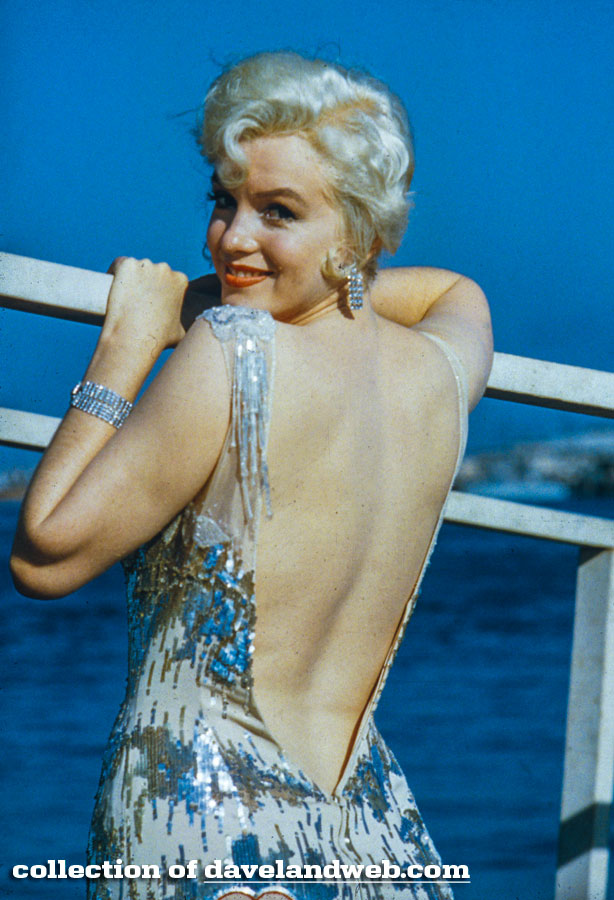


I wonder how many people who watched the movie even caught this little detail? While Monroe looked fabulous in black and white, seeing this costume in person in full color gives one an even deeper appreciation for the craftsmanship that went into it.


Monroe and Curtis between takes:


As I approached the legendary “Seven Year Itch” (1955) subway dress, I wondered…could this be the real thing? Well, kind of, but not really.

This replica was made by the original costume designer William Travilla. He often made close copies of his most iconic film looks for publicity purposes. This version has the belt secured in the middle. For the original costume, Monroe tied the belt to the side.


Tied front and center:


As seen in the film (with Tom Ewell), tied to the side. Much better! Good choice, Marilyn!


Final outfit for today is from “Bus Stop” (1956). All original EXCEPT for the shoes, tights, and gloves.

“Bus Stop” marked a turning point in Marilyn Monroe’s career. She had recently formed Marilyn Monroe Productions and signed a new contract with Twentieth Century-Fox that gave her a higher salary and more creative agency. This design by William Travilla supported Monroe’s performance as saloon singer Chérie, who dreams of one day making it big in Hollywood. Monroe learned an Arkansas accent for the role. She asked Travilla to tone down the glamour used for her costumes in previous roles to better suit Chérie.


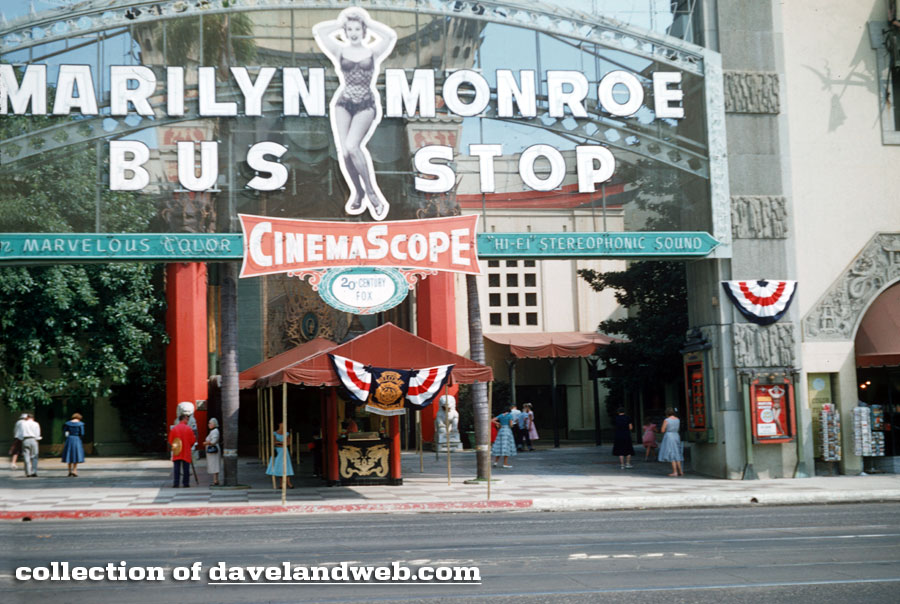
Monroe wearing this outfit on the larger-than-life marquee in front of Grauman’s on Hollywood Boulevard:


If you haven’t seen it yet, you have until February 28, 2027. Don’t put off for tomorrow what you can do today!

See more Academy Museum photos at my main website.

Thursday, July 16, 2026

More Marilyn at the Academy


We’re back at the Academy Museum of Motion Pictures on Wilshire Boulevard in Los Angeles to see more of the Marilyn Monroe exhibit that is currently being featured until February 28, 2027. I was truly impressed by the display, but also knew enough to carefully read the accompanying small placards to learn whether the item was authentic or a repro. In the deleted scene below from “The Seven Year Itch” (1955), Tom Ewell, Marilyn, and Robert Strauss vamp it up:


This particular William Travilla outfit appears to be mostly original. From the placard:

Monroe wore this “cellophane effect” gown in a scene that was cut from director Billy Wilder’s “The Seven Year Itch.” In the scene, Richard Sherman (Tom Ewell) dreams of Monroe’s character styled like early Hollywood star Mae West. Designer William Travilla micked key elements of West’s typical costuming, which often featured boas and her signature cigarette holder. Monroe admired West in real life, often emulating her sassy persona and irreverent humor for blonde bombshell roles. Synthetic eyelash fabric; non-original boa, jewelry, shoes, and cigarette holder.


Next I saw the famous “subway dress.” Could it be original? Or was that too good to be true for the outfit that was auctioned off for a cool $4.6 million in 2011? The answer is a little muddy; not original, BUT...it was still made by Travilla himself. From the placard:

This replica was made by the original costume designer William Travilla. He often made close copies of his most iconic film looks for publicity purposes. This version has the belt secured in the middle. For the original costume, Monroe tied the belt to the side. Rayon crepe; non-original shoes and jewelry.


 Last one from “The Seven Year Itch” is this silk pajama outfit. From the placard:

One of Monroe’s most successful roles was as The Girl in director Billy Wilder’s “The Seven Year Itch,” a comedy about a restless husband left to his own devices for the summer. These silk pajamas mark a pivotal moment in developing Monroe’s girl next door character: when her scheming neighbor invites her over for a drink, he imagines her arriving in a sexy ensemble. Instead, she appears in casual attire, selected by Travilla and made by Jax—one of Monroe’s favorite clothing brands. Silk; non-original shoes.


 What’s your guess on this one? Real or replica? From the placard:

Director Howard Hawks’s comedy “Gentlemen Prefer Blondes” was the third of eight film collaborations between Marilyn Monroe and costume designer William Travilla. In the movie, showgirls Lorelei Lee (Monroe) and Dorothy Shaw (Jane Russell) are introduced in matching red sequin gowns for the opening song and dance number, a performance that catapulted Monroe from up-and-coming starlet to icon. Travilla used a mix of beige and red sequins that give the costumes extra shimmer on camera. Rayon crepe, sequins, and silk chiffon; non-original hat, shoes, and jewelry.


The jewelry was re-created by Kathleen Lynagh Designs; the hat by Robyn Simms Johnson.


Below you can see Marilyn wearing the costume (sans hat) with Tommy Noonan, who played her nerdy but wealthy suitor:


More Monroe memorabilia to come!

See more Academy Museum photos at my main website.

Monday, June 22, 2026

Monday is for Marilyn: Diamonds Are A Girl’s Best Friend!


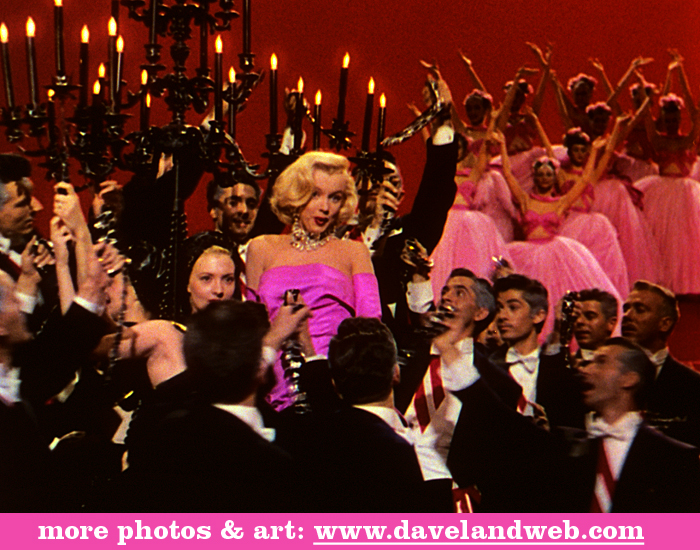
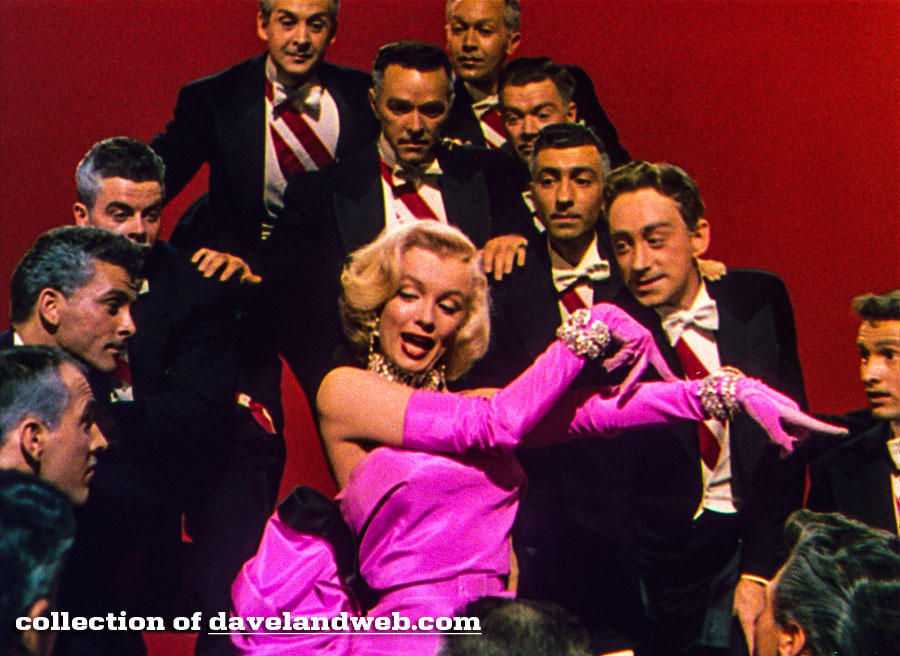
One of Marilyn Monroe’s most iconic numbers is from her 1953 film, “Gentlemen Prefer Blondes.” Wearing hot pink satin and covered in diamonds, the actress sang, “Diamonds Are A Girl’s Best Friend,” as shown in my recently created caricature above. It had to be done. At the Academy Museum of Motion Pictures in Los Angeles, they currently have an exhibit titled “Marilyn Monroe: Hollywood Icon.”


The entrance to the exhibit, designed for selfies of course:


One of the most gawked at pieces on display is the pink satin gown, which is an original with the jewelry re-created by Kathleen Lynagh Designs. The gloves and shoes are also reproductions.


William Travilla made the dress using a silk satin called peau d’ange (angel’s skin), chosen for its comfort and flexibility. In person, the fabric was described as pastel, but Travilla knew that Technicolor would boost the vibrancy. He added felt, boning, ostrich feathers, and horsehair to various areas of the dress to help keep its form during the rigorous dance number.


It amazes me how well preserved this costume is. The bow on the back:


This photo shows Marilyn wearing Travilla’s original design for the number:


…a bejeweled black two-piece over a mesh bodysuit. As the film was being finished, scandal broke out when Monroe’s 1949 nude photos resurfaced. The studio asked Travilla to remake the costume, resulting in this pink dress which was designed and completed just before filming.


Only the shorts and fan are known to remain of this original version which took months to create and cost about $4,000 at the time to produce (roughly $48k today!).


This unused pink bodice, which mirrors the chorus girls’ costumes, was archived and labeled with Monroe’s pink dress. It’s believed to have been made as Travilla explored options for the new design, though Monroe has never been pictured in it or described as wearing it.


A screenshot showing the chorus girls/dancers in the background:


This silverplate ring of elaborate links with a braided design, inlaid with shining clear gemstones, can be seen in the black and white photo showing Marilyn wearing the original outfit. Created by Joseff of Hollywood, it came up for auction recently:


Final photo for today is another screenshot of Marilyn performing the number that has been often imitated (but never improved upon!):


See more Marilyn Monroe photos at my main website.