

When it comes to Shirley Temple, you’re either a fan or you’re not, and if you fall into the latter category, you should avoid “Curly Top” (1935). Fox realized her box office power and put her front and center in this unashamed showcase of the little girl’s many charms and talents. In case you couldn’t figure out where the title came from, look no further than the opening frames of the credits which focus on Shirley’s signature curls. Although the story is loosely based on the novel Daddy Long-Legs by Jean Webster, there is no question that the title was meant to capitalize on Shirley’s skyrocketing fame with her adoring public. How adoring? No photos were too trivial for Shirley’s fans, including a series of shots that showed her hands and feet. No face.

As a gag, director Irving Cummings poses with Shirley and the other orphans looking through a rain-soaked window. Shirley’s stand-in, Marilyn Granas, is standing next to Shirley in the left corner of this shot:

Great care went into the production of “Curly Top,” including these architectural renderings for the beachside cottage that was owned by Shirley’s character’s ardent benefactor, played by John Boles. From the publicity caption on the back:
This is the front, or beach elevation, of the John Boles’ home used in the Winfield Sheehan production, “Curly Top,” starring Shirley Temple. A modern and simple treatment was designed by Jack Otterson, Fox Film art director, by accentuating horizontal lines in the wide banks of windows and a wide lap siding makes this a truly beautiful home. Great sliding doors open on the hallway toward the ocean.

The set was built on a soundstage; the scenic backdrop was a matte painting.

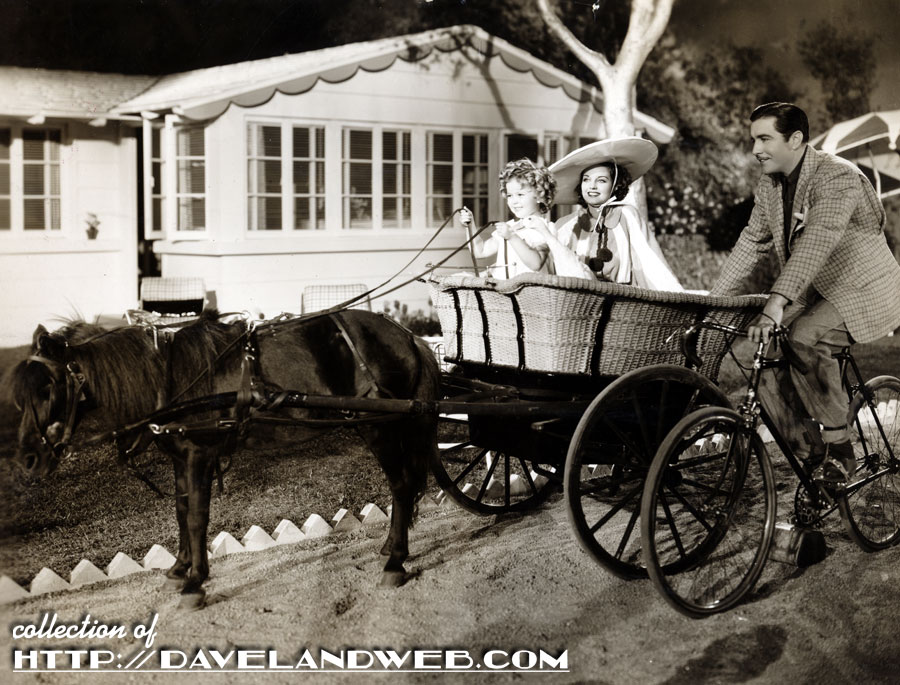
A closeup of the cottage from a deleted scene with Shirley, Rochelle Hudson (who played her sister), John Boles, and a newly purchased pony/pony cart.
Interior sets were just as elaborate, like this art deco styled conservatory where Shirley puts on a benefit for the orphanage she used to reside in with her sister.

A publicity still showing Shirley taking a bow after performing her one girl tour de force, “When I Grow Up.”

Zooming in so you can see Shirley’s curtsy.

Below, Cummings poses with Shirley, wearing a bridal gown for one of the segments from that musical number. “Curly Top” is a great film, but at times the emphasis is too Shirley-heavy. Early in the movie, she recites poetry while sitting in Boles’ lap and the camera quickly cuts to a closeup of her face. It’s a bit jarring and somewhat cloying/cutesy. The “When I Grow Up” number is truly over the top, featuring Shirley singing, reciting poetry, dancing, jumping rope, and aging from childhood to old age. OK, we get it, Shirley is talented, however the best Temple films are the ones that are a bit more balanced.
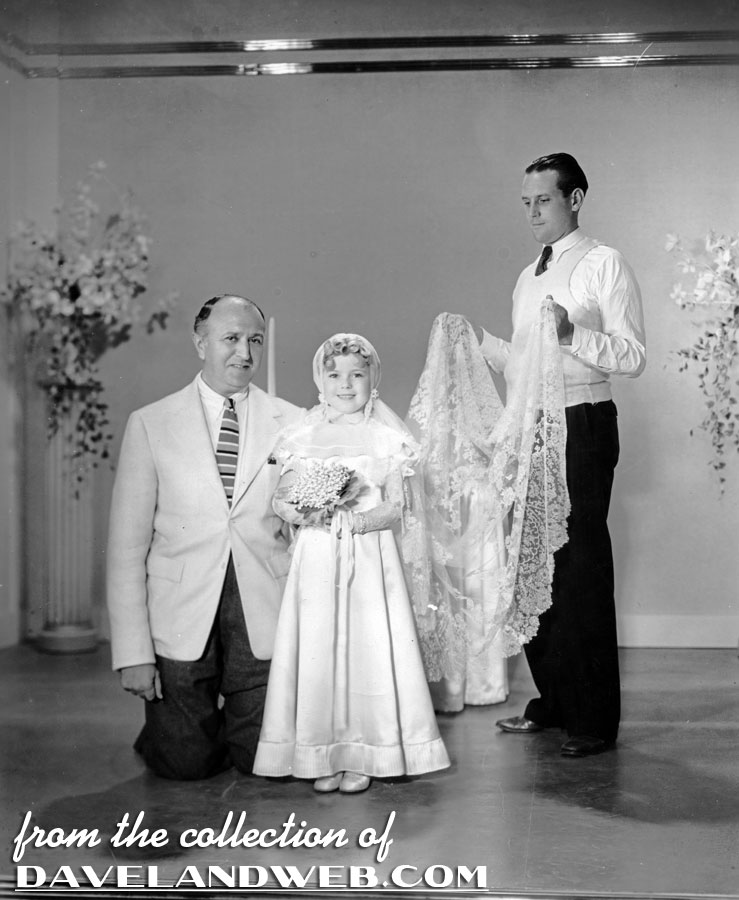
The above photo was also seen in the Spanish magazine Cinegraf, which showed a number of the set interiors from the movie.

The jaw-dropping bedroom set for the sisters:
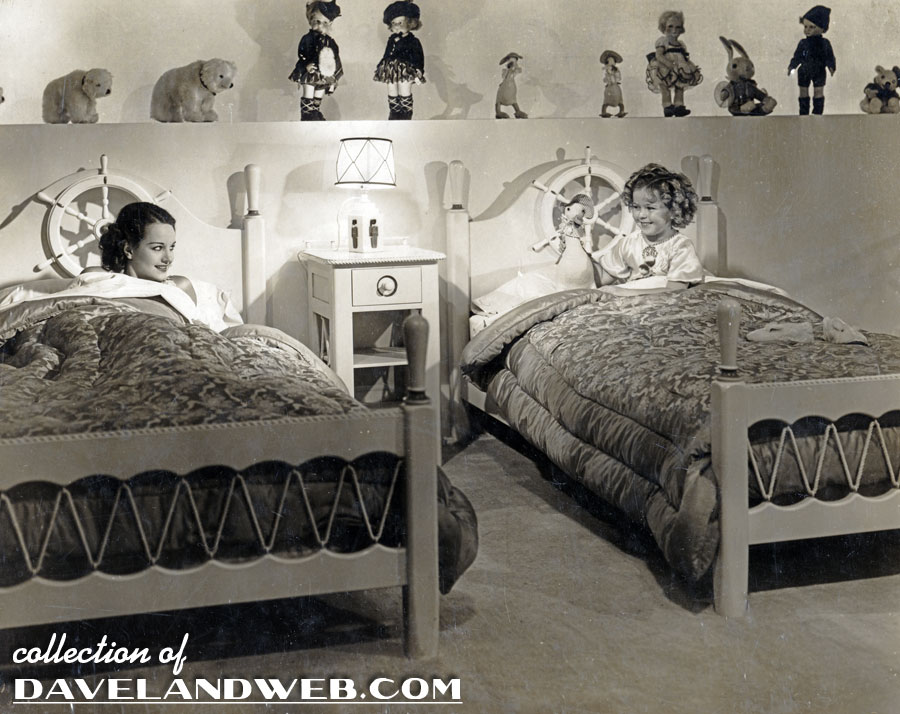
Set stills below of the entire set, which is only seen briefly in the film. Imagine what it must have cost to construct this childhood fantasy bedroom on a soundstage! Depression era children would have LOVED to have a fraction of the toys that Shirley’s character possessed.

From the publicity materials that accompanied the plans for this bedroom/playhouse:
This Jack Otterson neo-classic design embraces a new idea of making a playhouse part of the architecture of the bedroom. This playhouse makes an excellent toy closet and assures a neat and attractive nursery day and night.

Although I do not believe you see it in the finished film, the set had an original Charlotte Clark Mickey Mouse stuffed doll, complete with tag:

In 2015, when Shirley’s childhood costumes and possessions were auctioned off by Theriault’s, two Mickey Mouse dolls were part of the proceedings, selling for $6,000. While the listing stated that “according to family oral tradition, the Mickey Mouse dolls…had been gifted by Walt Disney,” the taller doll shown below has an uncanny resemblance to the one featured in the film.

Back to the set stills, note the alphabet blocks that spell out the title of the film:

Another view of the bedroom/playhouse:

Shirley herself poses on the set, wearing the pink silk pajamas designed by René Hubert:

Look at the bunny detail on the sliding doors. Incredible that little touches like that are completely missed when watching the film. Now THAT’S craftsmanship!

The original costume design and pajamas were auctioned off in 2015:

From the catalog description for the sketch, which sold for $1,100:
20" (51 cm.) x 17" framed. Watercolored sketch on parchment depicts the proposed costume design for the pink pajamas with bunny appliques from the 1935 film "Curly Top". The sketch also indicates that bunny themed slippers were proposed as well. It is hand-lettered at the bottom "bed sequence" and was proposed by Rene Hubert who was the credited costume designer for this film.
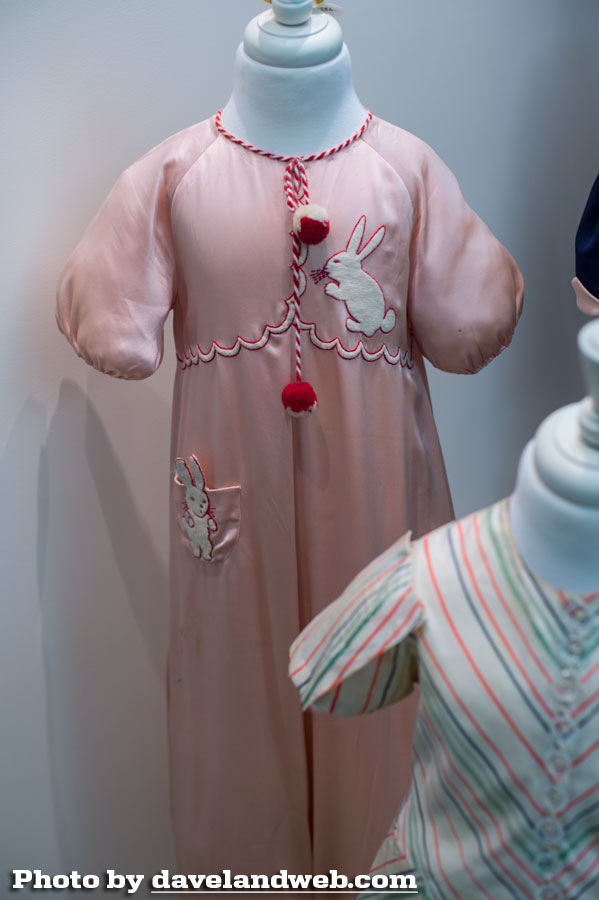
…and the pajamas, which sold for $5,750:
Of soft pink silk satin, the one-piece pajama playsuit is accented with two applique fuzzy bunnies, a scalloped border edged in red, and with red and white braids at neckline and red and white pom-poms. The costume has the studio label of "4994".
I was able to see them in person at the Santa Monica History Museum:
To wrap up this lengthy post, a color image of Shirley wearing the duck dress outfit from the film:
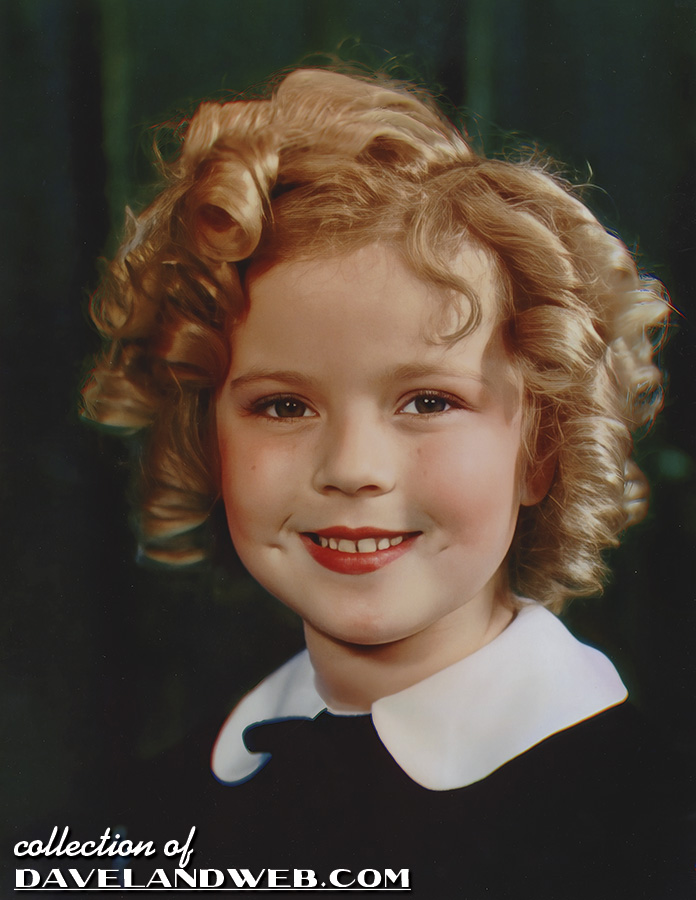
See more Shirley Temple “Curly Top” photos at my main website.


No comments:
Post a Comment