Showing posts with label René Hubert. Show all posts

Tuesday, April 21, 2026

Temple Tuesday: Curly Top In-depth


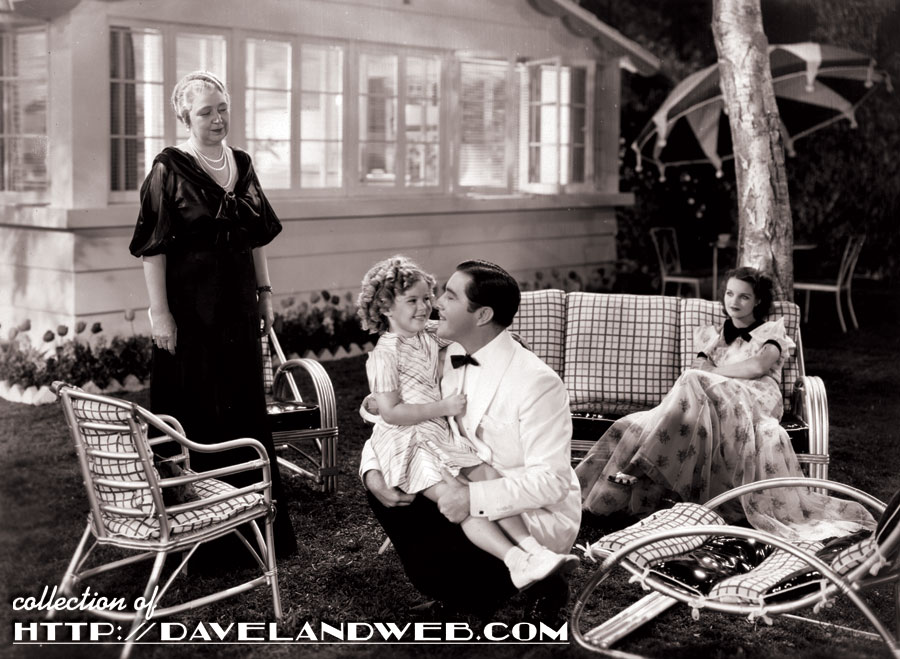
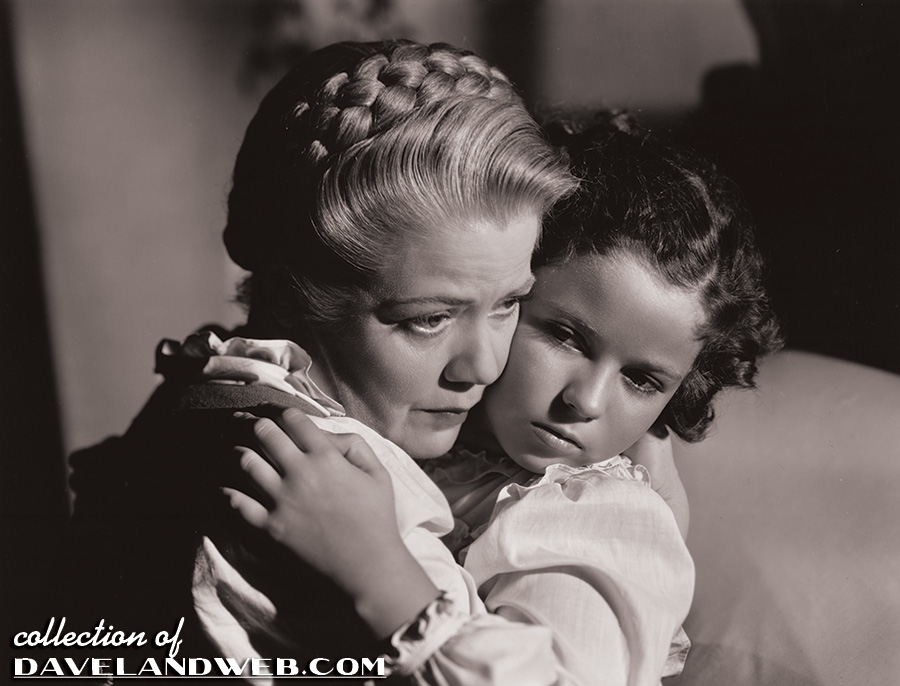
When it comes to Shirley Temple, you’re either a fan or you’re not, and if you fall into the latter category, you should avoid “Curly Top” (1935). Fox realized her box office power and put her front and center in this unashamed showcase of the little girl’s many charms and talents. In case you couldn’t figure out where the title came from, look no further than the opening frames of the credits which focus on Shirley’s signature curls. Although the story is loosely based on the novel Daddy Long-Legs by Jean Webster, there is no question that the title was meant to capitalize on Shirley’s skyrocketing fame with her adoring public. How adoring? No photos were too trivial for Shirley’s fans, including a series of shots that showed her hands and feet. No face.


As a gag, director Irving Cummings poses with Shirley and the other orphans looking through a rain-soaked window. Shirley’s stand-in, Marilyn Granas, is standing next to Shirley in the left corner of this shot:


Great care went into the production of “Curly Top,” including these architectural renderings for the beachside cottage that was owned by Shirley’s character’s ardent benefactor, played by John Boles. From the publicity caption on the back:

This is the front, or beach elevation, of the John Boles’ home used in the Winfield Sheehan production, “Curly Top,” starring Shirley Temple. A modern and simple treatment was designed by Jack Otterson, Fox Film art director, by accentuating horizontal lines in the wide banks of windows and a wide lap siding makes this a truly beautiful home. Great sliding doors open on the hallway toward the ocean.


The set was built on a soundstage; the scenic backdrop was a matte painting.


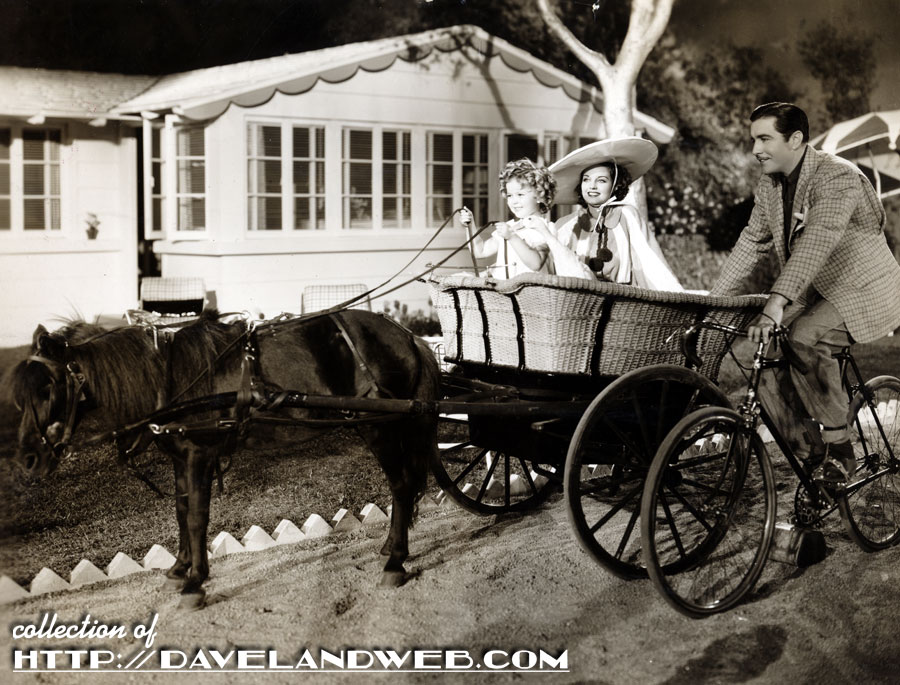
A closeup of the cottage from a deleted scene with Shirley, Rochelle Hudson (who played her sister),  John Boles, and a newly purchased pony/pony cart.


Interior sets were just as elaborate, like this art deco styled conservatory where Shirley puts on a benefit for the orphanage she used to reside in with her sister.


A publicity still showing Shirley taking a bow after performing her one girl tour de force, “When I Grow Up.”


Zooming in so you can see Shirley’s curtsy.


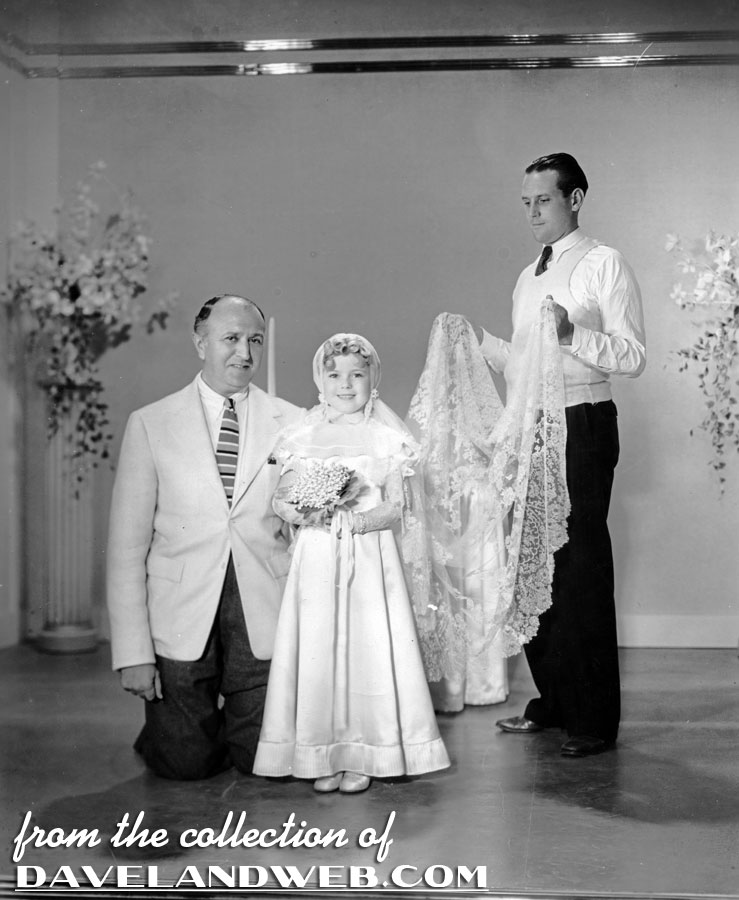
Below, Cummings poses with Shirley, wearing a bridal gown for one of the segments from that musical number. “Curly Top” is a great film, but at times the emphasis is too Shirley-heavy. Early in the movie, she recites poetry while sitting in Boles’ lap and the camera quickly cuts to a closeup of her face. It’s a bit jarring and somewhat cloying/cutesy. The “When I Grow Up” number is truly over the top,  featuring Shirley singing, reciting poetry, dancing, jumping rope, and aging from childhood to old age. OK, we get it, Shirley is talented, however the best Temple films are the ones that are a bit more balanced.


The above photo was also seen in the Spanish magazine Cinegraf, which showed a number of the set interiors from the movie.


The jaw-dropping bedroom set for the sisters:
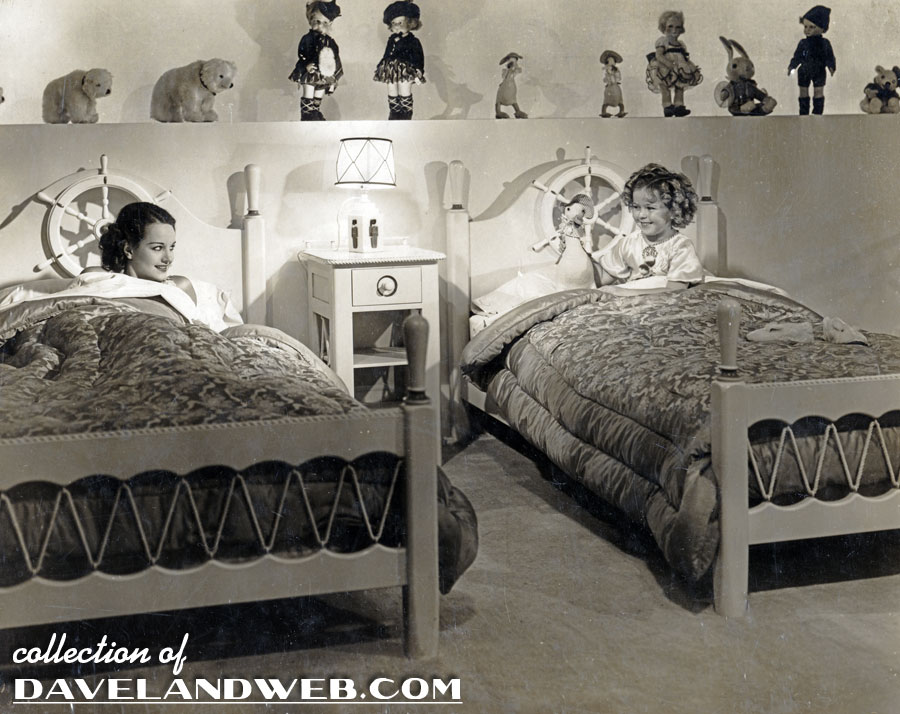


Set stills below of the entire set, which is only seen briefly in the film. Imagine what it must have cost to construct this childhood fantasy bedroom on a soundstage! Depression era children would have LOVED to have a fraction of the toys that Shirley’s character possessed.


From the publicity materials that accompanied the plans for this bedroom/playhouse:

This Jack Otterson neo-classic design embraces a new idea of making a playhouse part of the architecture of the bedroom. This playhouse makes an excellent toy closet and assures a neat and attractive nursery day and night.


Although I do not believe you see it in the finished film, the set had an original Charlotte Clark Mickey Mouse stuffed doll, complete with tag:


In 2015, when Shirley’s childhood costumes and possessions were auctioned off by Theriault’s, two Mickey Mouse dolls were part of the proceedings, selling for $6,000. While the listing stated that “according to family oral tradition, the Mickey Mouse dolls…had been gifted by Walt Disney,” the taller doll shown below has an uncanny resemblance to the one featured in the film.


Back to the set stills, note the alphabet blocks that spell out the title of the film:


Another view of the bedroom/playhouse:


Shirley herself poses on the set, wearing the pink silk pajamas designed by René Hubert:


Look at the bunny detail on the sliding doors. Incredible that little touches like that are completely missed when watching the film. Now THAT’S craftsmanship!


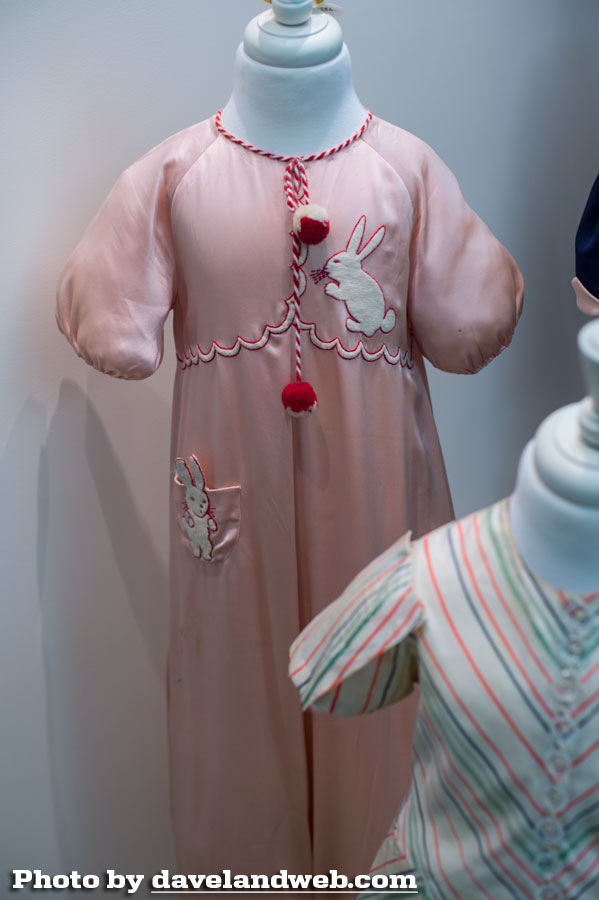
The original costume design and pajamas were auctioned off in 2015:


From the catalog description for the sketch, which sold for $1,100:

20" (51 cm.) x 17" framed. Watercolored sketch on parchment depicts the proposed costume design for the pink pajamas with bunny appliques from the 1935 film "Curly Top". The sketch also indicates that bunny themed slippers were proposed as well. It is hand-lettered at the bottom "bed sequence" and was proposed by Rene Hubert who was the credited costume designer for this film.

…and the pajamas, which sold for $5,750:

Of soft pink silk satin, the one-piece pajama playsuit is accented with two applique fuzzy bunnies, a scalloped border edged in red, and with red and white braids at neckline and red and white pom-poms. The costume has the studio label of "4994".

I was able to see them in person at the Santa Monica History Museum:


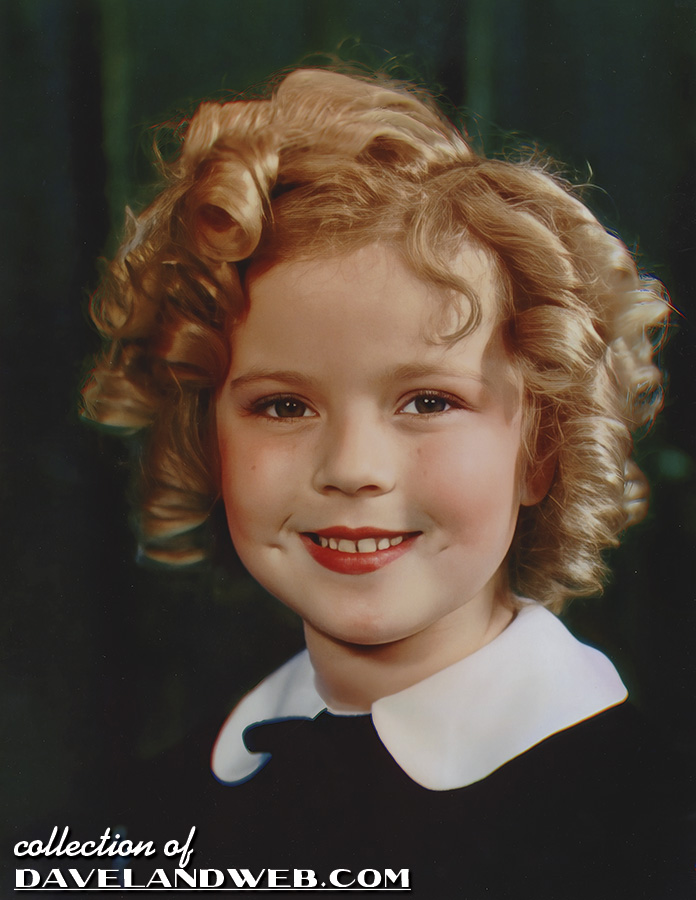
To wrap up this lengthy post, a color image of Shirley wearing the duck dress outfit from the film:


See more Shirley Temple “Curly Top” photos at my main website.

Tuesday, September 23, 2025

Temple Tuesday: Orchids to You


The 1935 Fox Film “Orchids to You” isn’t funny enough to be considered a comedy nor is it dramatic enough to be a tearjerker. The plot just hovers at mediocre. The story in a nutshell: a flower seller (Jean Muir) falls for a married attorney (John Boles) whose wife is having an affair. The acting is fairly decent, especially the performances of Muir and Charles Butterworth in the comic role of a wealthy admirer of Muir’s character. What does this film have to do with Shirley Temple, you ask? Plenty. To begin with, it was made at Shirley’s home studio, Fox (which was yet to be merged into 20th Century-Fox), with a short production date of April 27 — May 25, 1935 and released on July 12. In “Orchids to You,” there is a sequence set at a Flower Show, with a jazzy version of Tchaikovsky’s “Waltz of the Flowers” playing in the background.


The exhibit with Muir’s character is centered around a charming little storybook cottage, seen below.


The first place prize that Muir receives is displayed at her flower shop the next day next to a miniature version of the cottage. No explanation is given as to where the miniature came from, and it is only seen onscreen for less than a minute.


“Curly Top” features a seaside cottage where Shirley spends the summer with her wealthy benefactor, played by John Boles, who barely had time to breathe between films! Production began on May 25 (the same day “Orchids” ended), wrapping up on July 10, 1935. “Curly Top” was released two weeks after “Orchids.” 


Daily Variety reported that the eight-room cottage from “Curly Top,” built on a Fox sound stage (seen in the screenshot below), interested director Irving Cummings enough to offer the studio $25,000 for it. Instead, according to DV, Fox moved it to the lot to be used as a play room, dressing room, and school room for Shirley.


Below is a shot of Shirley’s Fox bungalow. Author and Hollywood historian Michael Troyan (20th Century Fox: A Century of Entertainment) disputed the Variety claim on social media, where he says it was built in 1930. Lilian Harvey used it in 1933 for the four Fox Films that she made, followed by Gloria Swanson. In her autobiography,  Swanson on Swanson, the actress wrote about the operetta she was making, “Music in the Air,” and that she took over:

…a sumptuous star bungalow on the Fox lot for the duration of the picture.…they commissioned René Hubert to design fabulous clothes for me.…We all felt fairly certain of success during the shooting, but the picture flopped. Hollywood producers learned once again that the taste of New York and Broadway was no barometer for the taste of the nation at large. The nation at large ignored “Music in the Air” and rushed instead to see “Stand Up and Cheer,” a musical starring a six-year-old, Shirley Temple.

The film was in production from July 24 —September 15, 1934. John Boles also starred in this film; a truly busy performer!


At best, furnishings from the “Curly Top” set were used inside Shirley’s bungalow, but not the structure itself. The bungalow when Harvey inhabited it:


Lloyd Pantages reported this in July 1934:

Lilian Harvey’s bungalow, which was once decorated in twenty-five cents a-piece ermine tails, is now yawning for an occupant, so why not re-do it in animal crackers and alphabet soup for little Shirley Temple?

How it looked when Shirley lived there:


There’s a semi-decent chance that the look of the bungalow inspired the design of the storybook cottage and the model, not vice versa. Below is Harvey at the entrance gate to her Fox bungalow:


Lilian Harvey was a famous British-German actress who made four films for Fox in 1933, returning to Germany two years later. More images of Harvey inside the Fox bungalow when it was hers:


The following publicity caption accompanied the photo below:

In the living room of Lilian Harvey’s bungalow dressing-room at Fox Movietone City. The rug is a deep peach shade. The wallpaper is white and the figure is in peach shade. The couch upon which Miss Harvey is sitting is an off-shade of white corduroy, trimmed with peach colored brush cording. The pillows are of coca brown chiffon velvet with frayed taffeta ruffles in flesh color. The drapes in this room are of peach satin. The mirror above the couch is framed in antique gold. Designed by Richard Lewis Smith, Fox Film interior decorator.


A November 1933 blurb about Harvey and the bungalow:


The model from “Orchids to You” ended up in Shirley’s possession. Perhaps John Boles played a part in the gift; or maybe costume designer René Hubert (he worked on both films, too). Arthur Treacher played a butler in both, but I doubt he would have been associated with the gift. My money would go on Jack Otterson, who was the art director for both films and would have had a closer association to the physical model itself. There is even a possibility that the model was created with the idea of giving it to Shirley, rather than it being an after-thought, which is why it was designed to resemble her bungalow. Publicity shots were released of the model/dollhouse once it was given to Shirley and placed inside her bungalow. The following caption accompanied these shots:


Shirley Temple’s prize possession - a doll house and garden that takes up most of one room in the Fox Film star’s bungalow at the studio, and where she spends most of her time between scenes.


The building and grounds were turned over to the youthful star after they had been used in a scene for “Orchids To You,” and Shirley promptly set about peopling the model house with dolls of appropriate size.


The detailing is incredible!


In September 1937, actress Helen Hayes and daughter Mary MacArthur paid a visit to Shirley in her bungalow:


Shirley described the visit in her autobiography Child Star:

A standard stop on tours for children my age was a souvenir doll’s house from “Curly Top,” now installed in our cottage bedroom. Piece by piece I demonstrated all its miniature equipment to Mary—the diminutive hooked rugs which lay on the parquet floors, the sheets covering each bed, and the bathroom commode with a lid that worked. Each door swung, every drawer slid open. Chintz curtains were tied back at each window, bric-a-brac cluttered the tiny tabletops, books lined the shelves, and fake food was in the refrigerator. We examined everything, preoccupied with the housekeeping details, as little girls would. Ghosts of vamp Lillian Harvey and sultry Gloria Swanson must have shuddered to witness what now transpired in their historic “Maison des Rêves” bedroom.


When Shirley left Fox, the dollhouse followed her and was on display in her home with the rest of her doll collection, as seen in this 1944 image:


After Shirley passed, the dollhouse was sold in the “Love, Shirley Temple” 2015 auction.


Shirley Temple's Wooden Bungalow Dollhouse with Tynietoy Furnishings Description 43" l. x 26" d. x 26" h. A wooden bungalow style home with clapboard siding and shingles, decorative cupola, blue shutters with fleur-de-lis design, multi-pane windows, and wide front door, has two interior rooms that are furnished with signed pieces of Tynietoy furnishings (fold-downable, faux marble top table, dining table, chest of drawers, buffet, red wing chair, six various chairs, and sofa), and with various carpets and curtains.


Also included are original picket fence sections on bases for arrangement as desired, a vintage photograph of the dollhouse, and a pencil sketch labeled "Shirley's Doll House". The dollhouse originally was made for the 1935 Fox film "Orchids to You" starring John Boles; in that film the doll-house appeared in a display that won first prize at the Annual Spring Flower Show. After the film was completed, the dollhouse was gifted to Shirley Temple who treasured it, placing the house in the center of her doll room.


Spring Byington has a bit part as the wronged wife in “Orchids”:


In 1940, she would play Shirley’s mother in “The Blue Bird”:


A final connection between Shirley and “Orchids” is this Spanish ad for both “Curly Top” and “Orchids to You.” While the photo on the left is definitely John Boles, Shirley, and Rochelle Hudson, the photo on display for “Orchids” is definitely not Boles and Muir!


Who moved into Shirley’s bungalow when she left Fox? It appears that it could be none other than John Barrymore! Shirley’s contract was closed on May 9, 1940 and she moved out of the bungalow on May 27th. Barrymore was said to have inhabited the bungalow at some point, and it seems that his one 20th Century-Fox film during the appropriate period was “The Great Profile,” which had a production schedule of late May through July 1940. According to the AFI website, Barrymore did not memorize any of his lines for the film, but instead read them from a blackboard. George French is listed as his blackboard toter. Because Barrymore never missed a cue or muffled a speech, the use of blackboards was credited with bringing the picture five days under schedule and saving the studio an estimated $25,000. What a difference from Shirley, who rarely flubbed a line!


Another trip down the rabbit hole has ended.

See more photos at my main website.