In the 1930s and 40s, my father was living in a small bungalow in the Hillcrest neighborhood of San Diego, cramped with his Italian immigrant family. To escape that existence, he often spent his time in a darkened theater, watching “Flash Gordon” serials, Charlie Chaplin, The Marx Brothers, or other popular fare. Years later, I remember his astonishment when he was perusing his Time-Life 1930s/40s volume of their This Fabulous Century series. There was a photo of the movie theatre he attended as a tot, with a crowd of excited kids holding up their free prizes and the owner whom he identified as Mr. Fink. Dad’s memory was spot-on; I looked up Fink’s name and came up with this info from the Chicano Park Museum website:
Prior to the toxic-air pollution and mixed land-use patterns, Barrio Logan, once known as Logan Heights, stood strong as a healthy and thriving neighborhood. During World War II the Coronet Theater opened in the heart of the community at 1796 Logan Avenue, along with Metro Theatre (located at 25 and Imperial Avenue) & Victory Theatre. A man by the name of Mr. Fink owned all three. These three theatres became extremely popular- especially amongst the community.…Metro was great for the community because for those that did not understand English there were not many theatres for them to go to and understand, Metro Theatre was completely in Spanish. There was little money available for entertainment. Movie theaters were one of the few affordable diversions. However, these theaters also sponsored events like a dish night or a grocery night. This was in the 1930s and families welcomed the opportunity to win a bag of groceries or some dishes. The Metro Theatre Building is located in Barrio Logan, near Galleries such as La Bodega Gallery & Creative Studios, Cafes like Cafe Moto & many more. The Metro Theatre itself was built in 1915. Today however it is currently being renovated into apartments with a lower level gallery for local artists.
One movie that my dad recalled vividly was Shirley Temple’s “The Blue Bird,” released in early 1940. Specifically, he would talk about the scene set in the Land of the Unborn Children. Frank Dawson played the Roll Caller, reading off the names to the children waiting with great anticipation:

Below, Shirley poses with Thurston Hall, who portrayed Father Time:
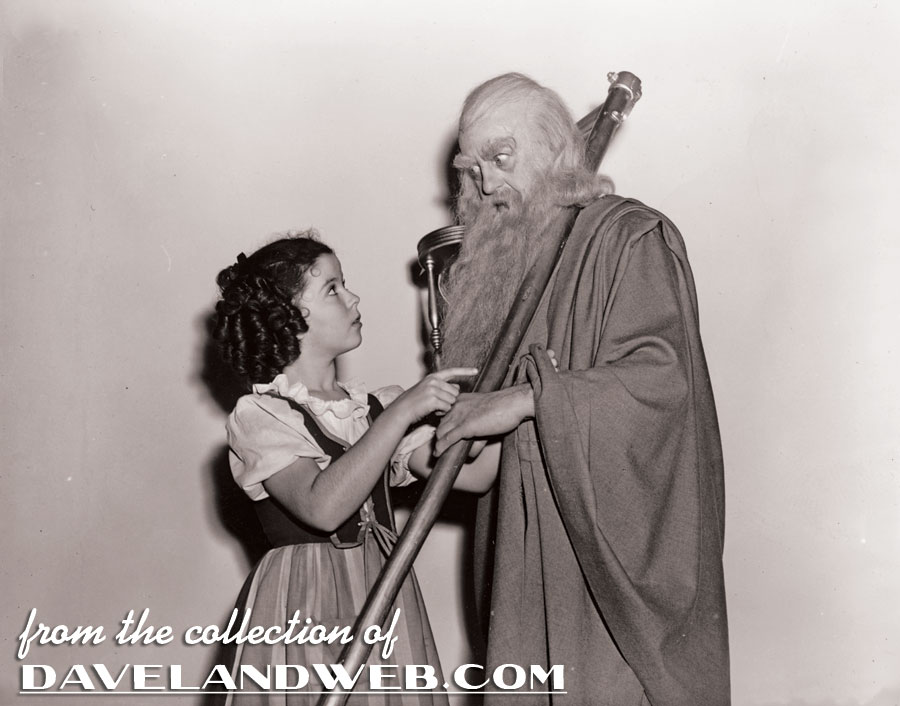
NOBODY would want to mess around with Father Time. He made sure the children made it to the ship with silver sails that would take them down to earth to be born. No dilly-dallying, kids!

The set was impressive, as was the large ship. Shirley is at left, with Johnny Russell who portrayed her brother and Helen Ericson, who played their ethereal guide, Light.
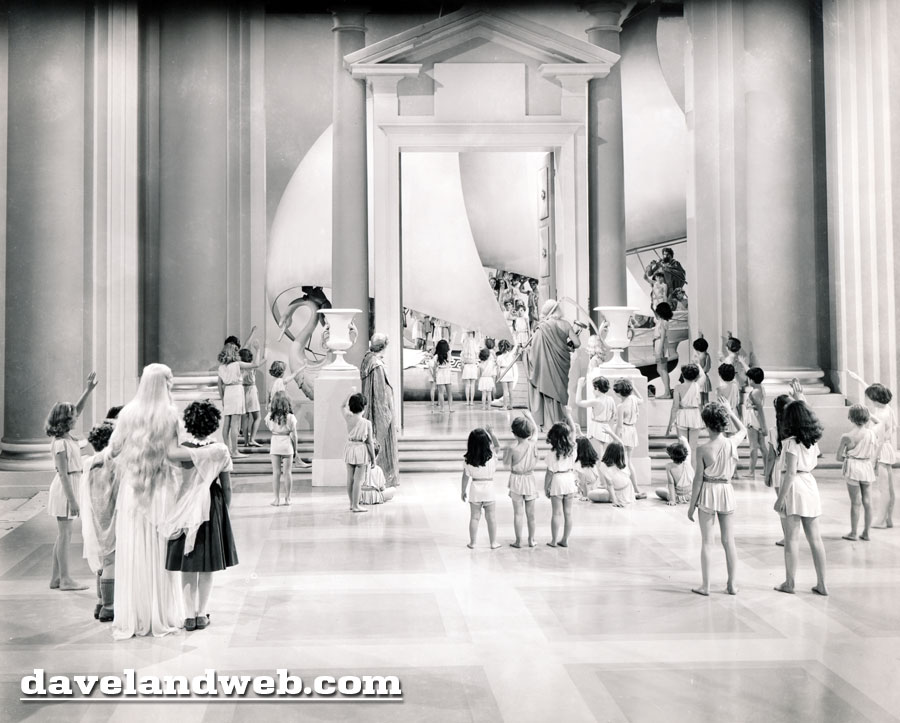
The ship ready for departure:

Zooming in, a tall Gene Reynolds is at back and child star Dickie Moore, noted for his earlier appearances in the Our Gang comedies.

Reynolds portrayed Studious Boy, a thinly veiled character meant to represent President Abraham Lincoln. Fox producer Darryl Zanuck had no problem inserting a few political messages into his movies, and this scene with Reynolds predicting his own death is a bit chilling.
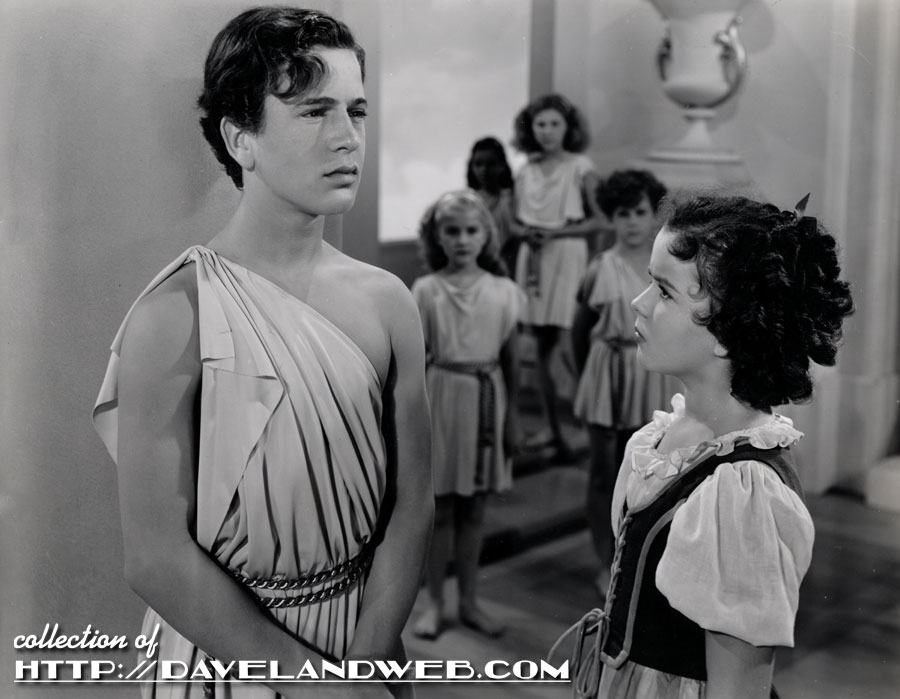
Russell and Temple as their characters survey all that’s going on in the Land of the Unborn Children:
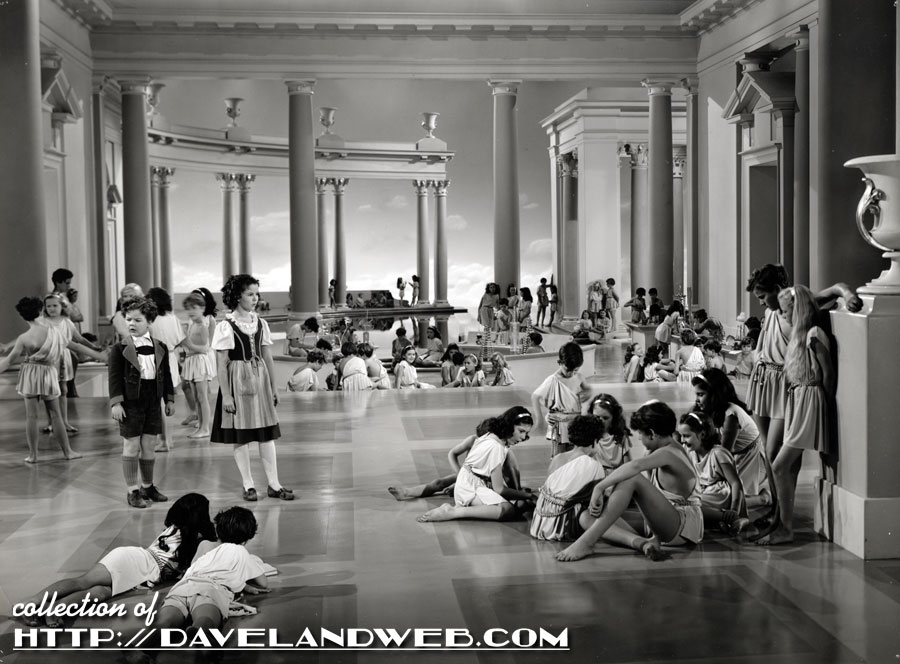
This detailed view of the teenage couple at right shows what really yanked at my dad’s heartstrings:

PLOT SPOILERS! The young couple is separated by Father Time, who tells them that they will not be born at the same time and therefore will not be able to continue their love for each other.

Despite their tearful pleadings, Father Time turns a deaf ear and forces the young boy to join the ship.

The little girl dramatically falls to the floor, as her golden hair manages to land perfectly on the gleaming marble. I wonder how many takes this shot required?

We see both lovers, tears streaming down their faces as they imagine a life without each other.

Some thirty years after he first saw this movie, my dad would tell me about how deeply this scene affected him.

Although I have no concrete proof, this little vignette was probably inspired by the popular 1935 Mildred Cram novel Forever. Irving Thalberg at MGM purchased the rights to it for wife Norma Shearer, but died before it got off the ground.

Tyrone Power gave Judy Garland the 60-page novella as a gift; she devoured the book and hoped that she could make the film version with Power, with whom she had a huge crush. Next, it was to be a project for Power and Lana Turner, who had an intense love affair. Turner’s daughter, Cheryl Crane, later recalled:
No book ever affected Mother as much as ‘Forever’ by Mildred Cram. It’s the book she wanted to make into a movie more than any other in the world, co-starring Tyrone Power. It would have been no small miracle if a loan-out for either of these two stars to rival studios could have been arranged. Short but powerful, ‘Forever’ is a story about a love longer than life & stronger than death. In the story, Julie & Colin meet in some otherworldly land before they are born but in their adult forms. They fall in love & vow to reunite in the next world, in exactly 27 years. Memories of this magic time before they are called to life are wiped from Julie and Colin’s minds upon birth & they grow up leading very different lives; she growing up & marrying well in Philadelphia; he living a quiet life in England, going to war, & then returning to his fiancée. Drawn together by some mysterious force, Julie & Colin’s paths converge on a fateful trip to the French Alps where love, tragedy, & a haunting recollection alter the course of their lives.
See more “The Blue Bird” photos at my main website.