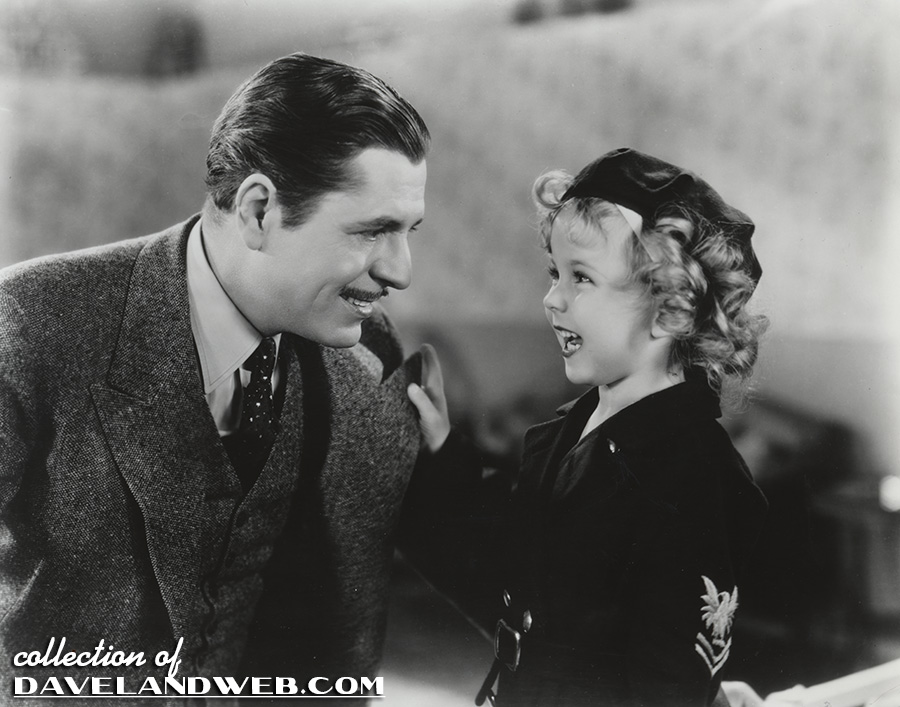
Warner Baxter was an Academy Award winning actor (“In Old Arizona,” 1928) by the time he worked with Shirley Temple in 1934’s “Stand Up And Cheer.” They had one scene together in the film, but were also seen together (most likely for publicity purposes!) in the Fox Commissary. Notice Warner is the only one with food in front of him!
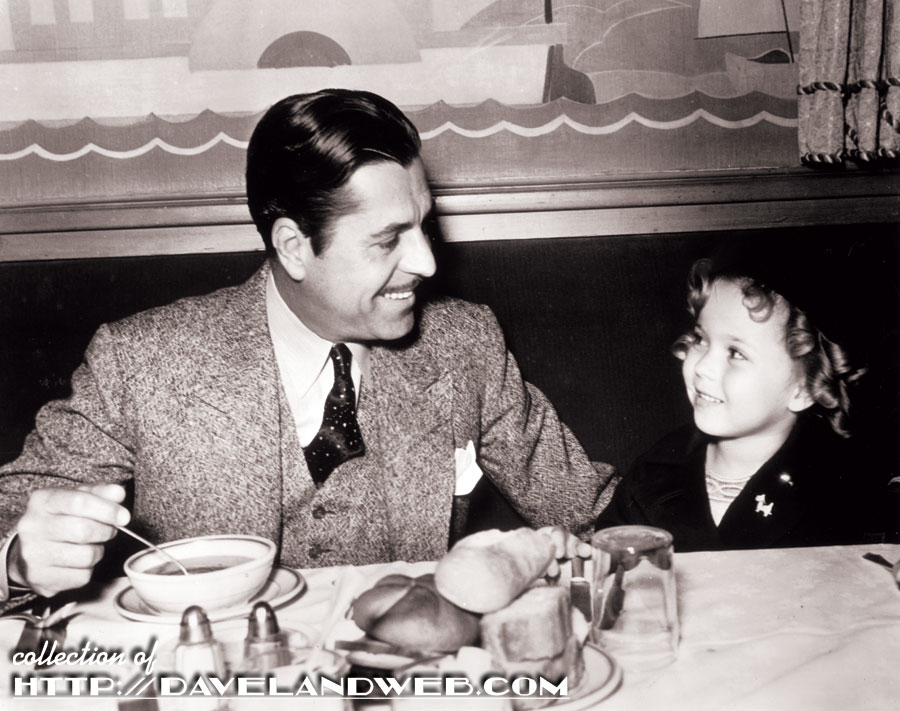
The two met again in front of the cameras three years later, according to a 2001 article in the Los Angeles Times:
Just 12 days after Amelia Earhart disappeared dramatically in the Pacific while attempting an around-the-world flight, a trio of Russian aviators blazing a new polar route had to take an unexpected forced landing—in a Riverside County cow pasture [the original destination was San Diego]. At a time when the young Soviet Union was establishing itself as, in Winston Churchill’s words, “a riddle wrapped in a mystery inside an enigma,” the experimental single-engine plane was the second of three pioneering Soviet flights intended to test the feasibility of a commercial airline route from Moscow to the United States. Their surprise landing here earned them parades and hobnobs with movie stars and aviation pioneers.
Shirley recalled the event in her autobiography, Child Star:
In mid-July of 1937 came visitors worth seeing because they were so abhorred in advance. “More Commies,” snorted Klammy [Shirley’s studio appointed teacher]. “They don’t believe in God.” To arm me with useful Russian phrases, the studio had sent comedian Gregory Ratoff to tutor. Demonstrating “very good” in Russian, he sputtered the syllables, and like all short people, I caught his fine rain of spray, leaving me rehearsed and sticky all over.
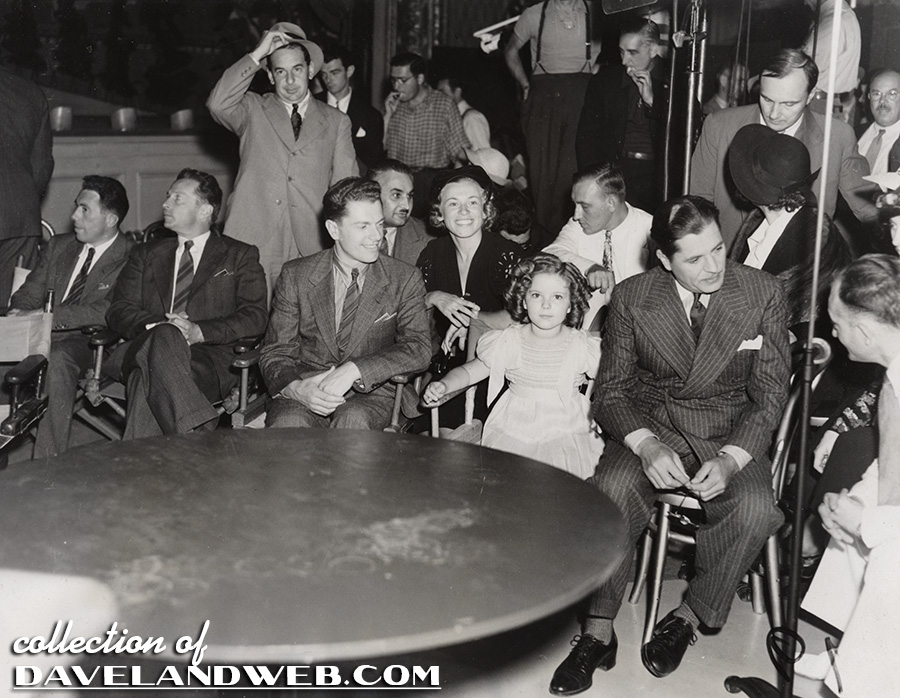
From the accompanying publicity blurb:
LOS ANGELES ENTERTAINS RUSSIAN FLYERS. Russia’s three flying aces were entertained at the 20th Century-Fox Motion Picture Studios in Hollywood, California on July 17th. Photo shows—left to right— Navigator Sergei Danilin, Pilot Mikhail Gromoff; Co-Pilot Andrei Yumasheff; Shirley Temple, child actress; and Warner Baxter.
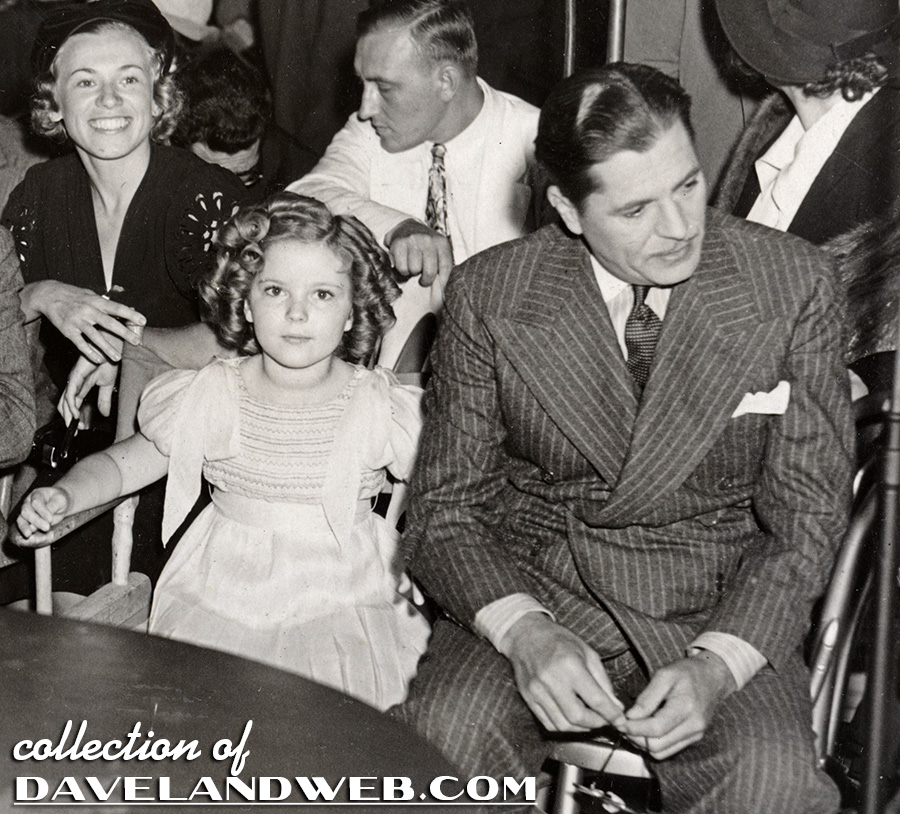
From a vintage newspaper:
The flyers were met at the gate by Shirley Temple, equipped with her best smile, an autograph book and a pen. Yumashev sketched her an airplane; Gromov drew a face, and Danilin, the navigator, drew a straight line, explaining that straight lines were the business of a navigator.
The autographs and sketches came up for sale in 2015 at the “Love, Shirley Temple” Theriault’s auction. From the catalog:
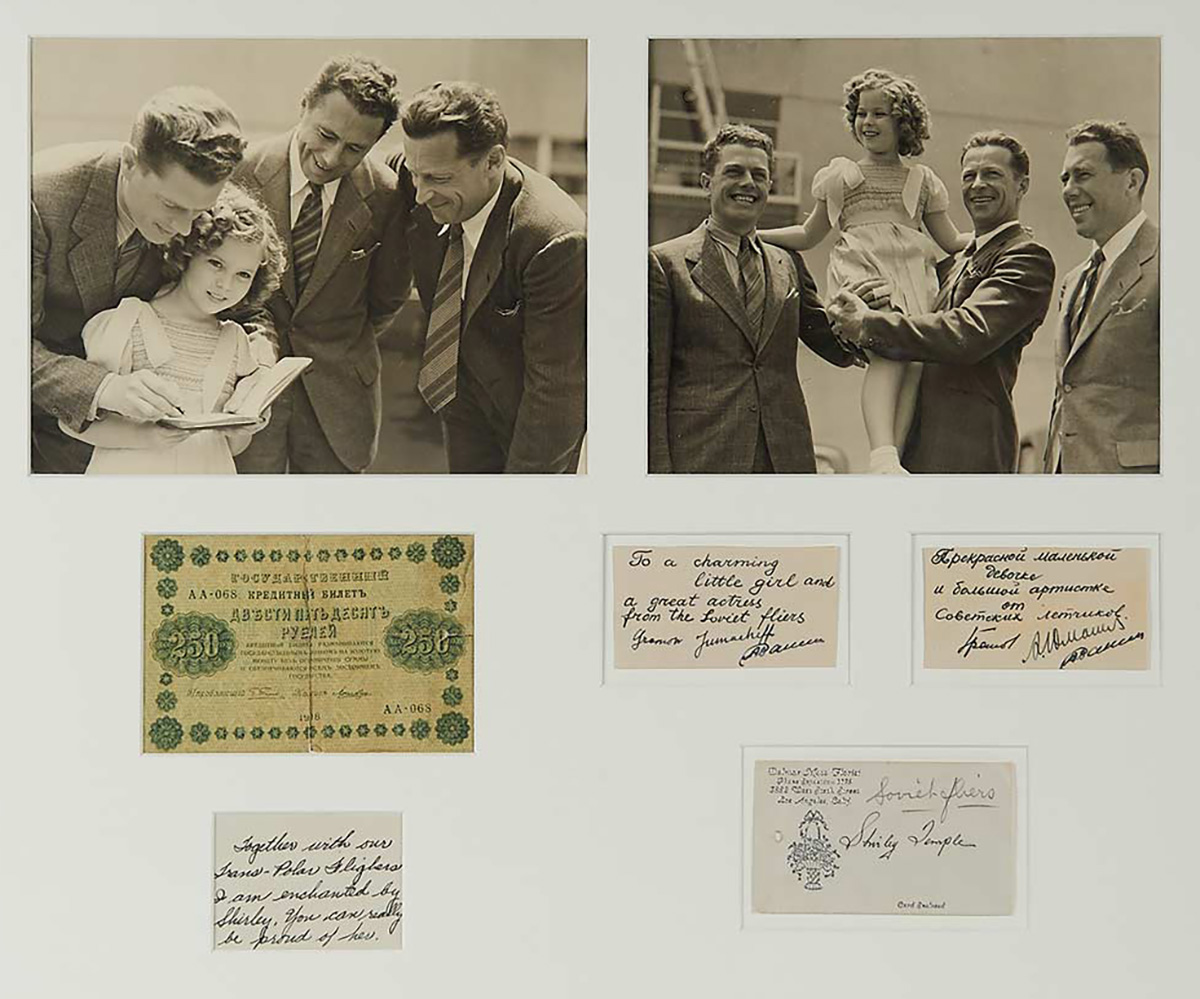
MEMORABILIA RELATING TO THE FIRST TRANSPOLAR FLIGHT FROM MOSCOW TO CALIFORNIA
Lot Number: 490. Comprising two photographs of nine-year old Shirley Temple and the three Russian fliers who made the first non-stop transpolar flight from Moscow to Southern California, July 12-14, 1937, along with three cards with little notes of admiration and autographs from those fliers, Mikhail Gromov (pilot), Andrei Yumashev (copilot) and Sergei Danilin (navigator) to Shirley Temple. The notes were written in both Russian and English language, the English noting "To a charming little girl and a great actress". Along with a card from Consantine Oumansky (charge d'affairs at the Russian embassy in Washington, and then from 1939-1941, Russian ambassador to the US), who noted "Together with our Trans-Polar Flighers [sic] I am enchanted by Shirley. You can really be proud of her", and with a ruble note. Of little attention today, that flight was extraordinary at the time, flying 7120 non-stop miles in 62 hours, a new flight record. The flight plan was designed to land in San Diego, but fog conditions caused its landing in a cow pasture in San Jacinto. The fliers were wildly celebrated including a ticker tape parade in Los Angeles, a visit with President Roosevelt, and, this, a meeting with Shirley Temple. Realized Price: $1,100 • Presale Estimate: $300+
Want to see the dress Shirley wore in color? Look no further than the July 1937 cover of Photoplay Magazine, shot by George Hurrell:

Back to Shirley’s account from Child Star:
Three of the visitors were short, two looming; all were dressed alike, in drab suits with trousers flared at the bottom. “I am Oumansky, chargé d’affaires from Washington,” said one, his voice sonorous and thickly accented. “I translate.” “Pashalsta! Thank you,” I replied, while everyone smiled politely. “And I help,” added Rigore Gokham, the USSR consul general in San Francisco, who took charge. The other three men were aviators who had just flown in a single-engine plane 6,295 miles nonstop from Moscow across the North Pole, a world record for distance. The filers had just landed in the early morning of July 12 in a pasture near San Jacinto, California, site of today’s March Field Air Base. “Know why they landed in a plowed field instead of the smooth nearby landing strip?” Gokham asked, then answered, “Because the air brakes were removed before takeoff to make room for a heavier fuel load. They had to use a rough field to help stop the plane.” It all sounded exciting and logical. “Yes, we pioneer commercial air route between our two countries,” interrupted the pilot, Mikhail Gromov, a lean and attractive man wearing a small medal on a red ribbon. Noticing my interest, he stooped forward so I could see better. “Medal of a Hero of the Soviet Union, from the great world war,” he told me. Although I hadn’t studied the war yet with Klammy, I was mighty impressed. “Ohin Khorosho! Very good! I commented, tucking in my chin for the requisite guttural tone. Actually the Gromov flight was the second Soviet transpolar flight. Severe head winds had forced the first plane to land at an army airfield near Vancouver, Washington. The U.S. commanding officer who took the three-man Soviet crew into his home was General George C. Marshall, later of international reknown. That initial long-distance record was short-lived, eclipsed by Gromov three weeks later. “We flew three days,” navigator Sergei Danilin began, reciting details, “precisely sixty-two hours and seventeen minutes. We heave cyclones, ice, and gov over magnetic pole. Only one night dark enough for sleep.” “Ochin Khorosho!” I repeated enthusiastically although I was puzzled. We had not reached astronomy either. “Now I will lead you around the lot. First we’ll see them making movies,” I advised, and paraded the group onto the set of Eddie Cantor’s “Ali Baba Goes to Town.” Although polite to the cast, the visitors were obviously far more interested in technical equipment than chatting with strangers. Actors Tyrone Power, Alice Faye, Warner Baxter and Andy Devine stood in an attentive circle around the visitors, but one by one the fliers drifted aside to examine cameras, lights, and sound equipment.
From the Globe-Democrat, July 18, 1937:
On one set [of “In Old Chicago”] they saw Alice Faye and Tyrone Power engaged in a love scene, and, while they didn’t understand the dialogue, they seemed to get the idea. Eddie Cantor, filming a comedy [“Ali Baba Goes to Town”], greeted the trio, and they grinned when attempted to explain what he was doing.…The entire party attended a luncheon at which Darryl Zanuck, head of the studio, was host.
Another vintage paper of the day reported:
Through an interpreter, Gromoff said: “The team work of the people who make motion pictures is amazing. A man blows a whistle and everybody is quiet. All know just what to do and how to do it. I admire the team work.”
From Child Star:
The fliers were my excuse to attend my first baseball game. Along with 28,000 other spectators at Wrigley Field in Los Angeles, we watched a pickup Film Comedians team edge the Leading Men 7 runs to 6. Long forbidden to nibble between meals, I was not allowed to have hot dogs, and having only a meager understanding of baseball, I was reduced to watching others eat and play. It was one of the few moments I could remember when I could stare at other people without catching them staring back. Sharing my disinterest in baseball, Gromov began to talk again. “Flying is like a game too,” he said, while Oumansky translated. “We are a young country. We cannot remain behind.” As he spoke he looked directly at me, his long fingers held just touching each other in a thoughtful pose. “World progress must be our progress. Maybe American aviators can better our record. So! We in turn once more may surpass your record.” Better than baseball, I thought. A simple contest, and perpetual. It intrigued and baffled me that so likable a person could bring horror into Klammy’s voice. Despite obviously irreconcilable divisions of political philosophy, Gromov and I remained friends for years, and forty-five years later, in 1983, he wrote me of his hope that the “meteorological and political storms will soon subside, and we again will be able to share pleasant memories of meetings on your soil.”

At the time of the Russian tour, Shirley was just wrapping up the filming of “Heidi,” which was in production from May 17, 1937 to mid-July 1937. Baxter’s most recent Twentieth Century-Fox production was the comedy “Wife, Doctor and Nurse,” released September 17, 1937 and also starred Loretta Young. As for what happened to Baxter, it seems like a sad story. Although very wealthy from his film career, he was also tired of the studio system and the amount of pictures he was forced to churn out per year. Age was not his friend, either, as he became increasingly more uncomfortable with the age disparity of his leading ladies. Turning to the bottle, he began a slow descent into depression and eventually had a nervous breakdown. At the end of his Fox contract, he slowed his pace down, enjoyed the fruits of his labor, and lived in Malibu beach with his wife, Winifred. His ending blew me away, as I’d never read about this before:
Baxter’s health deteriorated as he began suffering from arthritis. He tried many different medications and various forms of physical therapy, but his chronic pain only worsened over time. In 1951, he became so desperate to find a cure for the pain, that he decided to undergo transorbital lobotomy despite his physicians telling him that the procedure could permanently damage his brain. After he was lobotomized, Baxter stopped complaining about the pain, but he also experienced severe memory loss and crippling seizures. Furthermore, he stopped recognizing people around him and turned apathetic. Baxter died on May 7, 1951, of pneumonia [most likely developed from improper post-surgical care] several weeks after the procedure, at the age of 62.…Transorbital lobotomy remained a common practice for treating mental illnesses and various physical ailments until the 1970s. It was finally halted after it was proven that the procedure did not help but causes irreparable brain damage.
Many thanks to Melissa (aka “The Colonel”) for doing the legwork on the vintage articles!
See Shirley Temple more photos at my main website.